AB
AiBoss
Wiki

What is End-to-End Learning? - AI Encyclopedia

End-to-end learning is a design methodology in machine learning and deep learning that allows models to learn the desired output directly from the input data, without manually splitting the task into multiple independent parts...

什么是端到端学习(End-to-End Learning) - AI百科知识

End-to-end learning is a type of...powerfulThe learning paradigm, inartificialintelligentThe application prospects in this field are broad. By simplifying the process and global optimization, the performance and accuracy of the model have been improved. However, end-to-end learning also faces challenges such as large data requirements, high training complexity, and a lack of interpretability. These challenges can be effectively addressed through methods such as data augmentation, transfer learning, and model interpretability research, promoting the application and development of end-to-end learning in more fields. With continuous technological advancements, end-to-end learning is expected to achieve even wider applications in the future, providing...artificialintelligentThe development and application of technology providepowerfulThe driving force.

What is end-to-end learning?

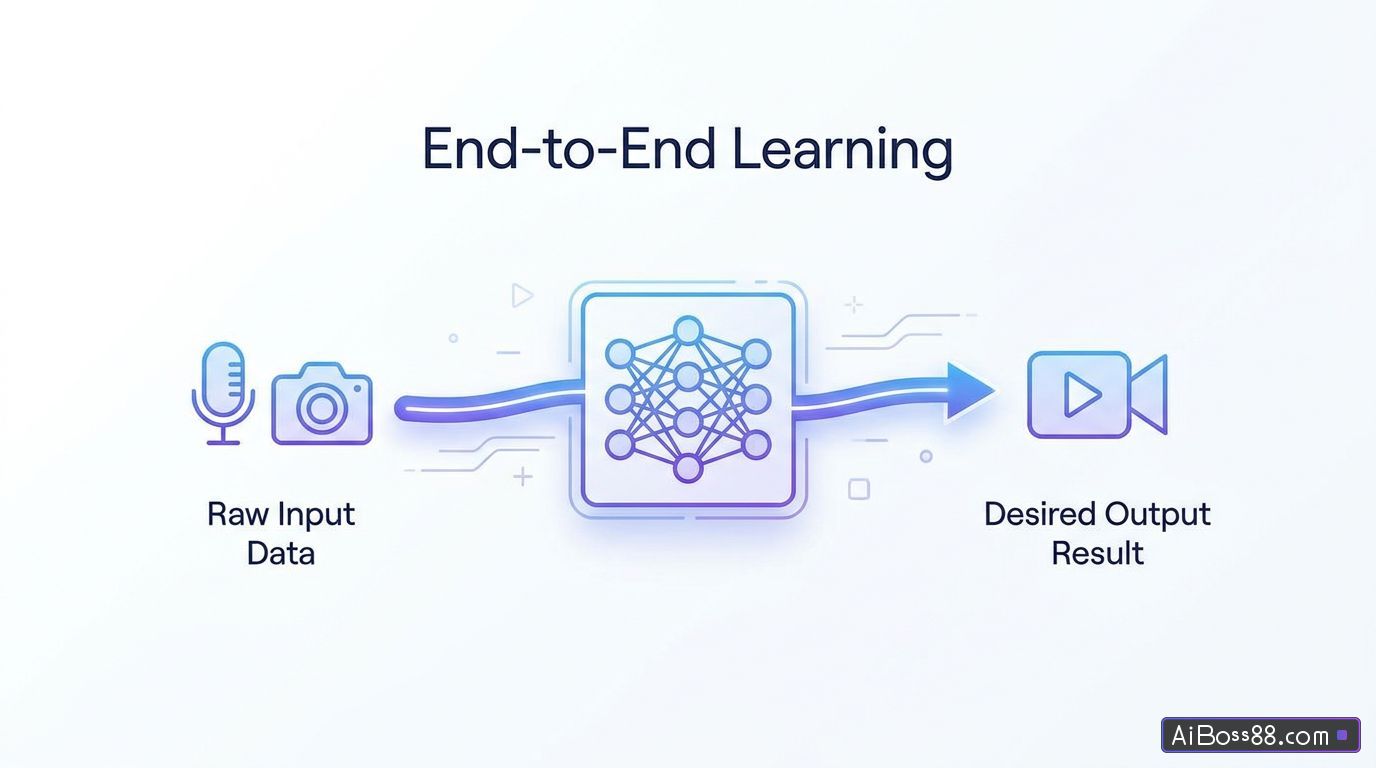
End-to-end learning is a type of...Machine LearningandDeep learningThe design methodology allows models to learn the desired output directly from input data, without manually dividing the task into multiple independent subtasks or modules. The core of this approach lies in simplifying the process by using a unified model to learn the mapping relationship between input and output, avoiding the complex feature engineering and modular design of traditional methods.

How end-to-end learning works

The core of end-to-end learning lies in the direct mapping from input data to output. The system receives raw data as input and directly produces meaningful output, without the need for manual feature engineering or intermediate processing. In end-to-end learning, the entire system is trained as a whole. This approach allows the model to be tuned and optimized through a unified learning process, rather than breaking down the task into independent subtasks or modules.Neural NetworksImplementation, especially deepNeural Networks(DNN). (Can)automaticLearn useful features from large amounts of data and directly output the desired results without the need for manual feature extraction.

End-to-end learning relies on the backpropagation algorithm for training.Neural NetworksThis algorithm minimizes the loss function by calculating the gradient of the loss function and using these gradients to update the network's weights and biases. It emphasizes learning directly from raw data, reducing the need for human intervention and domain-specific knowledge, and can adapt to various problem domains. Through iterative training, the system autonomously learns to map raw input data to the desired output, adjusting its internal representation to optimize task performance. After the learning process is complete, the system can directly generate meaningful outputs based on new, unseen input data, demonstrating end-to-end learning capabilities. End-to-end learning models can adapt to different tasks and datasets, have good generalization ability, and can achieve higher performance in practical applications. These steps realize an integrated process from input to output, simplifying traditional...Machine Learningprocess.

Main applications of end-to-end learning

End-to-end learning has wide applications in many fields:

  • Speech recognitionEnd-to-end models can directly convert speech input into text output without requiring intermediate processing layers for the speech signal. For example, Google's speech recognition system is based on...Deep learningThe end-to-end system can achieve high-precision speech recognition and transcription.
  • Image recognitionBy using convolutionNeural Networks(CNN) end-to-end image recognition systems can directly extract features from images and output recognition results without the need for manually designing feature extraction methods. This technology has been widely used in fields such as face recognition and object detection.
  • Natural Language ProcessingEnd-to-endNatural Language ProcessingThe system can directly convert natural language input into computer-understandable language output without the need for language decomposition and conversion. This technology has already been applied in fields such as machine translation, sentiment analysis, and text generation.
  • automaticdriveEnd-to-end learning inautomaticSignificant progress has also been made in applications within the driving field. For example, Nvidia's end-to-end CNN-based...automaticThe driving system takes an image as input and outputs the steering angle directly.

Challenges of end-to-end learning

The challenges of end-to-end learning include:

  • Large data demandEnd-to-end models require a large amount of labeled data for training, which may be difficult to obtain in practical applications.
  • High training complexityDue to the complexity of the model, training an end-to-end model requires a significant amount of computational resources and time.
  • Lack of explainabilityThe internal mechanisms of an end-to-end model are often a "black box," making them difficult to explain and debug, and potentially a problem in some critical applications.
  • Insufficient generalization abilityEnd-to-end learning is prone to overfitting the training data during the training process, which leads to poor model performance on new data.
  • Data privacy protectionSince end-to-end learning requires a large amount of data for training, how to protect data privacy has become an important issue.

The Development Prospects of End-to-End Learning

End-to-end learning as apowerfulThe learning paradigm, inautomaticDriving, voice recognition, image recognition,Natural Language ProcessingEnd-to-end learning has demonstrated enormous application potential across multiple fields. With continuous algorithm optimization, improved data efficiency, enhanced model interpretability, and hardware acceleration support, it is expected to achieve wider applications in the future, making significant breakthroughs in security and robustness. The combination of cross-modal learning, reinforcement learning, and imitation learning; the application of large-scale pre-trained models; the exploration of multi-task and meta-learning; and the development of vehicle-cloud collaboration will further drive the progress and innovation of end-to-end learning technology.

What is Retrieval-Augmented Generation (RAG)? AIEncyclopedic knowledge

What is overfitting? AIEncyclopedic knowledge