What is Unsupervised Learning? Definition, Techniques, Applications, and Challenges - AI Encyclopedia
Unsupervised learning is a type of machine learning where the model learns from data without any explicit guidance or labeled examples. This article introduces its definition, main algorithms, applications, and challenges.
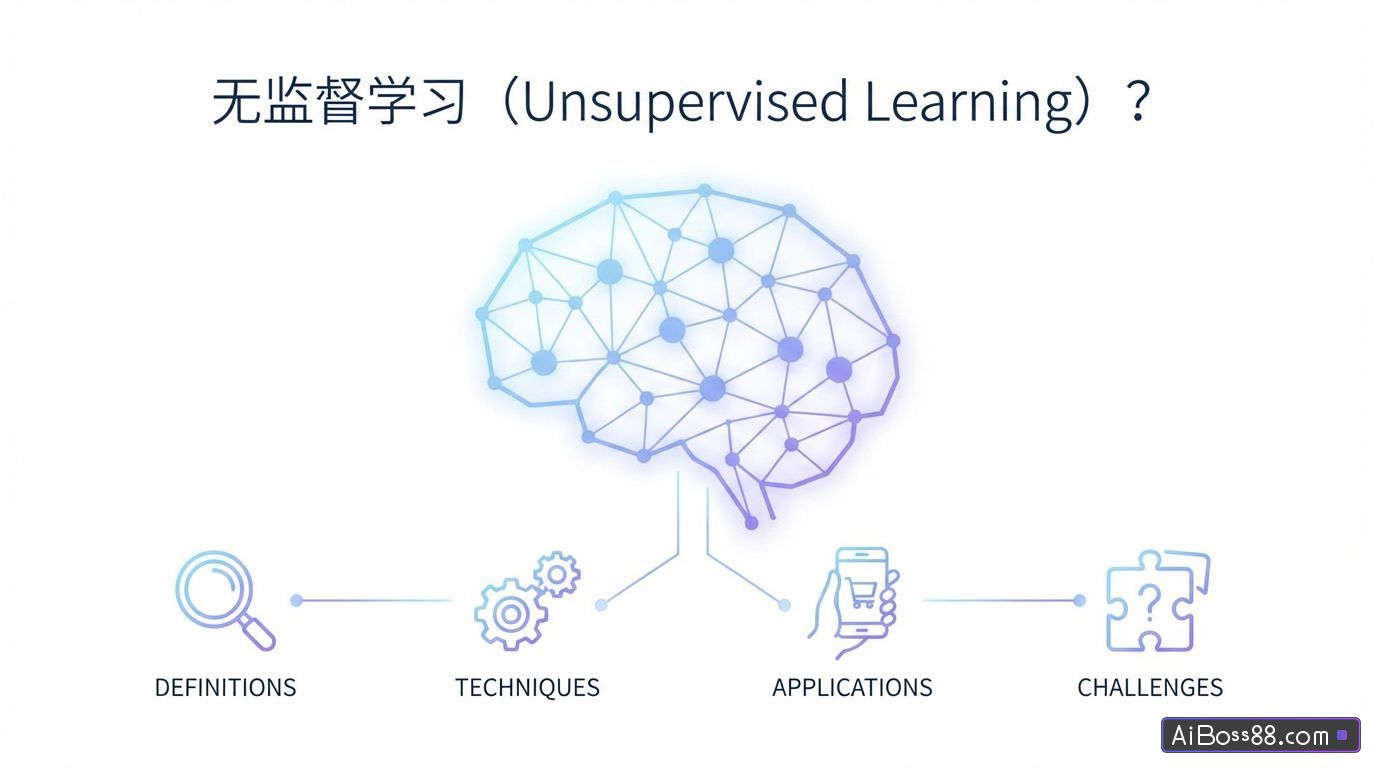
along withartificialintelligent(AIThe development of the fieldMachine LearningIt has become a core technology enabling computers to learn and make decisions on their own. Broadly speaking,Machine LearningIt can be divided into three main categories: supervised learning, unsupervised learning, and reinforcement learning. While supervised learning has attracted much attention due to its wide range of applications, unsupervised learning is still in its early stages of development.artificialintelligentIt possesses enormous potential in terms of true power.
In this article, we will delve into the world of unsupervised learning, exploring its fundamental concepts, key algorithms, applications, and challenges. By the end of this article, you will have a comprehensive understanding of what unsupervised learning is and why it is important for...artificialintelligentThe future is indispensable.
What is unsupervised learning?
Unsupervised learning isMachine LearningOne type of model learns from data without any explicit guidance or labeled examples. In other words, the algorithm is exposed to large amounts of unstructured data, and its task is to find meaningful patterns or structures within that data on its own.
The primary goal of unsupervised learning is to discover hidden structures, relationships, or patterns in data. It can be used for various purposes, such as dimensionality reduction, clustering, or generating new samples. These techniques are particularly valuable when dealing with large datasets where manual annotation is impractical or impossible.
Key Algorithms and Technologies for Unsupervised Learning
Unsupervised learning algorithms can be divided into two main categories: clustering and dimensionality reduction. Let's look at each category and some basic algorithms within them.
The purpose of clustering algorithms is to divide a dataset into distinct groups, each containing similar data points. The goal is to maximize the similarity within each group while minimizing the similarity between different groups. Some popular clustering algorithms include:
- K-means clustering: K-means is a type of...SimpleThe widely used clustering algorithm divides the data into K clusters. This algorithm iteratively assigns each data point to the nearest cluster center and updates the cluster centers based on the average value of the points in each cluster.
- DBSCAN: DBSCAN (Density-Based Noisy Spatial Clustering Application) is a density-based clustering algorithm that groups data points based on their proximity and density. It can identify clusters of arbitrary shapes and is robust to noise.
- Hierarchical clustering: Hierarchical clustering algorithms establish a tree-like structure (tree diagram) to represent nested groups of data points. They can be divided into clustering (bottom-up) and differentiation (top-down) methods.
Dimensionality reduction techniques aim to reduce the number of features in a dataset while preserving its basic structure or relationships. These methods can be used for data visualization, noise reduction, or other enhancements.Machine LearningModel performance. Some popular dimensionality reduction techniques include:
- Principal Component Analysis (PCA): PCA is a linear dimensionality reduction technique that projects data into a lower-dimensional subspace while preserving the maximum variance of the data. It can be used for data compression, visualization, and noise reduction.
- t-SNE:t-SNE (t-Distributed Stochastic Neighbor Embedding) is a nonlinear dimensionality reduction technique that is particularly effective for visualizing two-dimensional or three-dimensional high-dimensional data. It works by minimizing the discrepancy between the probability distributions representing pairwise similarities in the original space and the lower-dimensional space.
- automaticEncoder: automaticAn encoder is a tool used for dimensionality reduction and feature learning.Neural NetworksThey consist of an encoder that maps input data to a low-dimensional representation and a decoder that reconstructs the input data from the low-dimensional representation.
Applications of unsupervised learning
Unsupervised learning has wide applications in various fields, including:
- Anomaly detection: Unsupervised learning can be used to identify anomalous patterns or outliers in data, which is crucial for fraud detection, cybersecurity, or quality control.
- recommendsystem: Clustering algorithms in unsupervised learning can be used to group similar items or users, thereby enabling similarity-based personalization.recommend.
- Natural Language Processing: Dimensionality reduction techniques, such as word embeddings, can be used to represent words in a continuous vector space, improving the performance of various NLP tasks.
- Image and video processing: Unsupervised learning can be used for a variety of image and video processing tasks, such as image segmentation, feature extraction, or compression.
- Data exploration and visualization: Dimensionality reduction techniques can help visualize high-dimensional data, revealing hidden structures and relationships, and providing information for further analysis or model development.
Challenges and Future of Unsupervised Learning
Despite its wide range of applications, unsupervised learning still faces several challenges, which also present opportunities for future research. Here, we outline some of these challenges and potential future directions:
1. Scalability and efficiency
Unsupervised learning algorithms typically require large amounts of data to learn useful representations. However, the computational cost of these algorithms often increases with the size of the dataset. This presents a challenge to improve the scalability and efficiency of unsupervised learning algorithms to handle...fastThe amount of data is increasing.
Future direction:
- Develop more effective optimization techniques for unsupervised learning
- Research data reduction techniques, such as data sketching and data summarization.
- Explore parallel and distributed computing methods to extend unsupervised learning algorithms.
2. Robustness and stability
Unsupervised learning algorithms are highly sensitive to small perturbations in the input data, leading to unstable results. This can be a particular problem when the underlying data distribution is non-stationary.
Future direction:
- Develop robust unsupervised learning algorithms that can handle noise and outliers in data.
- Methods for studying and adapting to changes in data distribution
- Explore ensemble techniques to improve the stability of unsupervised learning outcomes.
3. Explainability and interpretability
Unsupervised learning models can be difficult to interpret and understand because they often involve complex mathematical transformations. This limits the practical applicability of these models, as users may be reluctant to trust their recommendations or take action without an understandable explanation.
Future direction:
- Design unsupervised learning algorithms to generate more interpretable and explainable representations.
- Develop methods for visualizing and interpreting learned representations and decision-making processes.
- Researchers are exploring human-in-the-loop approaches to improve the interpretability and reliability of unsupervised learning models.
4. Evaluation and Validation
Evaluating the performance of unsupervised learning algorithms can be challenging due to the lack of ground truth labels. This makes it difficult to compare different algorithms and assess their effectiveness in real-world applications.
Future direction:
- To develop more reliable and robust evaluation metrics for unsupervised learning, taking into account the inherent properties of the data.
- This study investigates methods for estimating the quality of learned representations in the absence of ground truth labels.
- Explore the use of semi-supervised and weakly supervised learning techniques for validation and performance evaluation.
5. Integration with other learning paradigms
Unsupervised learning can benefit from combining with other learning paradigms, such as supervised learning, semi-supervised learning, and reinforcement learning.
Future direction:
- This research explores methods that combine unsupervised learning with other learning paradigms to improve overall learning performance.
- Explore the use of unsupervised learning as a preprocessing step for supervised or reinforcement learning tasks.
- Develop a hybrid learning framework that leverages the strengths of different learning paradigms.