What is Sequence Modeling? - AI Encyclopedia
Sequence modeling is a modeling method in natural language processing and time series analysis used to process data with sequential dependencies. It can capture the temporal or sequential relationships between data points, such as in text...
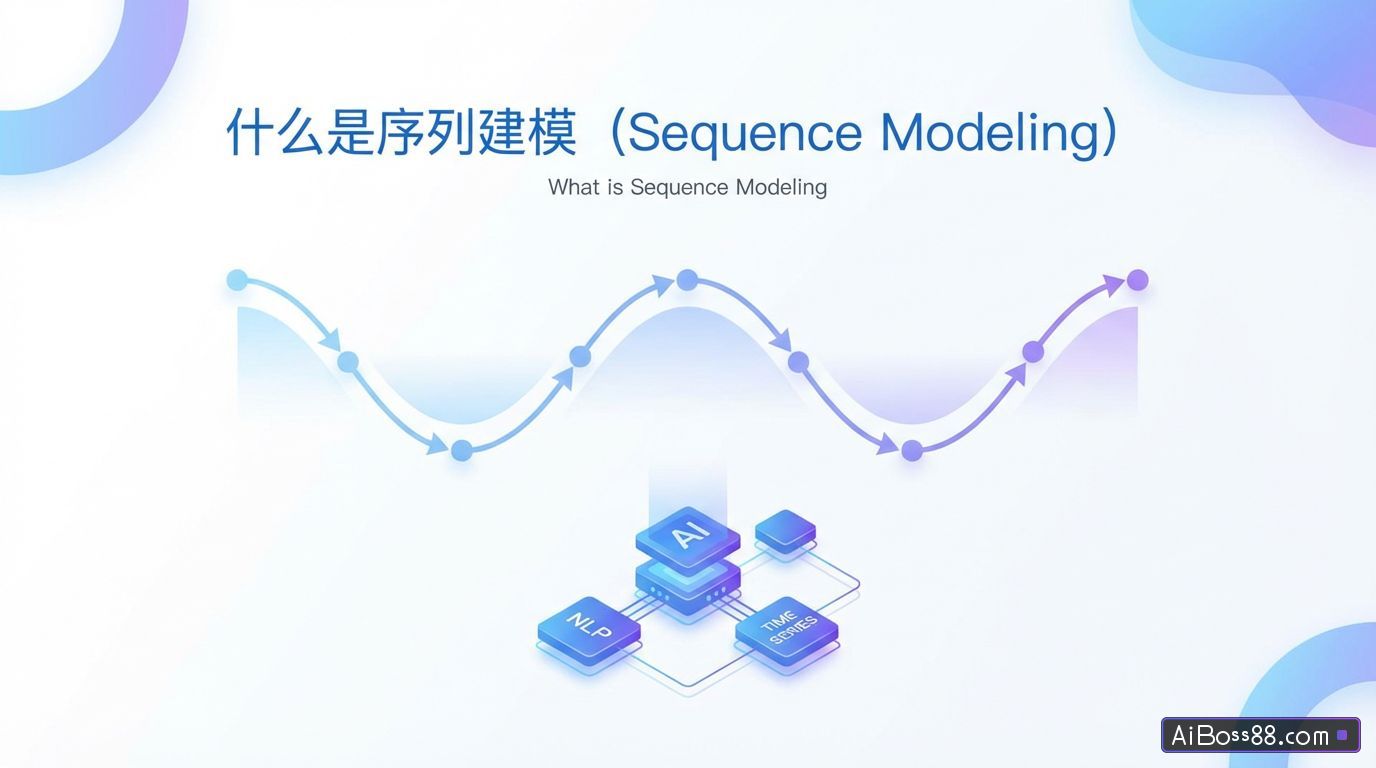
In today's data-driven world, sequence modeling plays a crucial role. Whether analyzing complex language structures, predicting financial market fluctuations, or identifying patterns in biological information, sequence modeling reveals temporal dependencies in data, providing us with profound insights and...powerfulSequence modeling possesses remarkable predictive capabilities. With continuous technological advancements, sequence modeling is becoming a key tool for solving various practical problems, exhibiting immense development potential and promising prospects. This article will delve into the core technologies, application areas, and challenges of sequence modeling.
What is sequence modeling?
Sequence modeling isNatural Language ProcessingSequence models are a modeling approach used in time series analysis to handle data with sequence dependencies. They can capture the temporal or sequential relationships between data points, such as the sequential association of words in text or the continuous patterns of sound in audio. Examples of sequence models include loops.Neural NetworksRecurrent Neural Networks (RNNs), Long Short-Term Memory Networks (LSTMs), and Gated Recurrent Units (GRUs) maintain information from the previous time step through recurrent connections or memory mechanisms, thereby effectively modeling sequence data.
How sequence modeling works
The core of sequence modeling lies in capturing the time-series dependencies in data. This is exemplified by cyclical...Neural NetworksTaking Recurrent Neural Networks (RNNs) as an example, sequential data is processed by introducing recurrent connections into the network structure. In this structure, the output at each time step depends not only on the current input but also on the output of the previous time step. This allows RNNs to consider previous data points when processing the current data point, thereby enabling the modeling of time dependencies in the sequence.
However, traditional RNNs encounter the vanishing or exploding gradient problem when dealing with long sequences, which limits their ability to capture long-term dependencies. To address this issue, researchers have introduced variants such as LSTM (Long Short-Term Memory) and GRU (Gated Recurrent Unit). These models effectively alleviate the gradient problem by introducing gating mechanisms to control the flow of information, enabling the network to learn long-term dependencies in the sequence.
Main applications of sequence modeling
Sequence modeling has wide applications in many fields, including:
- Natural Language ProcessingIt is used for tasks such as language model building, machine translation, text summarization, sentiment analysis, and named entity recognition. By understanding the contextual relationships in a text sequence, the model can predict the next word in the text or understand the structure of the entire sentence.
- Speech recognitionIt converts audio signals into text, and sequence models can identify and process sequence dependencies in speech to transcribe spoken content.
- Time series forecastingIn the financial field, it is used to predict economic indicators such as stock prices and trading volumes; in meteorology, it is used to predict weather changes.
- BioinformaticsUsed for gene sequence analysis, such as the study of gene expression patterns and the prediction of protein structure.
- Video analysisIn computer vision, models are used for behavior recognition, video annotation, and event prediction. They can understand the temporal relationships between video frames.
- recommendsystemAnalyze user behavior sequences to provide personalized services.recommendsuch as e-commerce productsrecommendMusic or video streaming services.
- automaticdriving a carIt processes time-series data from sensors for vehicle navigation, obstacle detection, and driving decisions.
Challenges of sequence modeling
Sequence modeling faces several major challenges in practical applications:
- Long sequence dependency problemTraditional sequence models such as RNNs struggle to capture long-term dependencies because gradients may vanish or explode during backpropagation as sequence length increases.
- computational efficiencySequence data is usually very long, which leads to a large amount of computation in the model training and prediction process, especially in real-time applications.
- Data sparsity:existNatural Language ProcessingIn fields such as [unspecified], certain words or phrases may appear infrequently, making it difficult for models to learn their representations.
- Noise data processingReal-world sequential data often contains noise, and models need to be able to robustly handle this noise and learn from it.
- High-dimensional dataSequence data is often high-dimensional, which can lead to the curse of dimensionality, making model training complex and inefficient.
- Model generalization abilityThe model may perform well on the training data, but it may generalize poorly on unseen data, which is known as overfitting.
- Parameter tuningSequence models typically contain a large number of parameters, and finding the optimal parameter settings is a challenge.
- Sequence labeling errorIn supervised learning, if the sequence labels of the training data are incorrect, the model will learn the wrong patterns.
- Multi-task learningIn multi-task learning scenarios, designing models to handle multiple related tasks simultaneously is a challenge.
- ExplainabilityDeep sequence models are often considered black boxes, making it difficult to explain their decision-making processes, which is unacceptable in some applications (such as medical diagnosis).
The Prospects of Sequence Modeling Development
Sequence modeling has broad prospects for development, withDeep learningWith continuous technological advancements, particularly the rise of the Transformer model, sequence modeling has made significant progress in handling long sequence dependencies and improving computational efficiency. In the future, by combining attention mechanisms, memory-enhancing models, and multi-task learning techniques, sequence modeling is expected to achieve more accurate and comprehensive results in fields such as natural language understanding, speech recognition, and time series prediction.High efficiencyThis will enhance prediction and analysis capabilities, while simultaneously improving the interpretability and generalization ability of the model. With hardware upgrades and algorithm optimizations, real-time sequence modeling applications will become more widespread.