What are Distributed Representations? - AI Encyclopedia
Distributed representations are a method for mapping words or objects to high-dimensional vector spaces, where each dimension represents a different feature attribute. Distributed representations can capture the similarity between words...
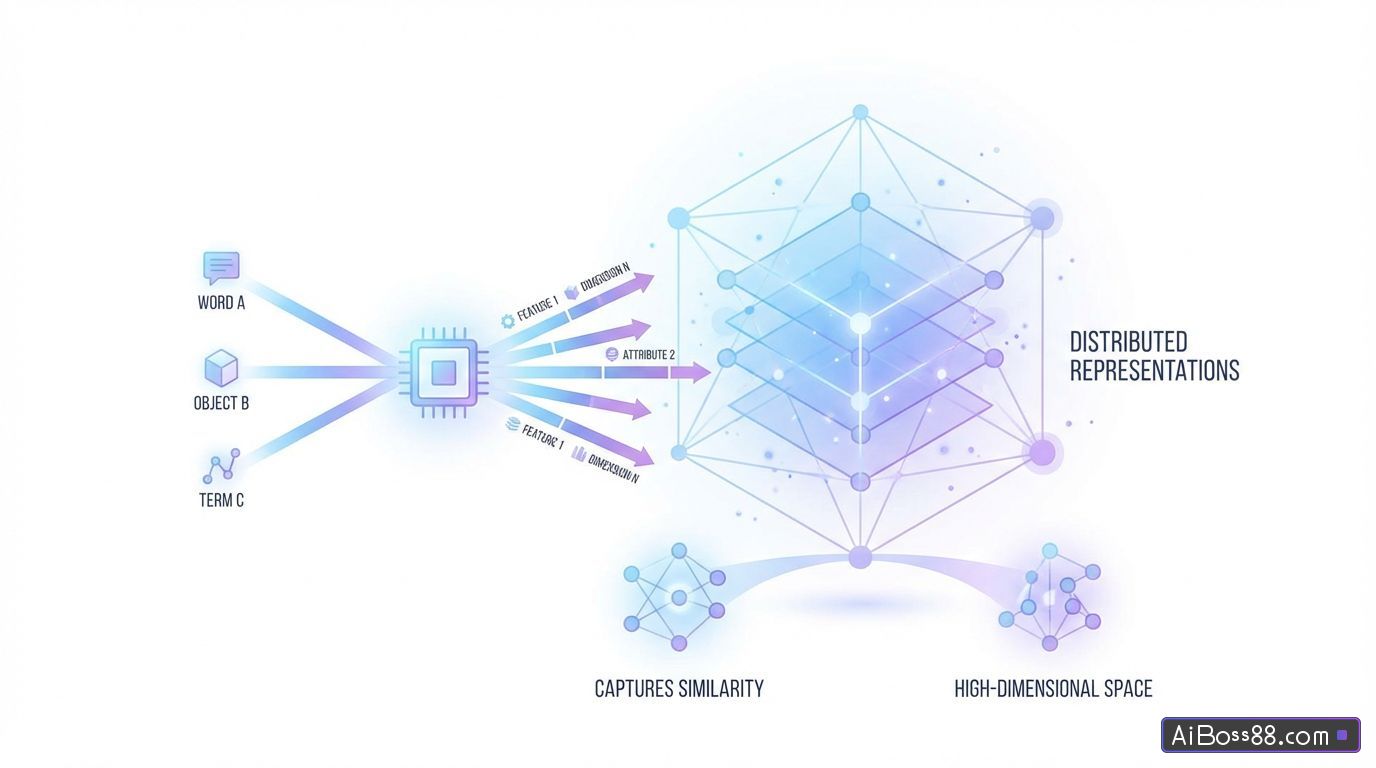
Distributed representations areNatural Language ProcessingA revolutionary advancement in the field, this approach captures the complex relationships between words by mapping vocabulary to vectors in a high-dimensional space. Distributed representations can reveal the richness of word meanings, significantly improving...Machine LearningThe model's performance across various language tasks. With the continuous evolution of technology, distributed representation is driving...artificialintelligentMoving towards a more accurate and in-depth understanding of human language.
What is distributed representation?
Distributed representations are a method for mapping words or objects to a high-dimensional vector space, where each dimension represents a different feature attribute. Distributed representations can capture the similarity and semantic relationships between words because neighboring points in the vector space often represent semantically similar words.Natural Language ProcessingandMachine LearningThis is crucial in tasks, as it allows for better preservation of semantic information and improves model performance. Common models include Word2Vec, GloVe, and BERT.
How Distributed Representation Works
The core idea of Distributed Representations is to map words or objects into a high-dimensional space, where each dimension represents a specific semantic feature. In Distributed Representations, each word is represented by a dense vector, and each element in the vector corresponds to a feature. These features collectively encode the semantic information of the word. For example, a word's vector might have a high value in one dimension representing "positive sentiment" and a high value in another dimension representing "negative sentiment," thus bringing semantically similar words closer together in the vector space.
Distributed representation is typically achieved throughMachine LearningModels, such as Word2Vec or BERT, learn word vectors by training on datasets. These vectors capture rich language patterns and relationships. For example, in Word2Vec, the model learns the vector representation of the current word by predicting context words; while in BERT, through masked language models of large amounts of text and next-sentence prediction tasks, the learned word vectors can understand the meaning of words in different contexts. The models leverage the statistical regularity of word co-occurrence, enabling the learned vectors to be effectively used in various contexts.Natural Language ProcessingTask.
Main applications of distributed representation
Distributed representation inNatural Language Processing(NLP) andMachine Learning(ML) has a wide range of applications, and the following are some of the main application areas:
- Text classificationConverting text to vector form makes it easier to apply.Machine LearningAlgorithms are used for tasks such as sentiment analysis and topic classification.
- Semantic searchIn search engines, distributed representations can help understand the semantics of queries and documents, providing more accurate search results.
- Machine translationBased on word vector representation, machine translation systems can more accurately capture the semantic correspondence between the source language and the target language.
- Question and Answer SystemIn question-answering systems, distributed representations help to understand the semantics of questions and candidate answers, improving the relevance and accuracy of the answers.
- Text similarity analysisBy comparing the vector representations of texts, the similarity between texts can be quantified, which can be used for plagiarism detection, document clustering, and other applications.
- Named entity recognition(NER): In the NER task, word vectors help the model identify specific entities in the text, such as names of people, places, and organizations.
- Semantic disambiguationDistributed representation helps solve the problem of word polysemy by determining the specific meaning of a word through contextual information.
- Text generationIn text generation tasks, such as chatbots and content creation, distributed representations can help generate more natural and coherent text.
- Speech recognitionAlthough distributed representations are primarily used for text, they can also be combined with acoustic models to improve the performance of speech recognition systems.
- recommendsystem:existrecommendThe system can more accurately predict user preferences by analyzing the vector representations of user behavior and item descriptions.
Challenges of Distributed Representation
Distributed representation, although inNatural Language ProcessingandMachine LearningIt is very useful, but it also faces some challenges:
- Sparsity of high-dimensional spacesWord vectors are usually located in high-dimensional space, which may lead to data sparsity, making effective learning and generalization more difficult.
- Context dependencyThe meaning of words often depends on the context, and traditional distributed representations may not be able to fully capture this dynamism.
- ExplainabilityHigh-dimensional vectors are difficult to understand intuitively, and the decision-making process of the model lacks transparency, which poses a challenge to the interpretability of the model.
- Computing resourcesTraining large models to obtain high-quality word vectors may require a lot of computing resources and time.
- Generalization ability beyond vocabularyThe model may perform well within the vocabulary range of the training data, but its ability to generalize to unseen words or new words is limited.
- Polysemous words and homonymsFor words with multiple meanings, a single vector representation may not be able to fully capture all their semantics.
- Data imbalanceIn practical applications, certain words or concepts may appear more frequently than other words, causing the model to be overly sensitive to common words.
- Domain adaptabilityPre-trained word vectors may perform poorly in specific domains or tasks, requiring additional domain adaptation steps.
- Language change and innovationLanguage is constantly evolving, and the emergence of new words and expressions may render existing word vector representations obsolete.
- Cross-language and cross-culturalDifferences in semantic understanding across different languages and cultural backgrounds pose challenges to the cross-language application of distributed representations.
The Development Prospects of Distributed Representation
The development prospects of distributed representation look very broad, with...Deep learningWith continuous technological advancements, future research may focus on improving the context sensitivity of representations through more advanced models such as BERT andGPTTo capture the diversity of word meanings; to enhance the interpretability of models, making the decision-making process more transparent; and to develop more...High efficiencyAlgorithms are being developed to reduce computational resource requirements. Cross-linguistic and cross-cultural representation learning, adapting to evolving language usage habits, and integrating structured data such as knowledge graphs will also be important directions for the development of distributed representations. These advancements will drive the development of distributed representations in...Natural Language ProcessingandartificialintelligentThe wider application of this field will enable a better understanding and processing of human language.