What is Weakly Supervised Learning? - AI Encyclopedia
Weakly supervised learning is a machine learning paradigm designed to address the problem of incomplete or inaccurate labeled data. It includes incomplete supervision (partially labeled data), imprecise supervision (data is not fully labeled), and so on.
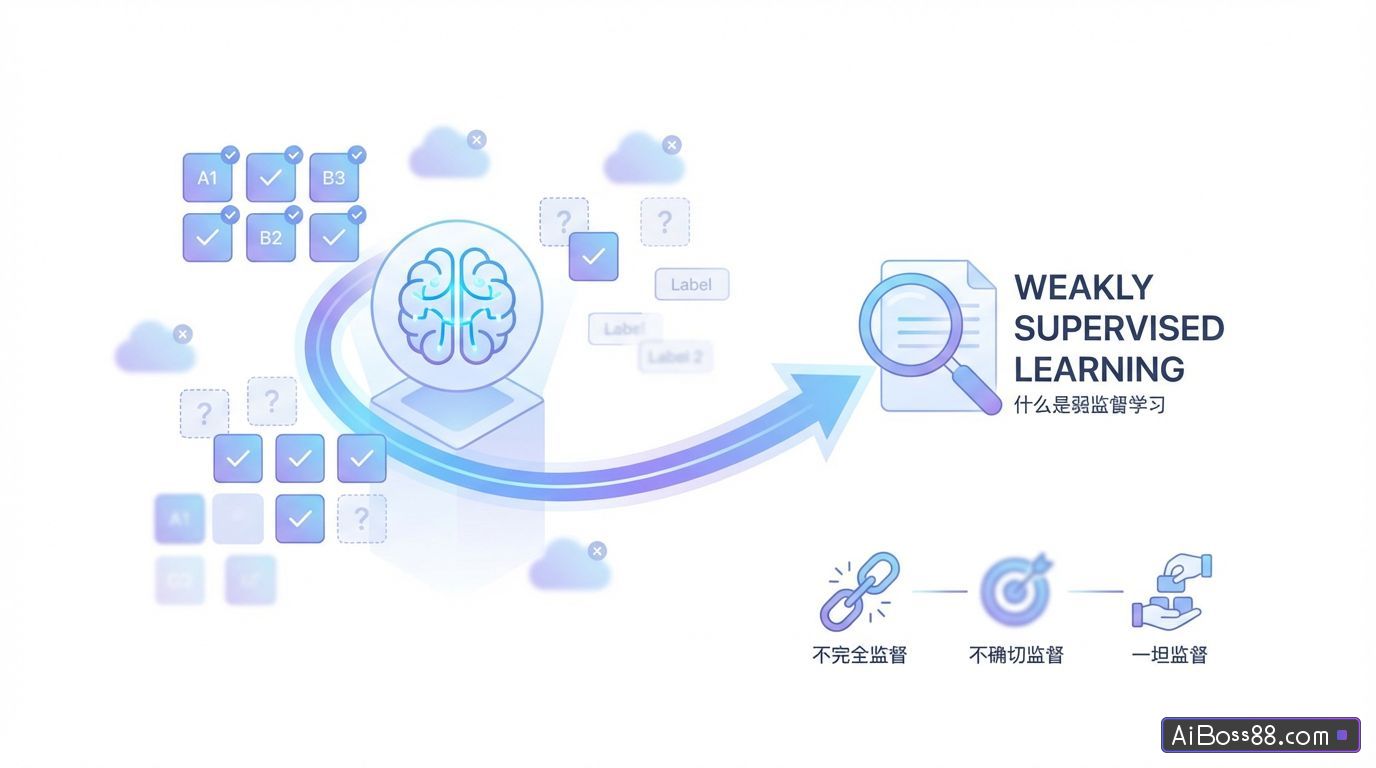
existartificialintelligentIn the grand blueprint,Machine LearningSupervised learning plays a crucial role, with it being at its core. Traditional supervised learning relies on large amounts of precisely labeled data to train models, aiming for accurate predictions of unknown data. However, real-world data is often far from ideal: labeling is costly, expert resources are limited, and data quality varies greatly. Weakly supervised learning emerged in this context. It is a method that can still effectively train models even when labeled information is incomplete or inaccurate.Machine LearningThe model's methodology. The emergence of weakly supervised learning not only alleviates the dependence on large amounts of precisely labeled data, but also opens up new avenues for...Machine LearningA new world of applications. Next, we will delve into the concept, methods, and applications of weakly supervised learning in modern times.artificialintelligentImportance in the field.
What is weakly supervised learning?
Weakly supervised learning is a type of learning that...Machine LearningParadigm aims to address the problem of incomplete or inaccurate labeled data. This includes incomplete supervision (partially labeled data), imprecise supervision (coarse-grained or incorrect labels), and inaccurate supervision (labels may be incorrect). By training the model based on limited labeled information and auxiliary knowledge sources, it improves learning efficiency and model performance.
How Weakly Supervised Learning Works
Weakly supervised learning trains the system using incomplete or imprecise labeled information.Machine LearningIn this learning approach, the algorithm attempts to learn from partially labeled datasets, coarse-grained labels, or noisy labels. For example, it might use a coarse classification label to train a more refined classifier, or infer useful patterns from incomplete labeled data. This method allows models to learn effectively with limited labeling resources and is common in domains where data labeling is costly or accurate labels are difficult to obtain.
To address the uncertainty introduced by weak labeling, weakly supervised learning algorithms typically combine multiple strategies, such as active learning (selectively acquiring more information), semi-supervised learning (utilizing unlabeled data), and multi-instance learning (processing data packets containing multiple instances). These methods enable models to extract useful information from weak labels while reducing the impact of mislabeled data, thereby building high-performance predictive models in imperfect data environments.
Main applications of weakly supervised learning
Weakly supervised learning has wide applications in many fields, including:
- Medical image analysisIn medical image processing, acquiring precisely labeled data is costly, and expert resources are limited. Weakly supervised learning can train models based on limited labeled data, and can be used for disease diagnosis, tumor detection, and medical image segmentation.
- Text mining andNatural Language ProcessingAccurate full-text annotation is extremely time-consuming when processing large amounts of text data. Weakly supervised learning can be applied to tasks such as sentiment analysis, topic classification, and named entity recognition, by training models using methods such as pattern matching, rule-generated labels, or crowdsourcing.
- Image recognition and computer visionIn image recognition tasks, weakly supervised learning can be used for object detection, image classification, and scene understanding, especially when labeled image data is costly or scarce.
- BioinformaticsIn bioinformatics fields such as gene expression analysis and protein function prediction, weakly supervised learning helps extract useful biological information from large-scale biological data.
- recommendsystem:existrecommendIn the system, weakly supervised learning can leverage implicit feedback (such as clicks and browsing history) in user behavior data to improve...recommendalgorithm.
- automaticdrive:existautomaticIn driving technology, weakly supervised learning can assist in processing and understanding road scenarios, such as pedestrian detection and traffic sign recognition, especially when it is difficult to obtain a large amount of accurately labeled video data.
- Speech recognitionIn the field of speech recognition, weakly supervised learning can be used to improve recognition accuracy in noisy environments, especially when labeled data is limited.
- Anomaly detectionIn fields such as credit card fraud detection and cybersecurity, weakly supervised learning can be used to identify abnormal patterns because often only data on normal behavior is labeled.
Challenges of Weakly Supervised Learning
While weakly supervised learning has significant advantages in handling incomplete or inaccurate labeled data, it also faces some challenges:
- Noise robustnessIn weakly supervised learning, the data often contains noise, such as incorrect or inaccurate labels. The model needs to be able to identify and reduce the impact of this noise to improve learning performance.
- Label ambiguityIn cases of incomplete or inaccurate supervision, labels may represent multiple instances or coarse-grained categories, which increases the difficulty for the model to understand the true structure of the data.
- Model selection and designFinding a suitable model structure and algorithm for weakly supervised data is a challenge, because different data and tasks may require different model designs.
- Development of annotation functionsIn some weakly supervised learning methods, it is necessary to manually design labeling functions to generate pseudo-labels, which requires domain knowledge and creative thinking, and can be very time-consuming.
- Evaluation and verificationBecause weakly supervised learning relies on incomplete or imprecise annotations, evaluating model performance becomes more complex. Effective validation methods need to be developed to ensure the model's generalization ability.
- Data imbalanceIn weakly labeled datasets, there may be far more samples of certain classes than other classes, causing the model to favor the majority class and making it difficult to capture patterns of the minority class.
- Ensemble learningIn weakly supervised learning, how to effectively integrate multiple weak annotation sources or weak learners to improve overall performance is a problem that needs to be solved.
- Computing resourcesSome weakly supervised learning methods may require significant computational resources, especially when dealing with large-scale datasets.
- Explainability and transparencyWeakly supervised learning models may not be as easy to interpret as fully supervised models, which can be a problem in some application areas such as medical diagnosis.
- Dynamic data environmentIn an environment where data is constantly changing, updating and maintaining weakly supervised learning models to adapt to new data distributions is also a challenge.
The Development Prospects of Weakly Supervised Learning
Weakly supervised learning asMachine LearningWeakly supervised learning is an important branch of the field with broad development prospects. With the advent of the big data era, the cost and difficulty of acquiring large amounts of accurately labeled data are constantly increasing. Weakly supervised learning, with its advantages in processing incomplete or inaccurate data, is expected to see significant applications in medical image analysis, etc.Natural Language Processing,recommendThey will play a more crucial role in fields such as systems. Researchers are working to improve the robustness of algorithms and develop more...High efficiencyThe model and the design of more reasonable annotation functions are needed to further improve the performance and application scope of weakly supervised learning. Furthermore, with the development of semi-supervised learning...automaticWith the development of annotation tools and active learning strategies, weakly supervised learning is expected to achieve wider practical applications and promote...artificialintelligentTechnological advancements.