What are Judge Models? - AI Encyclopedia
Judge models are auxiliary models used to evaluate the quality of the output of other models. They act as "referees," evaluating and scoring the output of Large Language Models (LLMs). The models are evaluated based on the input question and the...
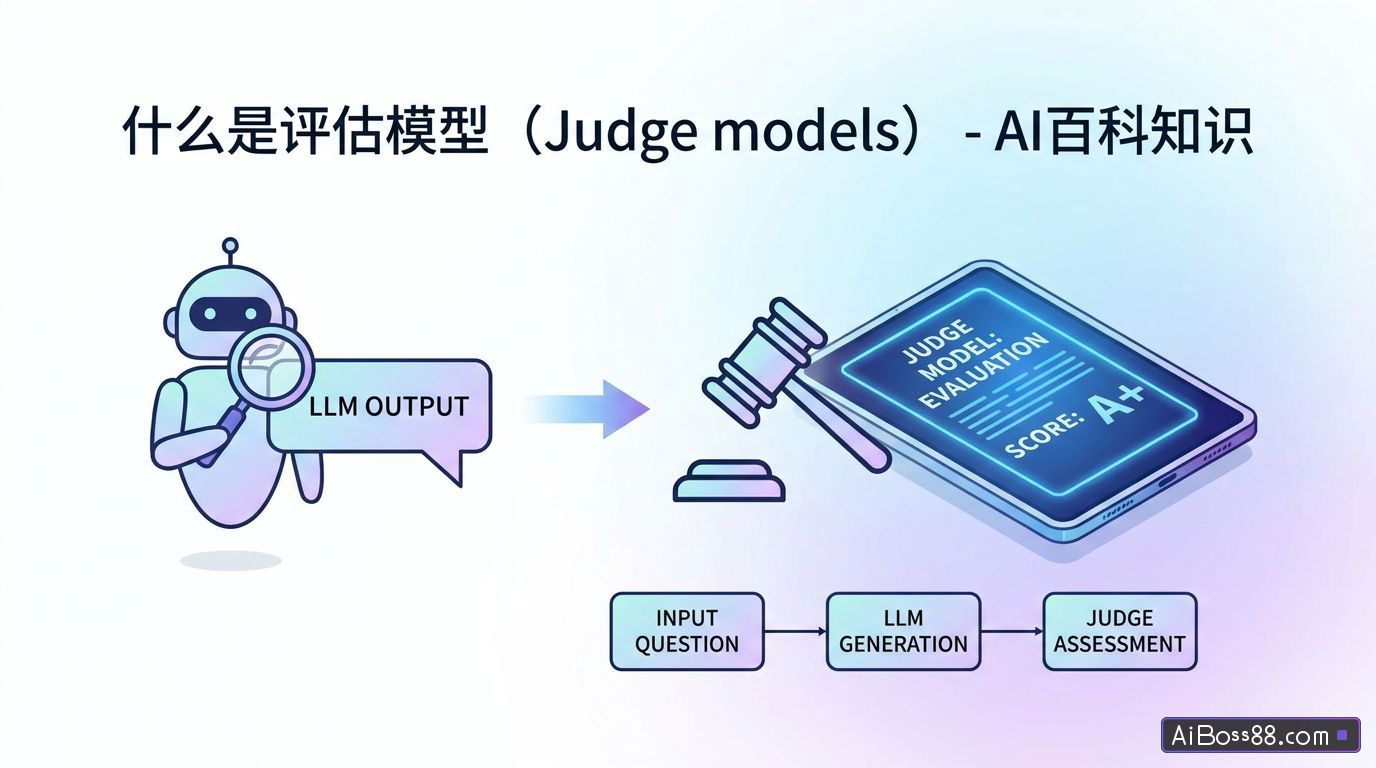
Judge models are auxiliary models used to evaluate the output quality of other models. They act as "referees" for large language models.LLMThe evaluation results are used to assess and score the large language model. These models autonomously analyze and evaluate the large language model by taking the input question and the model's response, providing a score and justification. The main advantages of the evaluation models include accuracy,High efficiencyThey are characterized by their reliability, ease of use, and low cost. They can handle a wide range of evaluation tasks, including but not limited to assessing the helpfulness, harmlessness, reliability, and overall quality of the generated text. Training methods for evaluation models typically include fine-tuning techniques and cueing strategies to improve their performance and efficiency.
What is an evaluation model?
Judge models are auxiliary models used to evaluate the output quality of other models, acting as "referees" for large language models.LLMThe model evaluates and scores the output of the input question and the model's response. It autonomously analyzes and evaluates the large language model based on the input question and the model's response.
How the evaluation model works
The main tasks of evaluating the model include scoring the text generated by the model, comparing a pair of model outputs to select the best text, or calculating the similarity between the model output and a reference. Training the evaluation model requires high-quality datasets, which can be publicly available evaluation data, self-collected subjective evaluation data, and reward data used to train reward models. The dataset needs to undergo processing such as re-evaluation, data classification, and balanced sampling to ensure data quality and class balance. Using the processed training data pool, optimal training parameters, such as epochs and learning rate, are determined experimentally. Ablation studies are conducted to determine the optimal ratio of reward data to general SFT (Supervised Fine-Tuning) data. A suitable base model is selected for fine-tuning, such as the Qwen2.5 series.
The effectiveness of the evaluation model was tested using a specially designed evaluation dataset (such as JudgerBench). The model's performance was evaluated on various subjective evaluation tasks, including single-turn and multi-turn dialogue evaluations. The model's output was compared with human-annotated or...LLMThe labeled results are used to evaluate the model's judgment ability. The evaluation model can output scores, comparison results, or generate detailed comments.
Main applications of the evaluation model
Judge models are widely used in multiple fields and specific scenarios to ensure...artificialintelligentThe model's performance, reliability, and security. Here are some of the main application areas:
- Text classification: Evaluation models can be used to determine the accuracy of text classification models. For example, in news articles...automaticIn classification tasks, the performance of a classification model is measured by calculating metrics such as accuracy, precision, recall, and F1 score.
- Sentiment Analysis: In product review sentiment analysis, the evaluation model uses a confusion matrix to demonstrate its performance in recognizing positive and negative sentiment, helping researchers understand the model's predictive ability across different sentiment tendencies.
- Machine translation: The evaluation model uses metrics such as BLEU and ROUGE to assess the output quality of the machine translation model. These metrics measure the accuracy and fluency of the translation by comparing the machine translation results with the reference translations translated by humans.
- Question and Answer System: When building a question-answering system, the evaluation model assesses the system's understanding of questions and the accuracy of its answers using precision and recall.
- Image recognition: Evaluation models measure the performance of image recognition models by calculating classification accuracy. For example, when identifying images of different types of animals, evaluation models can provide the model's performance across various categories.
- Object detection: existautomaticIn driving systems, the evaluation model uses average accuracy (mAP) to assess the object detection model's ability to identify and locate targets such as vehicles and pedestrians.
- Image segmentation: The evaluation model uses the Dice coefficient and Jaccard index to measure the accuracy of the image segmentation model in segmenting medical images or satellite images.
- Credit Score: The assessment model uses the AUC-ROC curve to evaluate the credit scoring model's ability to distinguish between good and bad customers, helping financial institutions reduce credit risk.
- Fraud detection: In credit card transaction fraud detection, the evaluation model uses precision and recall to measure the model's performance in identifying fraudulent transactions, while also taking into account the impact of false positive rate.
- Market risk forecast: The evaluation model assesses the accuracy of the market risk prediction model using mean squared error (MSE) and root mean squared error (RMSE).
- Medical image analysis: Evaluation models use specificity and sensitivity to measure a medical image analysis model's ability to identify lesion areas. For example, in tumor detection tasks, evaluating models can help researchers understand how well the model performs in identifying different types of tumors.
- Disease prediction: In disease prediction tasks based on patient data, the evaluation model is assessed through cross-validation to evaluate its generalization ability and ensure that the model maintains high accuracy on new patient data.
- Model comparison: The evaluation model compares different models on multiple benchmarks.Large ModelThe performance of a model is evaluated to determine which model is better suited for a specific task. For example, in natural language understanding tasks, evaluating models can help researchers compare BERT,GPTPerformance of models such as T5.
- Evaluation of the effects of fine-tuning: In theLarge ModelAfter fine-tuning, the evaluation model assesses the effectiveness of the fine-tuning by calculating the performance difference before and after the fine-tuning.
Challenges of evaluating models
Judge models face numerous challenges in practical applications. The following are some of the main difficulties and problems:
- Coverage:Large ModelThe capabilities are no longer limited to traditional downstream tasks of Natural Language Understanding (NLU), and it is unclear what capabilities a complete list of test items should include.
- OrthogonalityThe boundaries between different abilities are blurred. For example, text classification tasks may involve both comprehension and reasoning abilities, making it difficult to completely separate and evaluate these abilities.
- diversityThe differences in the models are as follows:SimpleThe differences are often small on simple tasks, but significant on complex ones. For example, almost all models can correctly answer "What does 1+1 equal?", but their performance varies considerably when faced with more complex mathematical problems. The test set needs to include a variety of complex tasks to comprehensively evaluate the model's capabilities.
- ComplexityThe test cases need to be complex enough to demonstrate the model’s ability to handle complex problems.
- Multiple choice questions vs. open-ended questionsMost evaluation methods use multiple-choice questions because this makes it easier to quantify results. However, in practice, the interaction between the model and the human is often not a multiple-choice question, so it is necessary to include subjective open-ended questions.
- Subjectivity of human evaluationWhile manual assessment can provide more accurate results, it is prone to introducing human bias and is inefficient and costly.
- Multiple choice questions vs. open-ended questionsMost evaluation methods use multiple-choice questions because this makes it easier to quantify results. However, in practice, the interaction between the model and the human is often not a multiple-choice question, so it is necessary to include subjective open-ended questions.
- Subjectivity of human evaluationWhile manual assessment can provide more accurate results, it is prone to introducing human bias and is inefficient and costly.
- Static vs. DynamicExisting evaluation methods are static, with fixed test samples that may already be included in the model's training data. Dynamic evaluation methods, on the other hand, can continuously update test samples, introduce open-ended questions, and explore new evaluation methods, such as evaluating multiple models through debate.
The Development Prospect of Evaluation Models
With the advancement of technology, moreHigh efficiencyTraining frameworks will continue to emerge. For example, distributed training techniques can further shorten model training time and improve training efficiency. New advancements will also be made in model compression, enabling lightweight models to run smoothly on mobile devices and meet the application needs of different scenarios. A natively unified...MultimodalLarge ModelThese models will receive more attention and development. They can not only handle single-type inputs but also integrate information from different sources across modalities, forming a more comprehensive cognitive system. As cooperation between upstream and downstream sectors of the industry chain becomes increasingly close, a complete ecosystem is gradually taking shape. By strengthening the synergistic effects between various links in the supply chain, the entire industry will become healthier and more stable, while also promoting the effective transformation of technological achievements into actual productivity.artificialintelligentThe continuous expansion of application scenarios necessitates the construction of richer benchmark datasets for evaluation.Large ModelPerformance across various scenarios. To improve evaluation efficiency, further exploration is needed.High efficiencyThe evaluation methods and algorithms reduce evaluation time and cost. To gain a more comprehensive understanding...Large ModelTo improve performance, a more comprehensive evaluation metric system needs to be built, incorporating elements such as sentiment analysis and moral judgment. The evaluation model will then need to be more...intelligentIt can more accurately assessLarge ModelThe evaluation model will provide more detailed feedback and improvement suggestions on performance. It will support dynamic evaluation, continuously update test samples, introduce open-ended questions, and explore new evaluation methods, such as evaluating multiple models through debate. In conclusion, the evaluation model has broad development prospects and will play an important role in multiple fields. With the continuous advancement of technology and the expansion of application scenarios, the evaluation model will become more...intelligentandHigh efficiency,forLarge ModelThis provides strong support for development.