What is Collaborative Filtering? - AI Encyclopedia
Collaborative filtering is a recommender system technique that predicts items a user might like by analyzing the similarity between users or user ratings of items. This technique can be based on user (...
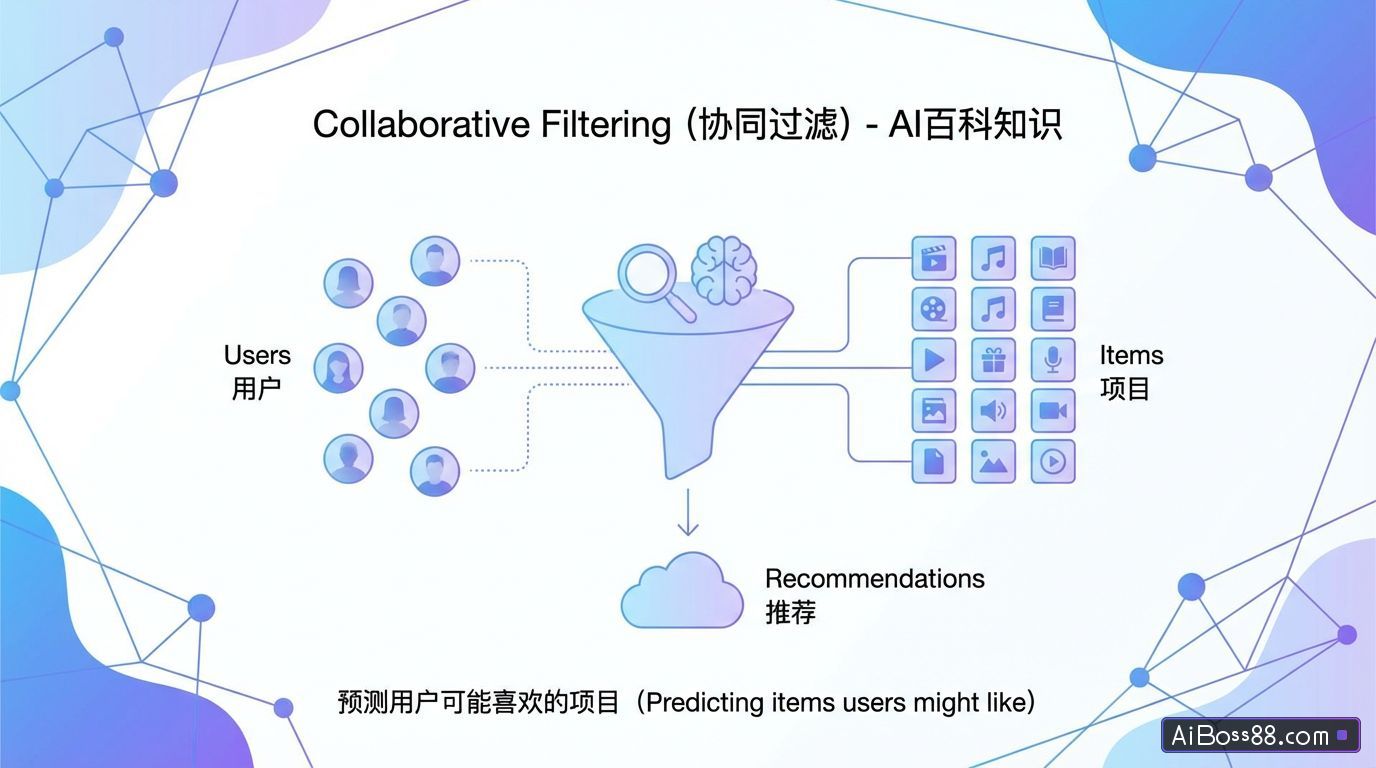
Collaborative filtering is a type of...intelligentrecommendTechnology, by analyzing user behavior and preferences, uncovers similarities between users or correlations between items, thereby predicting and...recommendProducts or content that users may be interested in. These play a significant role in e-commerce, social media, online video, and music services, greatly enhancing user experience and satisfaction. With...artificialintelligentandMachine LearningtechnologyfastWith advancements, collaborative filtering is becoming more precise and...High efficiencyContinuously promote personalizationrecommendServices are developing to a higher level.
What is collaborative filtering?
Collaborative filtering is a type of...recommendThis system technology predicts what projects a user might like by analyzing similarities between users or user ratings of projects. This technology can be user-based (finding the preferences of similar users) or project-based (…).recommendNew projects similar to those already liked by users. Collaborative filtering is widely used in e-commerce, video, and music platforms to provide personalized services.recommendThis increases user engagement and satisfaction.
How Collaborative Filtering Works
Collaborative FilteringrecommendThe system analyzes users' historical behavioral data, such as ratings, purchase records, or browsing habits, to discover similarities between users or between items. User-based methods identify other user groups with similar preferences to the target user, and then predict the target user's likely evaluation of unexplored items based on these similar users' ratings or behaviors on specific items. Item-based collaborative filtering, on the other hand, compares rating patterns between items to find new items similar to those the user has already expressed interest in, and then presents these new items to the user.recommendThese projects.
The core of collaborative filtering lies in its ability to uncover potential user interests and preferences, rather than requiring knowledge of the project's intrinsic characteristics.recommendThe project is novel and personalized, but it also presents challenges such as new user acquisition, data sparsity, and computational scalability.
Main applications of collaborative filtering
The main application areas of collaborative filtering include:
- e-commerce platformFor example, Amazon and Taobao analyze users' purchase history and rating behavior.recommendBy providing products to users, we can increase sales and user satisfaction.
- Video and music streaming services: Like Netflix and Spotify, which utilize users' viewing and listening history,recommendMovies, TV series, or music can increase user engagement.
- social media platformsPlatforms like Facebook and Weibo analyze user interactions and interests.recommendRelated content or advertisements can enhance user experience and advertising effectiveness.
- News and contentrecommendNews websites and blog platforms use collaborative filteringrecommendArticles that users may be interested in can increase page views and user engagement.
- Online education platformBased on students' learning history and preferences,recommendCourses and learning materials can improve learning efficiency.
- Travel and hotel booking servicesFor example, Ctrip and Booking.com use user reviews and preferences.recommendTourist destinations, hotels, or activities.
- Job search and recruitment platformCompanies like LinkedIn and Zhaopin.com analyze job seekers' resumes and recruiters' job descriptions.recommendMatching job opportunities or candidates.
- Personalized advertisingBy analyzing user behavior and preferences, we can provide users with...recommendAdvertising related products can increase click-through rates and conversion rates.
Challenges of Collaborative Filtering
Collaborative FilteringrecommendAlthough the system is personalizedrecommendSignificant progress has been made in this area, but some challenges remain:
- Cold start problemNew users or new projects often lack sufficient historical data, making it difficult to provide accurate information immediately.recommendThis is known as the cold start problem.
- Data sparsityIn large-scale systems, the number of users and projects is enormous, but most users only interact with a small number of projects, resulting in a very sparse user-project matrix, which has an impact.recommendquality.
- Scalability issuesAs the number of users and projects increases, calculating the similarity between users and projects becomes computationally intensive, posing a challenge to the scalability of the system.
- Privacy issuesCollaborative filtering requires the collection and analysis of users' personal data, which may raise concerns about privacy breaches.
- Systematic bias:recommendThe system may reinforce existing user preferences, leading torecommendThe results are homogenized, ignoring diversity.
- Complexity problemThe implementation and optimization of collaborative filtering algorithms can be very complex, requiring specialized knowledge and resources.
- Anti-manipulation:recommendThe system may be manipulated, for example, by influencing ratings.recommendresult.
- Novelty and SerendipityThe system may tend torecommendUsers are given access to familiar or popular items, while novel or niche content is ignored, reducing the chances for users to discover new interests.
- Real-time issuesIn a dynamically changing environment, user interests and project characteristics can change rapidly.recommendThe system needs to be updated in real time to maintain accuracy.
The Development Prospects of Collaborative Filtering
Collaborative filtering asrecommendOne of the core algorithms of the system has broad development prospects. With the development of big data and...Machine LearningWith continuous technological advancements, future collaborative filtering algorithms will more accurately capture user preferences and achieve more...High efficiencyData processing and more personalizedrecommendBy combining with otherrecommendTechnologies such as content-basedrecommendKnowledge-basedrecommendas well asDeep learningetc., mixrecommendThe system will effectively solve problems such as cold start and data sparsity, providing a more comprehensive and innovative solution.recommendAs a result, privacy protection and resistance to manipulation will also be important directions for the development of collaborative filtering, in order to enhance user trust and system security. Overall, collaborative filtering will continue to play a key role in improving user experience and driving personalized services.