What is Overfitting? - AI Encyclopedia
Overfitting refers to a phenomenon where a model performs too perfectly on training data, making it unable to accurately predict new data. It occurs when the model is too complex or the training time is too long, causing the model to begin learning incorrectly...
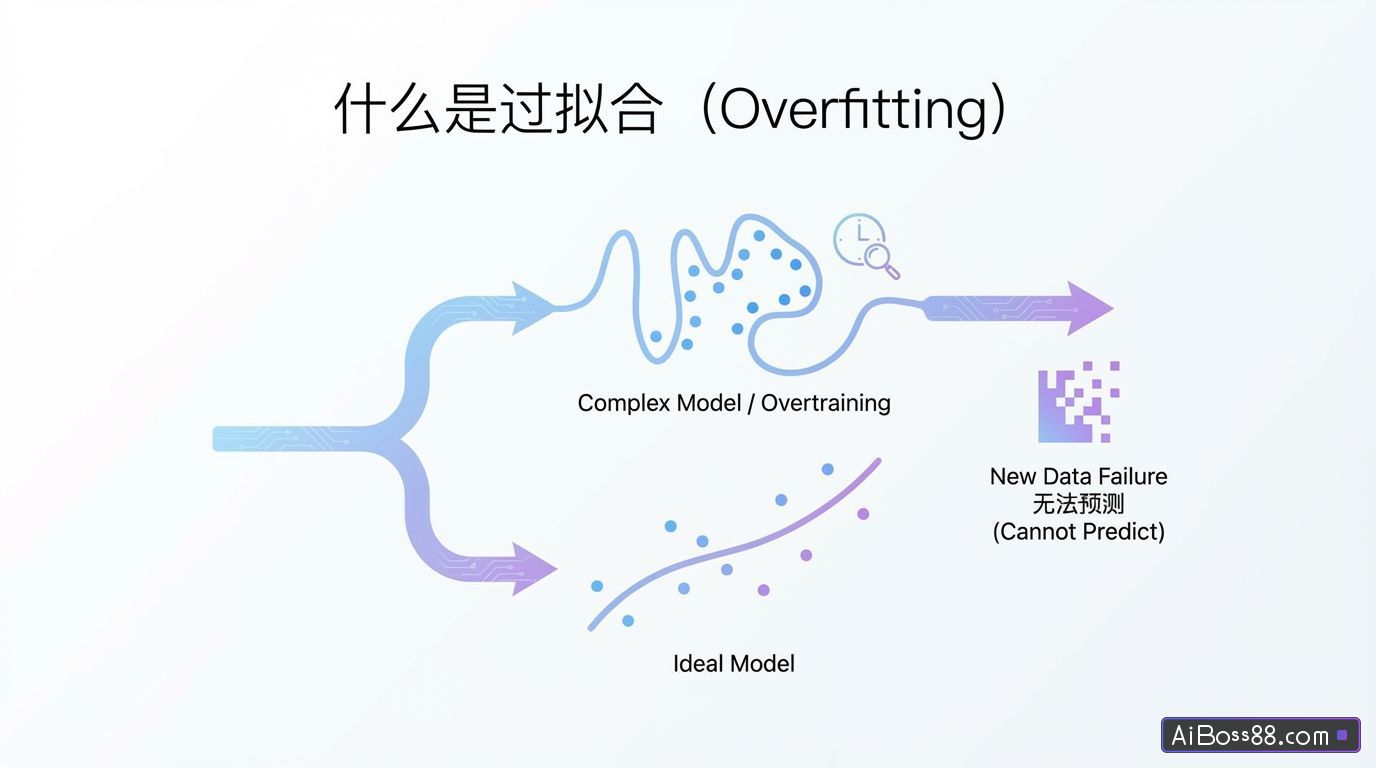
Overfitting isMachine LearningOverfitting is a common problem that leads to poor model performance on new data. By understanding the causes and effects of overfitting and taking appropriate preventative measures, data scientists can create models that capture dominant trends in existing data and generalize well to new data. This requires finding a suitable balance between model complexity and generalization ability, as well as leveraging domain knowledge to guide model training and evaluation. Several methods can be used to improve the predictive accuracy of models, ensuring their effectiveness and reliability in real-world applications.
What is overfitting?
Overfitting refers to a phenomenon where a model performs too perfectly on training data, making it unable to accurately predict new data. It occurs when the model is too complex or training takes too long, causing the model to learn "noise" or irrelevant information from the training data. Overfitted models have a low error rate on the training set but a high error rate on the test set, indicating that the model cannot generalize to new data.
How overfitting works
Overfitting occurs when a model fits the training data too closely, capturing noise and details within the data rather than just underlying patterns, leading to decreased generalization ability on new data. Too many model parameters result in an inability to capture every small fluctuation in the training data, including random fluctuations caused by measurement errors, data entry mistakes, or other non-systematic factors. The size and quality of the dataset directly impact model training performance. A small or poor-quality dataset may contain highly biased or noisy data, and the model trained on such a dataset is unlikely to represent the true patterns of the overall data. Excessive training time or unoptimized training methods may cause the model to constantly adjust itself to adapt to all characteristics of the data, including random errors, in an attempt to reduce training error.
Overfitting is identified by observing the difference in model performance between the training and independent validation sets. If a model performs well on the training set but poorly on the validation set, its stability can be assessed by dividing the data into multiple subsets and using one subset as the test set and the rest as the training set in turn. Cross-validation can effectively reduce the impact of random errors on model evaluation. Plot the changes in training error versus validation error at different training stages. If the validation error starts to increase after a certain training stage, overfitting can be prevented by using L1 and L2 regularization, which add a penalty term related to the parameter size to the loss function to limit the model's complexity. For specific types of data (such as images and text), the diversity and quantity of data can be artificially increased through rotation, flipping, and cropping to help the model learn a wider range of data distribution characteristics. Monitor the model's performance on the independent validation set; stop training when performance no longer improves or begins to decline to avoid the model overfitting the training data. By building multiple models and integrating their predictions, the risk of overfitting can be effectively reduced, and the stability and accuracy of the model can be improved.
Main applications of overfitting
- HealthcareIn the medical field,Machine LearningThe model is often used for disease diagnosis and patient outcome prediction.
- RetailThe retail industry frequently uses predictive analytics to improve customer relationships and optimize sales strategies.
- Financial sectorThe financial industry possesses a vast amount of data, and isMachine LearningOverfitting is an ideal testing ground for algorithms. However, it can have serious consequences in models such as stock price prediction, as the model may perform well on historical data but fail to maintain predictive performance under dynamic market conditions.
- Image recognitionIn the field of image recognition technology, overfitting may cause a model to perform well on training data but poorly in real-world applications.
Challenges of overfitting
- Diversity and scale of datasets:Machine LearningThe model requires a large amount of data to train and to generalize to new, unseen data. The diversity and scale of the dataset remain a challenge.
- Increased model complexity:along withDeep learningWith the development of technologies such as deep learning, the complexity of models is constantly increasing. These highly complex models, such as deep learning...Neural NetworksHaving a large number of parameters makes it easier to overfit.
- Processing of high-dimensional dataWhen dealing with high-dimensional data, such as genomics or financial market data, the number of features may far exceed the number of samples, a phenomenon known as the "curse of dimensionality." In such cases, models are prone to overfitting because they can find random noise in the data and mistake it for real patterns.
- Adaptability to real-time data and dynamic environmentsIn real-time data streams and dynamic environments, data distributions may change over time, requiring models to adapt to these changes and continuously learn. However, when adapting to new data, models may overfit to the most recent data points, neglecting long-term patterns.
- The complexity of model evaluation and validationAs models become increasingly complex, evaluating and validating their generalization ability becomes more difficult. Traditional evaluation methods, such as cross-validation, may be insufficient to capture a model's performance on new data.
- Limitations of computing resourcesDespite the continuous growth of computing resources, the training and validation processes can still require significant computational resources for very large datasets and extremely complex models. This can lead to insufficient model training under limited resources, increasing the risk of overfitting.
- Integration of domain knowledgeIn many fields, such as healthcare and finance, domain knowledge is crucial for building effective models. However, effectively integrating domain knowledge into model training and avoiding overfitting remains a challenge.
The Development Prospects of Overfitting
Overfitting will face challenges in future development, including improving model generalization ability, adapting to more complex data modes, and handling tasks. With...artificialintelligentWith continuous technological advancements, more innovative methods and techniques are expected to be proposed to address overfitting, including improved model training strategies, optimized algorithms, and regularization techniques. Furthermore, data augmentation and regularization techniques will continue to evolve, potentially leading to new methods that more effectively increase dataset diversity and limit model complexity. Early stopping and cross-validation, as crucial techniques for preventing overfitting, will be further optimized to adapt to different datasets and model structures. Simultaneously, model complexity tuning, ensemble learning, and model fusion techniques will continue to develop, improving overall performance and generalization ability. With the growth of computing resources and algorithm optimization, even more innovative methods may emerge in the future.High efficiencyModel training methods can reduce the risk of overfitting. In general, the future development of overfitting research will focus on improving the generalization ability of models, optimizing existing techniques, and developing new methods to prevent and mitigate overfitting, thereby enhancing...Machine LearningThe effectiveness and reliability of the model in practical applications.