What are Sequence Generation Models? - AI Encyclopedia
Sequence generation models are a class of deep learning models focused on handling problems where both input and output are sequential data. They learn the temporal dependencies and patterns within the sequence to generate new sequences...
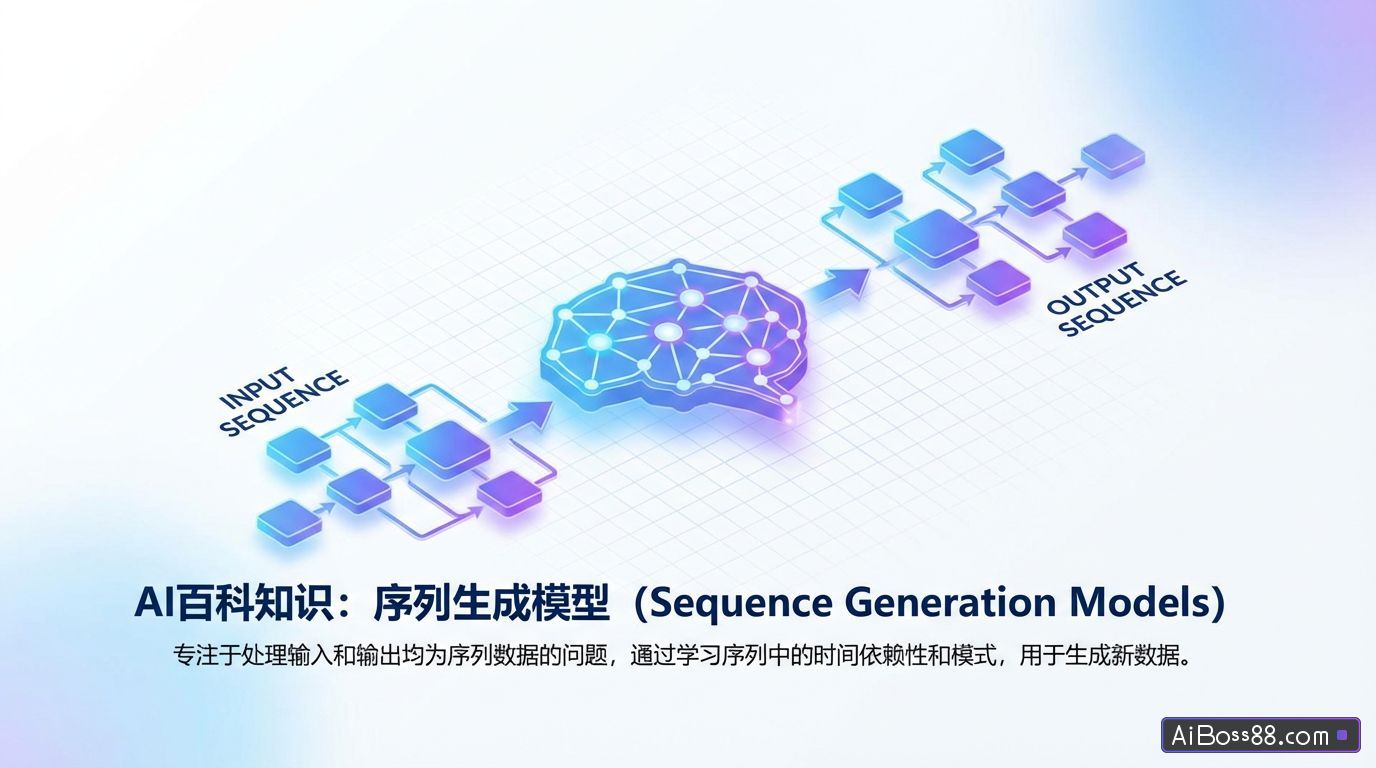
existartificialintelligentSequence generation models play a crucial role in many fields. They are specifically designed to understand and create ordered patterns in data such as text, speech, and music. These models learn the inherent patterns in sequences to generate coherent and meaningful new sequences, and are widely used in various fields.Natural Language ProcessingSpeech synthesis and creative content creation. Next, we will delve into the working principles, application scenarios, challenges, and future development directions of sequence generation models.
What is a sequence generation model?
Sequence generation models are a class of...Deep learningModels are designed to handle problems where both input and output are sequential data. They learn the temporal dependencies and patterns within a sequence to generate new data sequences; this is commonly seen in…Natural Language ProcessingThese models are used in fields such as speech synthesis and music composition. They include loops.Neural NetworksRecurrent Neural Networks (RNNs), Long Short-Term Memory Networks (LSTMs), and Transformers can capture long-term dependencies and generate new sequences that fit specific contexts.
How sequence generation models work
The core working principle of sequence generation models is to predict or generate new sequence data by learning the statistical properties of the input sequence. These models typically employ an encoder-decoder architecture, where the encoder maps the input sequence to a hidden state in a high-dimensional space, capturing the key information of the sequence. The decoder then uses this hidden state to progressively generate the target sequence, with the output of each step serving as the input for the next step, thus achieving autoregressive sequence generation.
During the generation process, the sequence generation model considers all previously generated outputs and possible external information at each time step to determine the next output. This autoregressive property allows the model to progressively construct sequences while taking into account their coherence and contextual relevance. Through training, the model learns how to generate reasonable sequences based on a given context, whether it's text, speech, or music, and can generate new instances that conform to specific distributions and rules.
Main applications of sequence generation models
Sequence generation models have wide applications in many fields, including:
- Natural Language Processing(NLP)Sequence generation models are capable of understanding and generating natural language text in fields such as machine translation, text summarization, question answering systems, dialogue systems, and text generation.
- Speech SynthesisConverting text into spoken language enables machines to "speak," which is used in voice assistants,automaticIt is widely used in speech recognition and speech synthesizers.
- Music and art creationGenerate new musical works or artistic patterns, providing inspiration and tools for the creative industries.
- BioinformaticsIn gene sequence analysis, it is used to predict protein structure or identify potential drug molecules.
- Time series forecastingIn the financial field, it is used to predict economic indicators such as stock prices and trading volumes; in meteorology, it is used to predict weather changes.
- Game developmentUsed to generate in-game stories, dialogues, and character behaviors, enhancing the game's interactivity and immersion.
- recommendsystemIn e-commerce or content platforms, personalized services are generated based on users' historical behavior.recommend.
- Text correction and language learningIt assists language learners in grammar and spelling correction and provides language learning advice.
Challenges of sequence generation models
Sequence generation models face several challenges in practical applications, including:
- Long-term dependency issuesWhen processing long sequence data, the model may lose early information, resulting in a weak correlation between the generated sequence and the early part of the input sequence.
- Data sparsityEspecially inNatural Language ProcessingIn this context, there are a large number of word and phrase combinations, and the model may have difficulty capturing all possible sequence combinations.
- Computational resource consumptionSequence generation models, especially those based on attention mechanisms, typically require significant computational resources, which limits their application in resource-constrained environments.
- Generative quality controlThe generated sequence may be grammatically or logically incoherent, or the generated content may not conform to the expected semantics or style.
- Vulnerability to adversarial attacksGenerative models may be sensitive to carefully crafted input data, leading to non-compliant or unsafe outputs.
- Evaluation criteriaThere is a lack of a unified evaluation standard to measure the quality of generated sequences, especially in creative tasks.
- The balance between diversity and consistencyGenerative models need to find a balance between maintaining output diversity and ensuring output consistency.
- Ethical and bias issuesThe model may unintentionally learn and amplify biases in the training data, leading to the generation of discriminatory or inappropriate content.
- Data privacy and securityProtecting user privacy and data security is a significant challenge when dealing with sensitive data.
- Real-time demand generationIn applications that require real-time response generation, how...fastGenerating high-quality sequences is a technical challenge.
The Development Prospects of Sequence Generation Models
Sequence generation models have broad development prospects, with...Deep learningWith continuous technological advancements, these models are expected to make significant progress in handling more complex sequence data and improving generation quality and efficiency. Future research may focus on addressing long-term dependency issues, enhancing model interpretability, reducing computational resource consumption, strengthening model robustness, and developing more impartial and unbiased generation strategies. Furthermore, interdisciplinary integration, such as combining cognitive science and linguistics, will further drive innovation and breakthroughs in sequence generation models across diverse application scenarios.