What is AIGC: AI Generated Content - AI Encyclopedia
This article introduces AIGC (AI Generated Content), its working principles, application scenarios, and challenges.
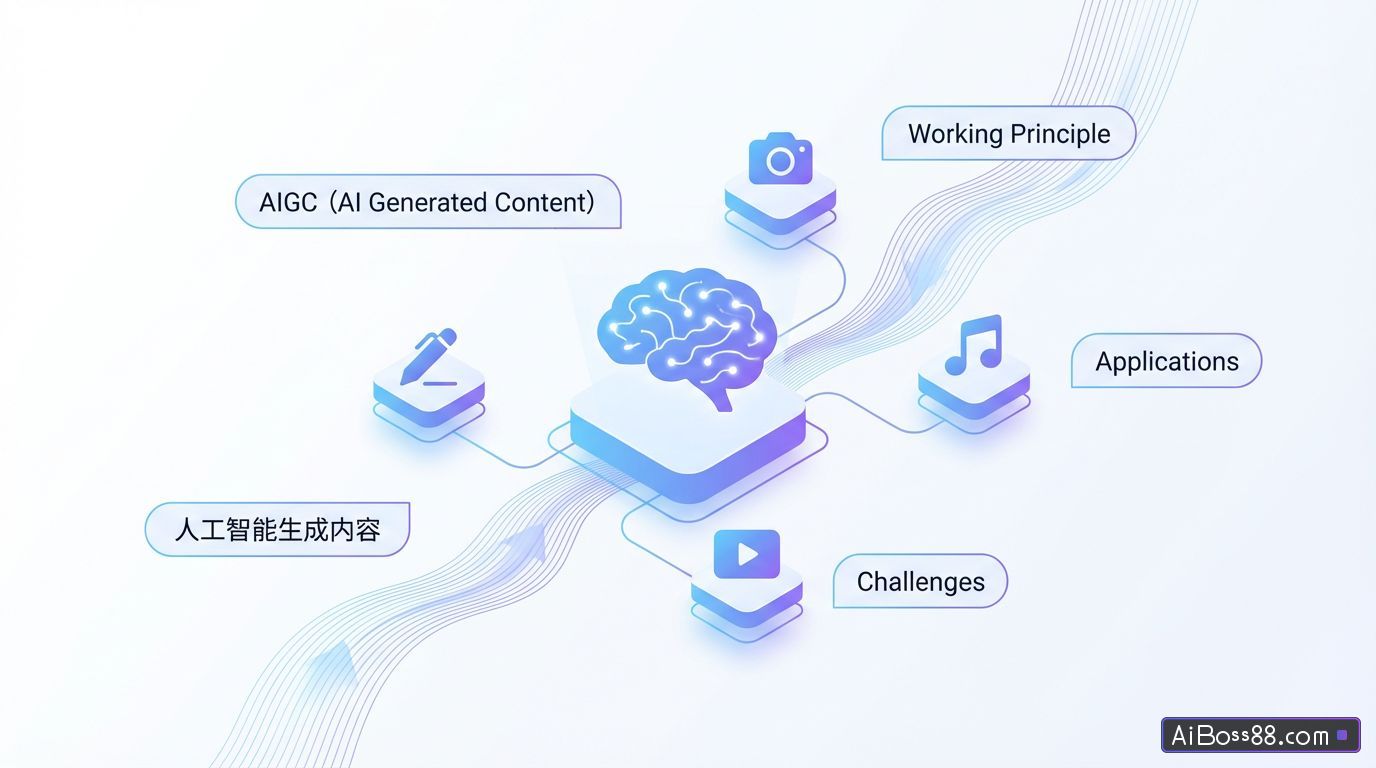
What isAIGC
AIGC isAI- is an abbreviation for generated content.artificialintelligentContent generation, a method of utilizingartificialintelligentThis content creation method is considered a new type of content creation method following PGC (Professionally-generated Content) and UGC (User-generated Content).
AIGC (Generative Content Generation) achieves this by extracting and understanding intent information from human-provided instructions and generating content based on that knowledge and intent. For example, a user can input a sentence and...AICreate a composite image that is associated with the description, or input a description of an article or story, and let...AITo accomplish it for them.
AIGC is considered a new type of content creation following PGC (Professionally-generated Content) and UGC (User-generated Content). PGC refers to content created by professionals such as journalists, artists, or programmers. UGC refers to content created by ordinary users such as bloggers, vloggers, or social media users. AIThe difference between GC and PGC and UGC is that it does not rely on human labor or creativity, but rather on... AI algorithm.
AIHow GC works
AIGenerative models rely on generative models that can learn from data and generate new data that resembles the original data distribution. Generative models can be divided into two categories: Generative Adversarial Networks (GANs) and Natural Language Generation (NLG) models.
- GAN consists of twoNeural NetworksComponents: A generator and a discriminator. The generator attempts to create realistic images from random noise vectors, while the discriminator tries to distinguish real images from the dataset and fake images from the generator. The two networks compete with each other until they reach equilibrium, at which point the images generated by the generator are indistinguishable from real images by the discriminator.
- The NLG model is based on a converter, which is a type of...Neural NetworksThe architecture uses attention mechanisms to capture long-range dependencies between words in natural language text. Transformers consist of an encoder that encodes the input text into a hidden representation and a decoder that generates the output text from the hidden representation. Transformers can be pre-trained on large-scale text corpora using self-supervised learning methods such as masked language modeling (MLM) or causal language modeling (CLM). The pre-trained transformers can then be fine-tuned for specific tasks such as text summarization, machine translation, or text generation.
Currently, some popular examples of generative models include:
- GPT-3: A large transformer model with 175 billion parameters, pre-trained on various text sources using CLM. Given some keywords or hints,GPT-3 can generate coherent text on a variety of topics.
- DALL-EA converter model with 12 billion parameters, pre-trained on text-image pairs using MLM. DALL-EIt can generate realistic images based on natural language descriptions.
- Codex: A converter model with 12 billion parameters, pre-trained on source code using MLM. Codex can generate executable code based on natural language commands or annotations.
- StyleGAN2: A GAN model with 50 million parameters, trained on high-resolution facial images using style-based modulation. StyleGAN2 can generate realistic faces through fine-grained control over facial attributes.
AIApplication scenarios of GC
AIGC has wide applications in various fields that require writing or content creation, such as:
- educate:AIGC can help students learn new knowledge by generating explanations, examples, quizzes, or feedback.
- entertainment:AIGC can create engaging stories, poems, songs, or games for entertainment or relaxation.
- marketing:AIGC can be used to create product copy and slogans for headlines or advertisements promoting products or services.
- news:AIGC can write fact reports, summaries, or data- or event-based analyses.
- Software development:AIGC can generate code snippets, documentation, or tests based on specifications or comments.
AIGC Challenges
AlthoughAIGC can achieve moreHigh efficiencyMore accessible content creation, however,AIGC also brings significant challenges related to bias and discrimination, misinformation, security, and credibility.
- Bias and discrimination: If the data used for training or generating content is not representative or diverse enough,AIGC can perpetuate harmful stereotypes and biases related to race, gender, ethnicity, and other factors. For example,AIGC has been used to create harmful content and reinforce race-related stereotypes. This has a negative impact on the rights and dignity of society and individuals.
- False information:AIGC can be used to manipulate and distort public opinion through disinformation and propaganda. For example,AIGC has been used to generate fake news, deepfakes, and other forms of deceptive content that can undermine public trust in the media and information.
- Security: If the data used for training or generating content is not properly protected or encrypted,AIGarbage collection (GC) can pose security risks. For example, if data is leaked or hacked,AIGC may expose sensitive information or personal information of users or creators.
- Credibility:AIGC makes people more aware ofAIThe authenticity and credibility of the content generated by the model are questionable, for example,AIGC makes it difficult to verify the source or author of content and its quality or accuracy.