What is Named Entity Recognition (NER)? - AI Encyclopedia
Named Entity Recognition (NER) is a key technology in Natural Language Processing, used to identify and classify entities with specific meanings from text, such as names of people, places, organizations, and time expressions.
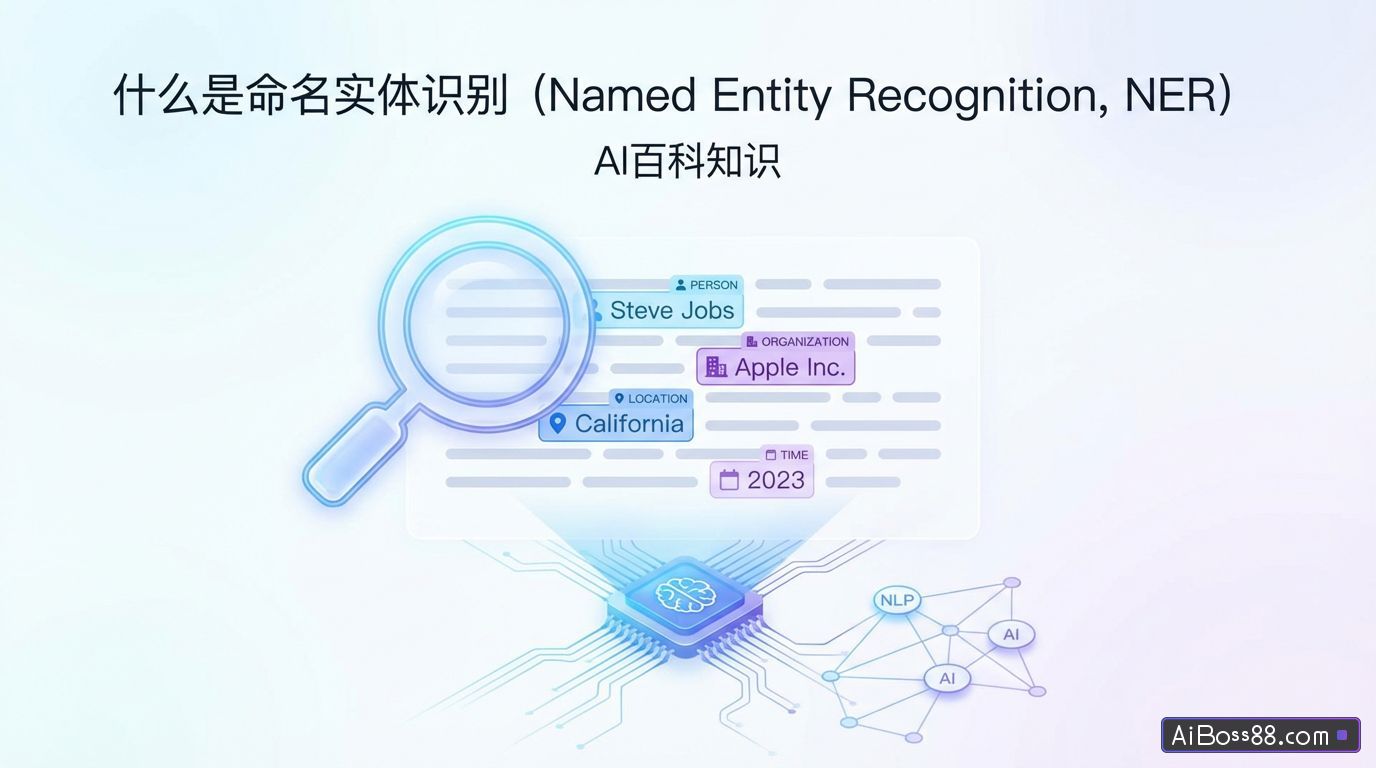
Named Entity Recognition (NER) can accurately extract key information, such as names of people, places, and organizations, from vast amounts of text data. With...artificialintelligentContinuous progressNatural Language ProcessingNamed entity recognition in [the context of] ...intelligentThe system is the core of improving machines' ability to understand natural language. This article will explore this topic in depth.Natural Language ProcessingThis paper discusses the working principle, application scenarios, and challenges of named entity recognition in China, and looks forward to its broad prospects in future technological development.
What is Named Entity Recognition?
Natural Language ProcessingNamed Entity Recognition (NER) is a key technology in machine learning, used to identify and classify entities with specific meanings from text, such as names, locations, organizations, and time expressions. NER enables machines to understand entity information in text, which is crucial for applications such as information extraction, question answering systems, and machine translation.Machine LearningandDeep learningThe method, NER model, learns to identify entities from large amounts of labeled data and is widely used to improve performance.intelligentThe system's ability to understand and process natural language.
How Named Entity Recognition Works
Named Entity Recognition (NER) works by collecting and labeling data, specifically by acquiring text datasets containing information about entities and their categories. These datasets are used for training.Machine LearningorDeep learningThe model. During training, the model learns to extract features from text, such as part-of-speech tags, syntactic structure, and contextual information, to identify and classify entities. The model utilizes algorithms such as Conditional Random Fields (CRF), Support Vector Machines (SVM), or recurrent...Neural Networks(RNN) is used to predict and classify entities.
After model training, the NER system is applied to new text data to identify and extract entities. This process includes text segmentation, feature extraction, and entity annotation. The system's performance is evaluated on a test dataset to check its accuracy and generalization ability. NER technology enables machines to extract structured information from unstructured text, supporting various applications such as information retrieval, knowledge graph construction, and natural language understanding.
Main applications of named entity recognition
Named Entity Recognition (NER) inNatural Language ProcessingThe main applications in (NLP) include:
- Information ExtractionFrom a large amount of textautomaticExtract key information, such as names, locations, and dates, to build databases and knowledge bases.
- Question and Answer SystemIt helps the system understand the entities in the user's question and provides a more accurate answer.
- Machine translationDuring the translation process, proper nouns and important entities in the text are preserved and translated correctly.
- Sentiment AnalysisIdentify entities in product reviews and comments, and analyze public sentiment towards specific entities.
- recommendsystemBy analyzing user interactions with entities, personalized services can be provided.recommend.
- Legal and financial analysisIdentify key entities in legal documents and financial reports for compliance checks and risk assessments.
- BioinformaticsIdentifying biological entities such as genes and proteins in scientific literature to support biomedical research.
- Social media monitoringAnalyze discussions on social media to identify mentioned people, places, and events for use in public relations and market analysis.
- automaticsummaryIdentify and retain key entities when generating text summaries to ensure the integrity and accuracy of information.
- Customer ServiceIn customer serviceautomaticIn the process, by identifying entities in the user's question, more...fastAn effective response.
Challenges of Named Entity Recognition
- Entity ambiguityThe same word may refer to different entities in different contexts. For example, "apple" may refer to fruit or a technology company. NER needs to accurately identify the specific meaning of the entity.
- New Entity RecognitionAs time goes by, new entities (such as new companies and new locations) continue to emerge, and NER systems need to be able to identify these unseen entities.
- Fine-grained entity recognitionIn addition to general categories (such as personal names and place names), NER also needs to identify more specific entity types, such as product models and drug names.
- Cross-linguistic and dialectal challengesThe differences in grammar and expression in different languages and dialects increase the complexity of NER in a multilingual environment.
- Context dependencyEntity recognition often relies on contextual information; a lack of sufficient context may lead to incorrect entity recognition.
- Entity nesting and overlapIn some cases, entities may be nested or overlapped. For example, in "San Francisco International Airport", both "San Francisco" and "International Airport" are entities, but there is a nesting relationship between them.
- Entity disambiguationIn a text, the same entity may have multiple referential forms, such as abbreviation, full name, alias, etc. NER needs to correctly associate these different expressions.
- Challenges of Text PreprocessingThe accuracy of NER is affected by text preprocessing steps, such as the quality of word segmentation and part-of-speech tagging.
- Low-resource languagesFor some languages with limited resources, the lack of sufficient training data and pre-trained models makes the NER task even more difficult.
- Cross-domain adaptabilityA NER model may perform well in one domain, but may need to be retrained and tuned in another domain to adapt to new entity types and contexts.
The Development Prospects of Named Entity Recognition
Natural Language ProcessingNamed entity recognition in [the context of] [the field] has broad development prospects. With [the development of] [the field of] [named entity recognition],Deep learningWith the continuous advancement of technology,Natural Language ProcessingThe named entity recognition model in this technology will significantly improve its ability to handle complex linguistic phenomena and cross-domain applications. In the future...Natural Language ProcessingNamed entity recognition in this field promises to achieve finer-grained entity recognition and better understand and handle ambiguity and contextual dependencies. With the increasing volume of multilingual and cross-cultural data,Natural Language ProcessingNamed entity recognition in this field will achieve breakthroughs in supporting more languages and dialects, promoting global applications. With the development of knowledge graph and semantic understanding technologies,Natural Language ProcessingNamed entity recognition in [the context of] [the technology] will contribute to building richer and more dynamic knowledge bases and improving [the system/mechanism].intelligentIt plays a key role in the ability to understand the system.