What is Semantic Segmentation? - AI Encyclopedia
Semantic segmentation is a computer vision technique that uses deep learning models, especially convolutional neural networks (CNNs), to classify each pixel in an image, recognizing and distinguishing different objects...
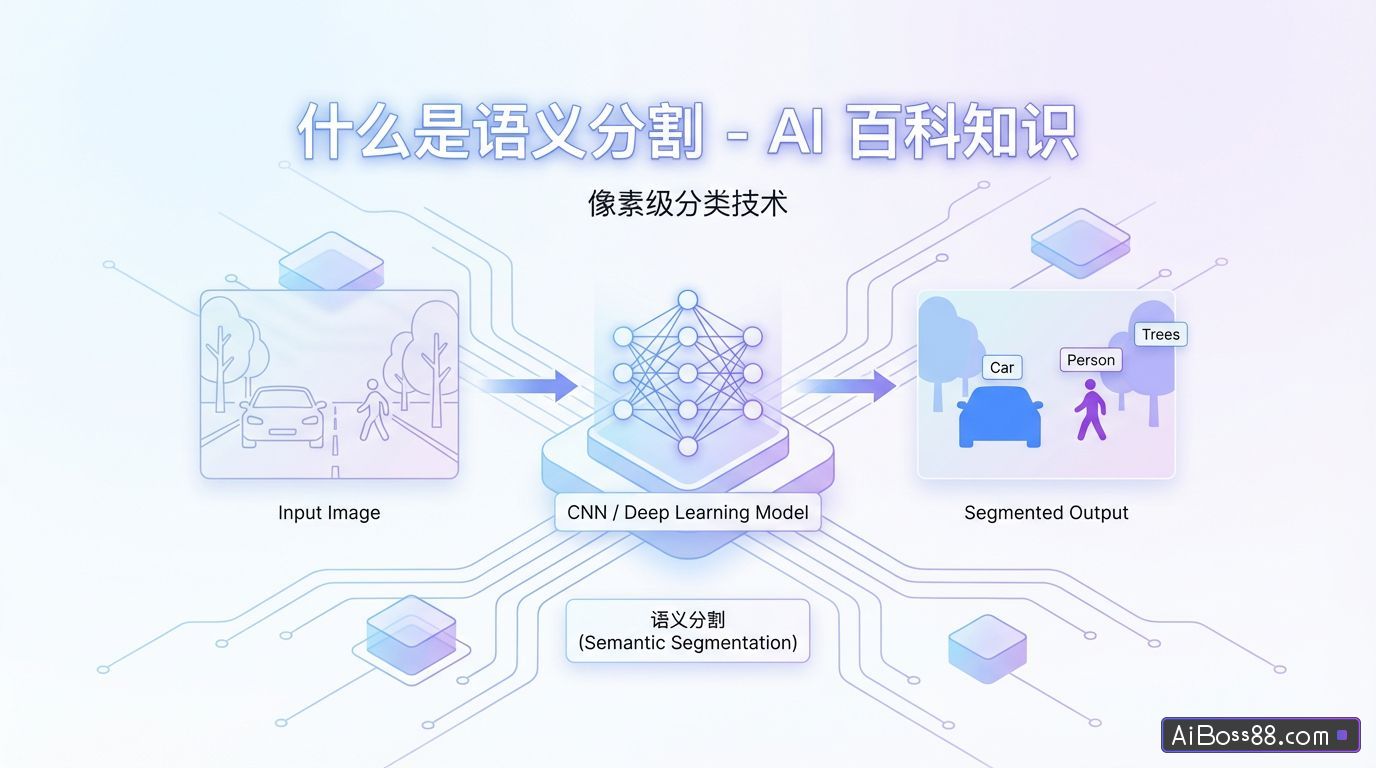
Semantic segmentation, as one of the core technologies in computer vision, is gradually becoming key to understanding and interpreting image data. By assigning precise semantic labels to each pixel in an image, machines can recognize and interpret visual scenes like humans.Deep learningWith the rapid development of technology, semantic segmentation inautomaticWith increasingly broad application prospects in fields such as driving and medical image analysis, semantic segmentation research and applications are driving the development of semantic segmentation.artificialintelligentMoving towards a higher level of visual understanding.
What is semantic segmentation?
Semantic segmentation is a computer vision technique that uses...Deep learningModels, especially convolutional modelsNeural Networks(CNN) classifies each pixel in an image, identifying and distinguishing different objects and scenes. Semantic segmentation assigns a semantic label to each pixel in an image, clearly defining its specific category, such as people, vehicles, or buildings. Semantic segmentation in...automaticIt has wide applications in fields such as driving, medical image analysis, and robot vision.
How semantic segmentation works
The working principle of semantic segmentation is based onDeep learningEspecially convolutionNeural Networks(CNN). By learning the features of images through training, the network can identify different patterns and objects in images. During training, the network receives a large amount of labeled image data, where each pixel is assigned a label representing the category to which that pixel belongs. As training progresses, the network's weights and parameters are continuously adjusted to reduce the difference between the predicted labels and the actual labels. In this way, the network gradually learns to assign pixels in an image to the correct category.
In practical applications, a trained semantic segmentation model receives a new image as input and extracts features through its convolutional layers. These features are then upsampled or expanded to restore the resolution of the original image, ensuring that each pixel receives a predicted class label. The final output is a segmentation map with the same resolution as the input image, where the color or value of each pixel represents its class, thus achieving accurate segmentation of regions within the image.
Main applications of semantic segmentation
The main application areas of semantic segmentation include:
- automaticdrive:existautomaticIn driving technology, vehicles need to accurately identify and understand their surroundings, including pedestrians, vehicles, road signs, and obstacles. Semantic segmentation can provide pixel-level road and obstacle information, which is crucial for driving decisions and route planning.
- Medical image analysisIn the medical field, semantic segmentation can help doctors identify and segment different tissues and organs in medical images such as MRI and CT scans, assisting in disease diagnosis and treatment planning.
- Robot VisionRobots use semantic segmentation to better understand their working environment, identify and manipulate objects, and navigate and interact.
- Augmented Reality (AR)In AR applications, semantic segmentation can be used to analyze and understand real-world scenes in real time, seamlessly overlaying virtual information onto the real world.
- Geographic Information System (GIS)Semantic segmentation can be used to analyze satellite images and aerial photographs.automaticIdentify geographical features such as roads, rivers, and buildings to assist in urban planning and environmental monitoring.
- Agricultural monitoringBy analyzing images of crops, soil, and pests, semantic segmentation helps monitor crop health and optimize irrigation and fertilization strategies.
- Video surveillanceIn the field of security monitoring, semantic segmentation can be used for crowd analysis, abnormal behavior detection, and other applications, improving the performance of monitoring systems.intelligentLevel of modernization.
- Industrial testingIn manufacturing, semantic segmentation can be used for...automaticStandardized quality control to identify product defects or inconsistencies.
Challenges of semantic segmentation
While semantic segmentation technology has wide applications in many fields, it also faces some challenges:
- Data diversity and complexityImages in the real world are extremely complex and varied, including different lighting conditions, weather changes, occlusion, and the diversity of object shapes and textures, all of which increase the difficulty of semantic segmentation.
- Data labeling costHigh-quality semantic segmentation models require a large amount of accurately labeled data for training. Manually labeling this data is both time-consuming and expensive, especially when pixel-level annotation is required.
- Computing resource requirements:Deep learningModels, especially those used for semantic segmentation, typically require significant computational resources for training and inference, which limits their application on resource-constrained devices.
- Generalization abilityA model may perform well on one dataset but poorly on another, different dataset or in a real-world scenario. Improving the model's generalization ability is a significant challenge.
- Category ImbalanceIn some datasets, there may be far more samples of certain categories than other categories, causing the model to be biased towards predicting the more frequently occurring categories while ignoring the minority categories.
- Real-time performanceFor applications that require real-time response (such as...)automatic(Driving) Semantic segmentation models need to ensure accuracy while also having sufficiently fast processing speed.
- Model interpretability:Deep learningModels are often considered "black boxes" because their decision-making processes are difficult to explain. Improving the interpretability of models is crucial for certain applications, such as medical diagnostics.
- MultimodalData fusionIn some applications, it is necessary to combine image data with data from other types of sensors (such as radar and lidar), which requires the model to be able to process and fuse these data.Multimodaldata.
- Model compression and optimizationTo deploy on mobile or edge devices, the model needs to be compressed and optimized to reduce its size and computational requirements while maintaining performance as much as possible.
- Adapt to new application scenariosWith the emergence of new technologies and applications, semantic segmentation models need to...fastAdapting to these new scenarios requires models to be flexible and scalable.
The Development Prospects of Semantic Segmentation
Semantic segmentation, as one of the key technologies in computer vision, has broad development prospects. With...Deep learningWith continuous advancements in algorithms, increased computing power, and the accumulation of big data, semantic segmentation technology will become more accurate and...High efficiencyIn the future, we expect to...automaticSemantic segmentation technology will play a more crucial role in multiple fields such as driving, medical diagnosis, robotics, and smart city construction. At the same time, researchers will continue to explore how to reduce the computational requirements of the model, improve its generalization ability and interpretability, and how to handle more complex scenarios and data, thereby promoting the widespread application and further development of semantic segmentation technology.