What is Text Generation? - AI Encyclopedia
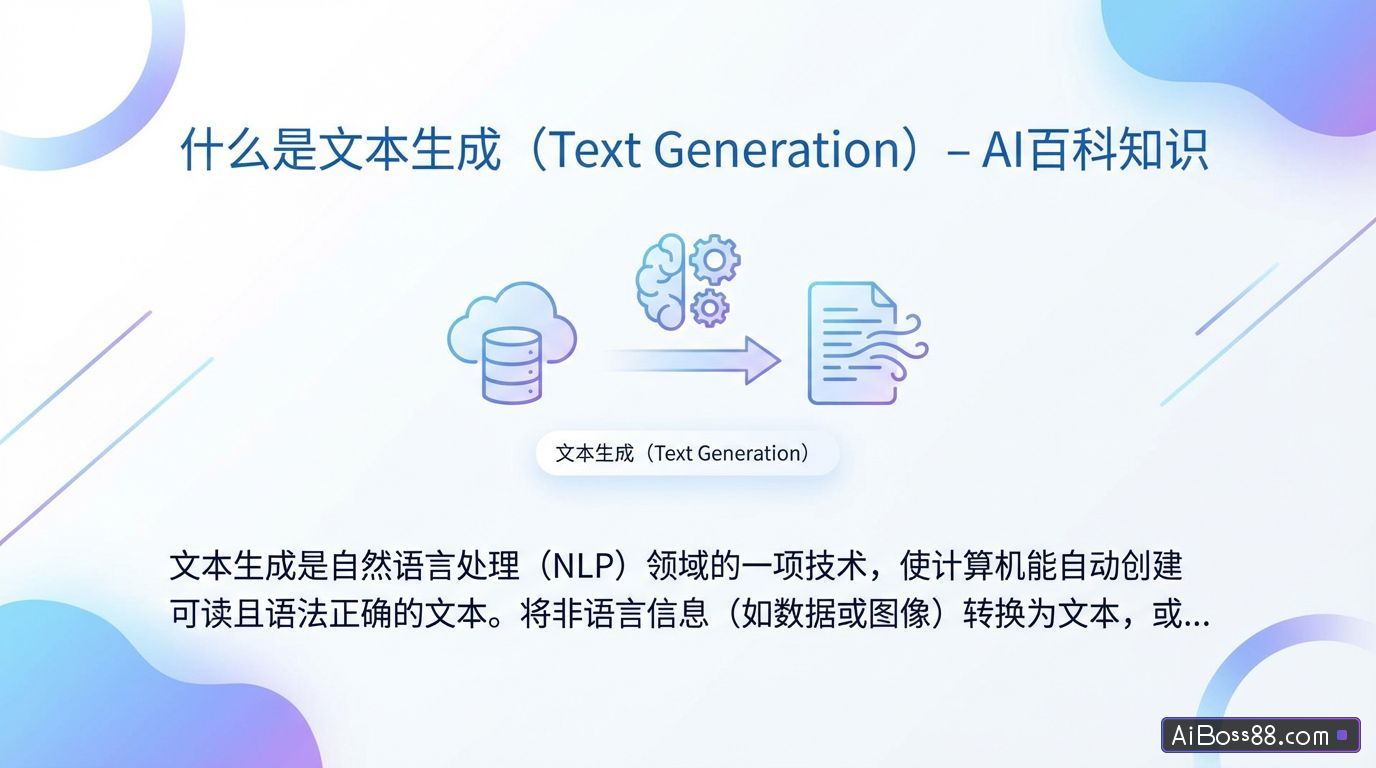
Text generation is a technique in the field of Natural Language Processing (NLP) that enables computers to automatically create readable and grammatically correct text. It involves converting non-linguistic information (such as data or images) into text, or...
Text generation is becomingNatural Language ProcessingA shining jewel in the field, text generation has endowed machines with creativity, enabling them to write news reports, craft stories, and even simulate human conversations. This has significantly improved the efficiency of content production, opening up new possibilities for personalized communication and creative expression. With continuous algorithm optimization and increasingly abundant data resources, text generation is gradually breaking through traditional boundaries, showcasing limitless possibilities. This article will take you on a journey through the mysteries of text generation, revealing how it transforms cold data into heartwarming words.
What is text generation?
Text generation isNatural Language ProcessingA technology in the field of NLP that enables computers toautomaticCreate readable and grammatically correct text. Convert non-linguistic information (such as data or images) into text, or generate new content based on existing text. Text generation has a wide range of applications, including...automaticNews reporting, chatbot response generation, and creative writing assistance, etc. Relying on...Machine LearningModels, such as loopsNeural Networks(RNN) and Transformer learn language patterns by learning from large amounts of text data, generating coherent and meaningful text.
How text generation works
Text generation works based onMachine LearningModels, especiallyNatural Language ProcessingLoops in NLPNeural NetworksRecurrent Neural Networks (RNNs), Long Short-Term Memory Networks (LSTMs), and Transformer models. These models analyze large amounts of text data to learn the statistical regularities and structures of language, thereby understanding how words, sentences, and entire documents are organized. During training, the model learns how to predict the next most likely word or character based on a given context, enabling it to generate coherent and grammatically correct text.
When generating text, the model typically starts with a seed text or a portion of the text and builds the output step by step. At each step, the model considers all the text generated so far and predicts the next word. The process is repeated until a complete sentence or document is generated. The diversity and creativity of the text can be controlled by tuning the model parameters and using different sampling techniques, thus generating text of various styles and themes.
Main applications of text generation
Text generation technology has wide applications in many fields, including:
- newsautomaticWriting:automaticGenerate news reports, especially those based on data and statistics, such as financial news and sports results.
- Customer ServiceIn chatbots and virtual assistants, text generation is used to provide a natural and human-like conversational experience to improve customer satisfaction.
- Content creation assistanceIt helps writers, bloggers, and content creators generate creative copy, story outlines, or article drafts.
- Social media management:automaticGenerate social media posts to help brands and individuals maintain an active online social presence.
- Technical documents and reportsGenerate product manuals, user guides, or financial reports, saving time on writing standard documents.
- Education and trainingCreate personalized learning materials and mock tests to suit the learning needs of different students.
- Game developmentGenerate storylines, character dialogues, and environmental descriptions in video games to provide a richer gaming experience.
- Market AnalysisGenerate market trend reports and consumer behavior analysis to help businesses make smarter decisions.
- Legal documents:automaticIt generates contracts, legal documents, etc., improving the efficiency of the legal industry.
- virtual charactersGenerate realistic dialogues and storylines in simulation and role-playing applications to enhance user interaction.
Challenges of text generation
While text generation technology has shown great potential in many fields, it also faces some challenges:
- Quality control:automaticThe generated text may contain grammatical errors, logical inconsistencies, or inaccurate information, requiring an effective quality control mechanism.
- Creativity and diversityGenerating highly creative and diverse text is a challenge becauseMachine LearningModels tend to mimic patterns in the training data.
- contextual understandingThe model may struggle to understand complex contexts or subtle linguistic nuances, resulting in generated text that lacks depth or relevance.
- Avoid bias and inappropriate contentBias in the training data may be reproduced in the generated text, including stereotypes about gender, race, or culture, and measures need to be taken to reduce this risk.
- Copyright and ethical issues:automaticThe generated content may involve copyright issues, especially when it is similar to existing works. Furthermore, ethical issues are also important, such as how to ensure that the generated content does not mislead or harm users.
- Accurate capture of user intentIn some applications, such as chatbots, accurately understanding and responding to user intent is a challenge.
- Data privacy and securityText generation systems typically require access to large amounts of data, which can raise concerns about data privacy and security.
- Explainability and transparencyFor complex generative models, the decision-making process is often a "black box," which is difficult to explain and understand, and this can be a problem in some applications.
- Resource consumptionTraining high-performance text generation models requires significant computational resources and time, which may limit their application in resource-constrained environments.
- Technology acceptanceUsers and the industryautomaticThe acceptance of generated content is also a challenge that needs to be overcome by improving the quality of generated content and social awareness.
The Development Prospects of Text Generation
The prospects for text generation look very promising, with...Machine LearningandartificialintelligentWith continued progress in the field, more precise and accurate [technology/technology] is expected to emerge in the future.High efficiencyAnd innovative text generation models. Text generation technology will be able to better understand and generate complex language structures, providing more personalized and diverse content. With increasing emphasis on ethical and bias issues, future text generation systems will also focus more on fairness and transparency, ensuring content quality while avoiding the generation of inappropriate content. With increasingly abundant computing resources and optimized algorithms, the application scope of text generation technology will become even wider, from...automaticText generation can be seen in everything from content creation to decision support.