What is Word Embedding? - AI Encyclopedia
Word embedding is a technique used in Natural Language Processing (NLP) to represent text data. It maps words or phrases to a fixed-dimensional vector space, allowing semantically similar words to be represented in the same vector space...
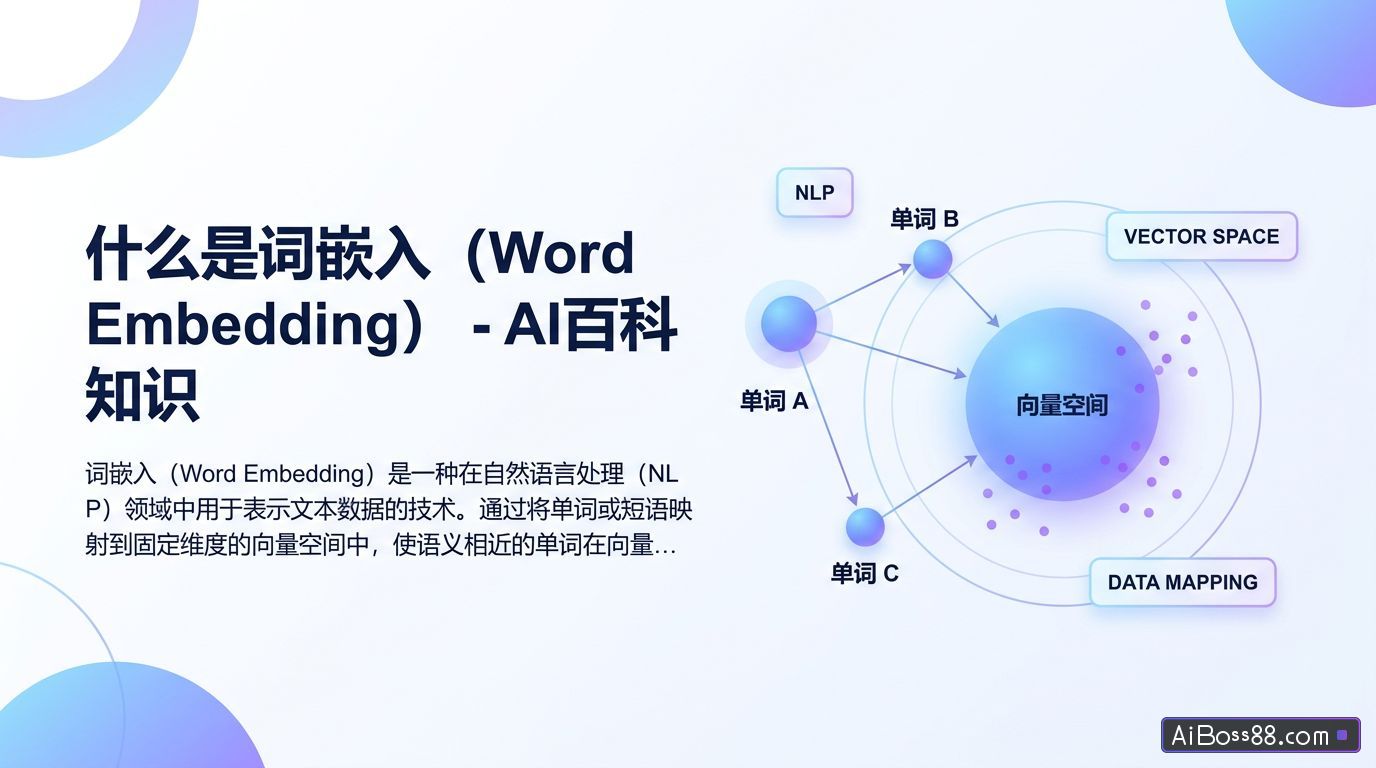
Word embedding is a type of...Natural Language Processing(NLP) technology maps words to a continuous vector space, allowing semantically similar words to be embedded in the same vector space. What is word embedding? AIThe words in encyclopedic knowledge are also located close together, thus capturing the semantic relationships between them. This technique can effectively represent words in text data as real-valued vectors, with each word or phrase mapped to a vector in the real-valued domain, facilitating computer processing and analysis. In short, word embedding is a way to map words in natural language to numerical values. Its roles in NLP include dimensionality reduction and representation learning, improving the performance of NLP tasks, and scalability.
What is word embedding?
Word embedding is a technique used in...Natural Language ProcessingIn the field of Natural Language Processing (NLP), this technique is used to represent text data. By mapping words or phrases to a fixed-dimensional vector space, words with similar meanings are placed close together in the vector space, thus capturing the semantic relationships between words.
How word embedding works
Word embedding is primarily based on converting words from discrete symbolic representations into continuous vector representations that capture the semantic and syntactic relationships between words.
Word2Vec, proposed by Google, includes two models: Skip-gram and CBOW. The Skip-gram model predicts the context given a head word, while the CBOW model predicts the word given its context. Both models utilize...Neural NetworksWe learn the vector representation of words so that semantically similar words are closer together in the vector space.
GloVe (Global Vectors for Word Representation) constructs word vectors by statistically analyzing word co-occurrence information, capturing more semantic information. GloVe's advantage lies in its ability to utilize global statistical information, not just local contextual information.
BERT is based on the Transformer architecture and uses a Mask task and a bidirectional encoder to achieve word embeddings, capturing rich contextual information. The BERT model can dynamically adjust word embeddings according to the context, generating more accurate word vector representations.
These methods, employing different techniques, share the common goal of mapping words into a continuous vector space, enabling computers to better understand and process natural language. In this way, word embedding techniques can improve the representation of text, capturing the essence of language and its rich semantic information.
Main applications of word embedding
Word embedding technology inNatural Language ProcessingIt has a wide range of applications in the field of NLP.
- Text classificationWord embedding technology maps text into a continuous vector space, providing better feature representations for text classification tasks. Through learned word vectors, the semantic information of the text can be accurately captured, resulting in better performance in text classification tasks.
- Sentiment AnalysisWord embedding is the process of determining the sentiment (positive, negative, or neutral) expressed in text (such as product reviews, social media posts, etc.). Word embedding techniques help models capture the sentiment in text by mapping words to a vector space.
- Machine translationIn machine translation tasks, word embedding technology plays a crucial role. By mapping words from the source and target languages to the same vector space, cross-lingual representation learning can be improved, leading to more accurate translation results.
- Question and Answer SystemWord embedding technology improves the question-answering system's ability to understand questions and answers, enabling the system to respond to user questions more accurately. In complex question-answering tasks, word embeddings can help the model understand the context and relevance of the question.
- Text SummaryThe goal of text summarization is to generate a concise version of a text while retaining its key information. Word embedding techniques help models identify key sentences and topics, generating concise and accurate summaries. By calculating the similarity of word vectors, the most representative sentences in the text can be extracted.
- Semantic searchIn semantic search, word embedding technology helps search engines understand a user's query intent and return more relevant search results. By calculating the vector similarity between query terms and words in a document, the relevance of the document to the query can be assessed more accurately.
- Semantic disambiguationSemantic embedding is the process of determining the specific meaning of a word in different contexts. By calculating semantic similarity, word embedding technology can determine the contextual information of each word in a sentence, thus better understanding the meaning of words.
- recommendsystemWord embedding technology is also applied.recommendIn systems, especially when dealing with content-based...recommendBy treating items from a user's historical behavior (such as reading articles, listening to music, watching videos, etc.) as "vocabulary," word embedding models can be trained to capture the relationship between user preferences and item features.
Challenges of word embedding
- Extending to new languages requires new embedding matrices.For new languages, new embedding matrices are required, and parameter sharing is not allowed, meaning that the same type cannot be used across languages.
- Unable to be used to initialize state-of-the-art architecturesWith the rise of various state-of-the-art architectures that accept character sequences as input, if the model accepts character-based input, it cannot take advantage of the benefits of pre-training, forcing random initialization of embeddings.
- MultimodalChallenges of word embedding:along withMultimodalWith the increase in data (such as images, audio, and video), word embedding technology will need to be expanded.MultimodalData processing.
- The need for adaptive word embeddingAs the amount of data increases, word embedding technology will need to become more sophisticated.High efficiencyAnd flexible methods for processing large-scale data. Adaptive word embedding technology will become an important research direction, capable of adapting to different tasks and datasets.automaticAdjust the word embedding model to improve its performance.
- Explanation and visualization:along withartificialintelligentWith technological advancements, interpretability and visualization will become important research directions. Word embedding technology will require the development of new interpretability and visualization methods to better understand and interpret the representations and decisions of word embedding models.
- Ethical and privacy issues:along withartificialintelligentWith technological advancements, ethical and privacy issues will become a significant challenge. Word embedding technology requires the development of new ethical and privacy-preserving methods to protect user privacy and interests during the processing and analysis of natural language text.
- Cross-language word embeddingWith the advancement of globalization, cross-linguistic word embedding technology will become an important research direction. There is a need to develop new cross-linguistic word embedding methods to better understand and handle semantic relationships between different languages.
- Semantic disambiguation and context dependencyWord embedding techniques need to better handle word sense disambiguation and contextual dependencies. For example, the contextualized word embeddings generated by models such as ELMo and BERT directly integrate contextual information into the word representation, allowing the same word to have different embeddings depending on its context. This is crucial for solving polysemous words and improving the performance of word sense disambiguation (WSD) tasks.
The Development Prospect of Word Embedding
Word embedding technology asNatural Language ProcessingA major innovation in the field of NLP, withMultimodalWith the increase in data (such as images, audio, and video), word embedding technology will need to be expanded.MultimodalData processing, development of newMultimodalWord embedding methods enable better understanding and processing.MultimodalData. As the amount of data increases, word embedding technology will need to be more sophisticated.High efficiencyAnd flexible methods for processing large-scale data. Adaptive word embedding technology will become an important research direction, capable of adapting to different tasks and datasets.automaticAdjust the word embedding model to improve its performance. WithartificialintelligentWith technological advancements, interpretive visualization will become an important research direction. Word embedding technology will require the development of new interpretive visualization methods to better understand and interpret the representations and decisions of word embedding models. Ethical and privacy issues will be a significant challenge. Word embedding technology needs to develop new ethical and privacy-preserving methods to protect user privacy and interests during the processing and analysis of natural language text. With increasing globalization, cross-lingual word embedding technology will become an important research direction. New cross-lingual word embedding methods need to be developed to better understand and handle semantic relationships between different languages. These trends indicate that word embedding technology will continue to play a vital role in the field of NLP, constantly evolving and improving in new application scenarios and technological challenges.