What is Pre-training? Definition, Importance, Techniques, and Challenges - AI Encyclopedia
Pre-training is a cornerstone of modern machine learning models. In this article, we will explore the conceptual definition of pre-training, its importance in artificial intelligence, the various techniques used to implement pre-training, and the work of researchers in this field...
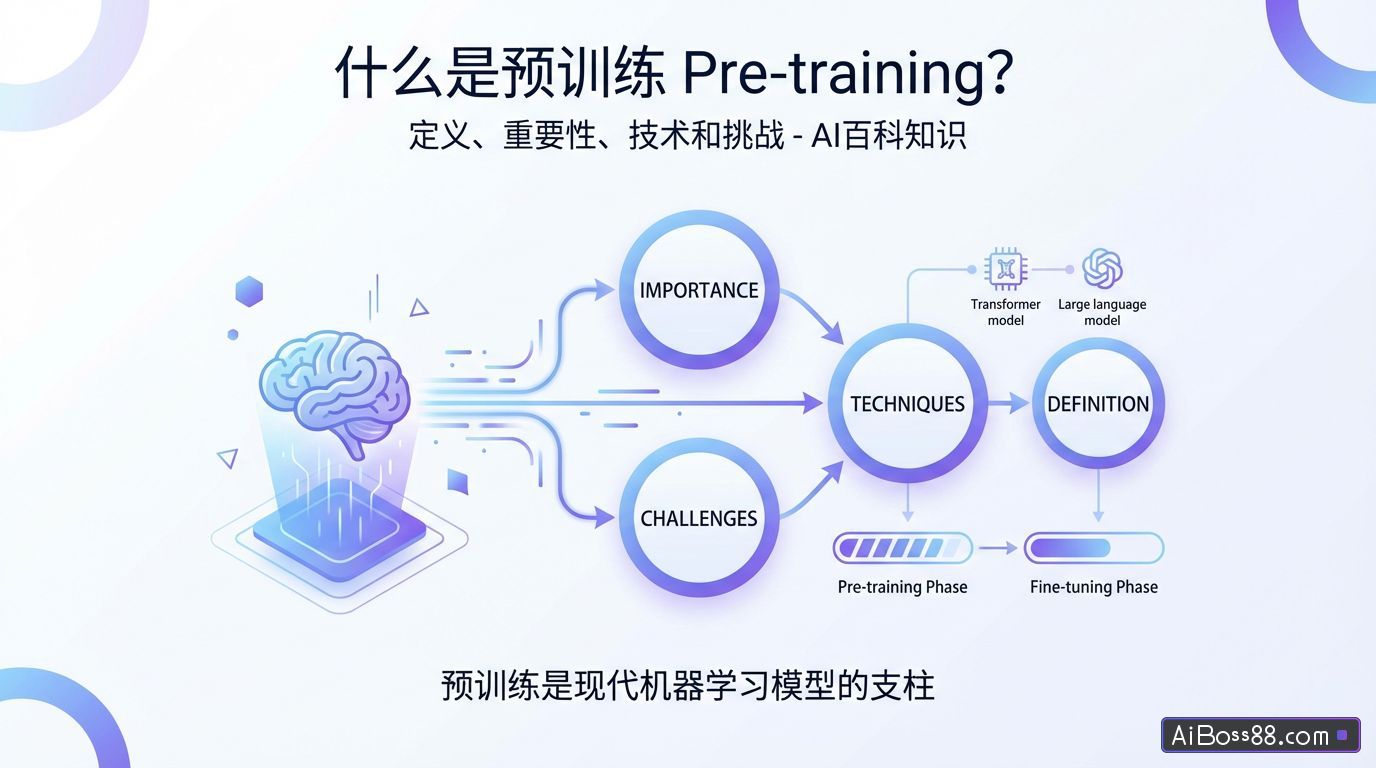
along withartificialintelligent(AI) is constantly reshaping our world, and a key aspect of its development has become modernMachine LearningThe backbone of the model: pre-training. In this article, we will explore the concept of pre-training, which...artificialintelligentThe importance of pre-training, the various techniques used to achieve it, and some of the challenges faced by researchers in this field.
What is pre-training?
existartificialintelligentandMachine LearningIn the field of [the study of model training], pre-training refers to the process of training a model on a large dataset before fine-tuning it on a smaller, task-specific dataset. This initial training phase allows the model to learn general features and representations from the data, which can then be fine-tuned for a specific task.
The primary motivation behind pre-training is to leverage knowledge gained from large-scale datasets to improve model performance on smaller, more concentrated datasets. In this way, researchers can achieve better results with fewer labeled instances, reducing the need for large amounts of task-specific, labeled data.
The importance of pre-training
Pre-training has become a modernartificialintelligentThere are several reasons why it is an important component:
- Transfer learning: Pre-training enables knowledge to be transferred from one domain or task to another. By learning general features and representations from large datasets, models can be fine-tuned to perform well on a wide range of tasks. This reduces the need for task-specific training data, allowing researchers to more easily tackle new problems.
- Computational efficiency: Pre-training allows models to learn from large amounts of data without requiring task-specific, labeled examples. This can significantly reduce the computational resources required for training, making it more feasible to train large-scale models.
- Model performance: Pre-trained models often outperform models trained from scratch on specific tasks. General features and representations learned during pre-training can be fine-tuned for a wide range of tasks, thereby improving performance and accelerating convergence.
Pre-training techniques
Several technologies are availableartificialintelligentModel pre-training, with unsupervised and supervised pre-training being the most common methods.
Unsupervised pre-training
Unsupervised pre-training involves training a model on a large dataset of unlabeled examples. The model learns to recognize patterns and structures in the data without any label guidance. Some popular unsupervised pre-training techniques include:
- automaticEncoders (Autoencoders, AE): automaticAn encoder is a tool that learns to encode and decode data.Neural NetworksThey are trained to reconstruct their input by minimizing the difference between the original input and the reconstructed output. This is achieved by learning a compressed representation of the data.automaticThe encoder can capture important features and patterns that are useful for subsequent tasks.
- Generative models: Generative models, such as mutation models...automaticGenerative Adversarial Networks (VAEs) and Generative Adversarial Networks (GANs) learn to generate new data samples similar to the training data. By learning the underlying data distribution, these models can learn useful features and representations that can be transferred to other tasks.
Supervised pre-training
Supervised pre-training involves training a model on a large, labeled dataset. This model learns to predict labels associated with the input data and can then be fine-tuned for a specific task. Some popular supervised pre-training techniques include:
- Language models: Language models are trained to predict the next word in a sequence, given the preceding words. By learning to generate coherent text, these models capture important linguistic features and representations that can be transferred to other languages.Natural Language ProcessingIn the task. Examples of pre-trained language models include Open.AILaunchedGPTAnd Google's BERT.
- Image classification models: Image classification models are trained to predict the category of an input image. Pre-trained image classification models, such as ResNet and VGG, can be fine-tuned to perform well on a wide range of computer vision tasks, including object detection and classification.
Challenges of pre-training
- Scalability: WithartificialintelligentAs models become increasingly larger and more complex, the computational resources required for pre-training also increase. Developing more efficient pre-training techniques and utilizing distributed computing resources will be key to driving progress in this field.
- Data bias: Pre-trained models are easily affected by biases present in the training data. Addressing data bias and developing methods to ensure the fairness and robustness of pre-trained models is an ongoing area of research.
- Interpretability: As models become increasingly complex, understanding their inner workings and the representations they learn becomes increasingly challenging. Developing better methods for understanding and interpreting pre-trained models is crucial for building trust and ensuring...artificialintelligentSystem security is of paramount importance.