What is Semantic Role Labeling (SRL)? - AI Encyclopedia
Semantic role labeling (SRL) is a technique in natural language processing that aims to identify arguments of predicates in a sentence and assign appropriate semantic role labels. It helps to reveal the relationships between sentence components...
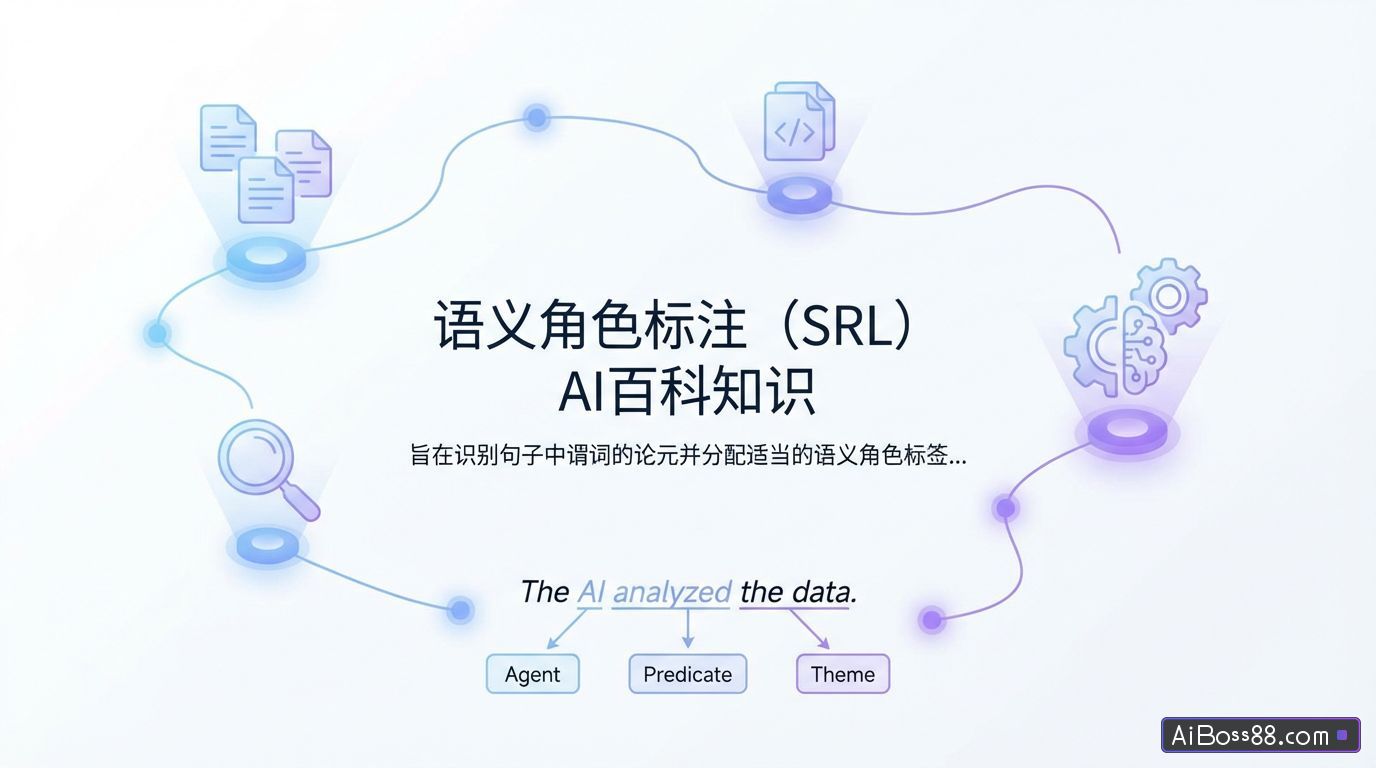
In explorationNatural Language ProcessingIn both depth and breadth, semantic role labeling (SRL) plays a crucial role. It reveals the rich semantic connections between sentence components and also provides a basis for constructing...intelligentThe system provides robust technical support. WithartificialintelligentoffastWith advancements, semantic role annotation is gradually becoming a key technology for understanding language, extracting information, and constructing knowledge graphs. This article will delve into the core technologies, application areas, challenges, and future development trends of semantic role annotation.
What is semantic role labeling?
Semantic Role Labeling (SRL) isNatural Language ProcessingThis technology, within the field, aims to identify arguments of predicates in sentences and assign appropriate semantic role labels. It helps reveal semantic relationships between sentence components, such as distinguishing agent, patient, time, and place. SRL plays a crucial role in various applications, including information extraction, question-answering systems, and machine translation, and is a key step in understanding the deeper meaning of sentences.
How Semantic Role Labeling Works
Semantic Role Labeling (SRL) analyzes sentence structure, identifies predicates and their associated arguments, and assigns semantic role labels to these arguments. It reveals the semantic relationships between sentence components and distinguishes different roles such as agent, patient, time, and place. Key steps in SRL include predicate identification, argument determination, and assigning appropriate semantic roles to each argument.
In the implementation of semantic role labeling, traditional methods can be adopted.Machine LearningorDeep learningMethods. Traditional methods handle annotation tasks using manually designed features and classifiers.Deep learningThe technology learns the internal representation of sentences,automaticCapture complex semantic relationships and long-distance dependencies to improve the performance of semantic role labeling. This enables semantic role labeling to play a crucial role in multiple fields such as information extraction, question answering systems, and machine translation.
Main applications of semantic role labeling
Semantic role labeling inNatural Language ProcessingThis field has a variety of applications, mainly including:
- Information ExtractionSemantic role labeling helps the system extract structured information from large amounts of text by identifying events and participants in the text.
- Question and Answer SystemSemantic role labeling can understand the intent and keywords in user questions and provide more accurate answers.
- Machine translationIn the translation process, semantic role labeling helps to correctly understand the semantic structure of source language sentences and generate more fluent target language text.
- Text Summary:existautomaticWhen generating text summaries, semantic role labeling helps identify key sentences and arguments while preserving the main semantic content of the original text.
- Sentiment AnalysisSemantic role labeling helps identify and understand emotional expressions in text, and can identify entities and arguments associated with emotional words.
- Knowledge Graph ConstructionSemantic role labeling can identify the relationships between entities and events, which is crucial for building and enriching knowledge graphs.
- Semantic searchSemantic role labeling can improve the relevance and accuracy of search engines by understanding the semantic structure of queries.
- Natural Language UnderstandingSemantic role labeling is one of the key technologies for improving machine understanding of the deeper meaning of natural language, and it helps to build more...intelligentThe interactive system.
- Education and Language LearningSemantic role labeling technology can assist language learning software and help learners understand sentence structure and usage.
- Legal and medical document analysisIn professional fields, semantic role labeling helps extract key information from complex documents and supports the decision-making process.
Challenges of Semantic Role Labeling
Semantic role labeling inNatural Language ProcessingWhile this field has wide applications, it also faces a series of challenges:
- Diversity and ambiguityThe diversity and ambiguity of natural language mean that the same sentence may be interpreted in multiple ways, which increases the difficulty of correctly labeling semantic roles.
- Cross-language and cross-domain issuesTexts in different languages and from different fields (such as law and medicine) have unique expressions and terminology, which poses additional challenges to SRL systems.
- Long-distance dependencyIn long sentences, there may be a large distance between the predicate and its arguments, which makes relation identification complicated.
- Limited labeled dataHigh-quality labeled data is key to training effective SRL models, but obtaining this data is both time-consuming and expensive.
- Predicate polysemyA word may have different meanings in different contexts, which requires the SRL system to accurately determine and process word meanings.
- Argument omission and impliedIn some cases, arguments in a sentence may be omitted or implied, increasing the difficulty of identification and annotation.
- Complex sentence structurePassive sentences, negative sentences, and complex clauses increase the complexity of SRL.
- Computing resource limitations:Deep learningWhile methods perform well in SRL, they typically require significant computational resources.
- Real-time processing requirementsIn certain application scenarios, such as question-answering systems or dialogue systems, SRL systems are required to be able to...fastReal-time processing and response.
- Model generalization abilitySRL models often perform well on specific datasets, but may encounter generalization problems on new or different datasets.
The Development Prospect of Semantic Role Labeling
Semantic role labeling has broad development prospects, withDeep learningWith continuous technological advancements, semantic role labeling models will see significant improvements in their ability to handle complex linguistic phenomena and long-range dependencies. In the future, semantic role labeling is expected to achieve better generalization capabilities in multilingual and cross-domain applications. Furthermore, with increasingly abundant computing resources and optimized algorithms, real-time and large-scale semantic role labeling processing will become possible. Combined with knowledge graphs and commonsense reasoning, semantic role labeling will play a greater role in enhancing machines' deep understanding of natural language, driving further advancements in this field.Natural Language ProcessingTechnology towards moreintelligentTo develop in a more precise direction.