What is Inverse Reinforcement Learning (IRL)? - AI Encyclopedia
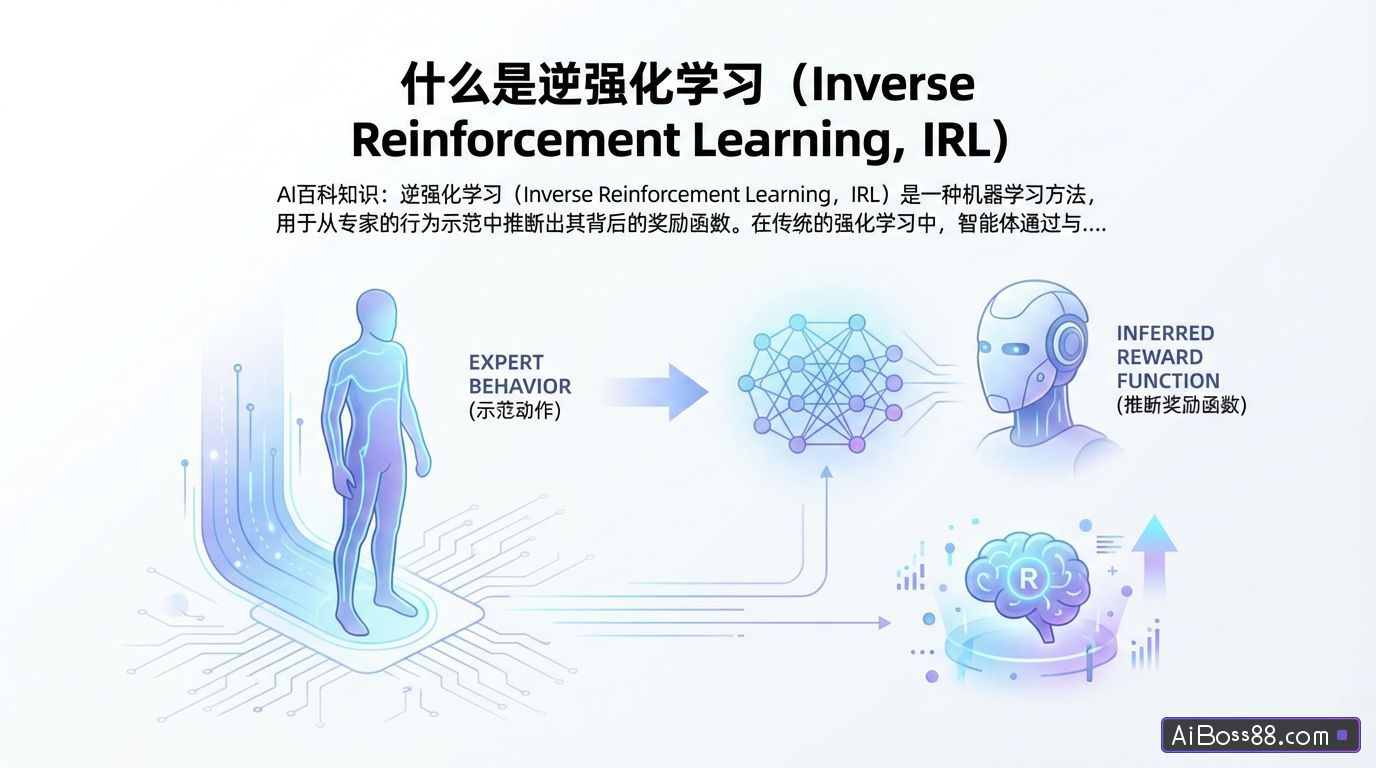
Inverse reinforcement learning (IRL) is a machine learning method used to infer the underlying reward function from expert behavioral demonstrations. In traditional reinforcement learning, the agent interacts with...
Inverse Reinforcement Learning (IRL) has a promising future. With continuous algorithm optimization and improved computing power, it is poised for further development.automaticDriving, robots, gamesAIApplications in fields such as [specific areas] will become more widespread. In the future, inverse reinforcement learning is expected to address the limitations of expert demonstration data and improve the accuracy of reward function inference. Combined with [other technologies/methods]...Deep learningBayesian methods andMultimodalData, inverse reinforcement learning can handle more complex tasks and enhance...intelligentbodyIts generalization ability and decision-making efficiency. With further research, inverse reinforcement learning will...intelligentIt plays a more crucial role in the design and development of the system.
What is inverse reinforcement learning?
Inverse Reinforcement Learning (IRL) is a type of...Machine LearningThis method is used to infer the underlying reward function from expert behavioral demonstrations. In traditional reinforcement learning,intelligentbodyInverse reinforcement learning, on the other hand, learns how to maximize cumulative reward through interaction with the environment, and the reward function is usually predefined. Instead, it derives the reward function by observing expert behavior and uses this function for training.intelligentbodyThis allows it to behave similarly to experts. Inverse reinforcement learning has important applications in fields such as imitation learning and robot learning, especially when it is difficult to design a clear reward function.
How inverse reinforcement learning works
Inverse Reinforcement Learning (IRL) works by first observing and analyzing the behavior of experts in a specific task. By collecting sequences of actions taken by experts in different states, IRL algorithms attempt to infer the reward function behind these actions. It is assumed that the expert's behavior aims to maximize some cumulative reward, but this reward function is unknown. The goal of IRL is to deduce the possible reward function from these observed behaviors.
Once the reward function is deduced, the next step in the inverse reinforcement learning algorithm is to use this function to train a reinforcement learning algorithm.intelligentbodyAt this stage,intelligentbodyUsing standard reinforcement learning methods, such as Q-learning or policy gradient, an optimal policy is learned through interaction with the environment. This policy aims to maximize the reward function derived from the inverse reinforcement learning stage. In this way,intelligentbodyIt can learn to imitate the behavior of experts, and even surpass their performance in some cases.
Main applications of inverse reinforcement learning
Inverse reinforcement learning has wide applications in many fields, including:
- automaticdrive:existautomaticIn driving systems, inverse reinforcement learning can learn from the decisions of human drivers to infer safe and effective driving strategies, guiding...automaticMake decisions while driving in complex traffic environments.
- RoboticsInverse reinforcement learning can help robots learn to perform complex tasks, such as carrying, cleaning, or navigating, by observing human behavior, without explicitly programming each action.
- gameIn video gamesAIInverse reinforcement learning can be used to learn strategies from player behavior, creating systems that can mimic or even surpass human players.AIopponent.
- Medical decision supportInverse reinforcement learning can be used to analyze doctors' decision-making processes, thereby learning models of clinical decision-making and assisting doctors in making more effective diagnostic and treatment plans.
- recommendsystemInverse reinforcement learning can be used to improve [user behavior] by learning user preferences and behaviors.recommendAlgorithms provide users with more personalized services.
- Simulation and trainingIn the military and aviation fields, inverse reinforcement learning can be used to create simulation environments that train new members by simulating the behavior of experts.
- social robotsInverse reinforcement learning can help social robots better understand the motivations behind human social behavior and behave more naturally when interacting with people.
- industryautomaticchangeIn manufacturing, inverse reinforcement learning can optimize production processes by learning from the behavior of expert operators.High efficiencyIncrease efficiency and reduce errors.
Challenges of Inverse Reinforcement Learning
While inverse reinforcement learning has shown great potential in many fields, it also faces some challenges and problems:
- The quality and quantity of expert demonstrationsInverse reinforcement learning relies on expert demonstration data to infer the reward function. If the demonstration data is limited or of poor quality, the learned reward function may be inaccurate, affecting performance.intelligentbodyThe learning effect.
- Ambiguity of reward functionDifferent reward functions can lead to similar behavioral policies, making it difficult to uniquely determine the reward function from behavioral data. This ambiguity problem limits the generalization ability of inverse reinforcement learning.
- Computational complexityEspecially in high-dimensional state or action spaces, the computational cost of inferring the reward function and learning the optimal policy can be very high.
- Demonstration of non-optimal strategiesIn the real world, expert strategies may not be globally optimal, but rather suboptimal solutions based on specific contexts. Inverse reinforcement learning needs to be able to handle such suboptimal scenarios and learn effective strategies.
- Unknowns in environmental modelsWithout an environment model, inverse reinforcement learning algorithms may struggle to accurately infer the reward function, especially when the environment is dynamic and complex.
- The balance between exploration and utilizationInverse reinforcement learning algorithms need to find a balance between exploring new strategies and utilizing known strategies to avoid getting trapped in local optima.
- Generalization abilityThe learned strategies need to be able to generalize to unseen states or environments, which is especially important in practical applications.
- Stability and convergence of the algorithmEnsuring that inverse reinforcement learning algorithms can stably converge to a reasonable policy and reward function is a major challenge, especially when dealing with complex and nonlinear problems.
- Feasibility of practical applicationWhen applying inverse reinforcement learning algorithms to real-world problems, it is necessary to consider the algorithm's scalability, real-time performance, and robustness to noisy data.
- Ethical and security issuesIn some applications, such asautomaticDriving requires that the learned strategies comply with ethical standards and safety requirements, which increases the complexity of designing inverse reinforcement learning algorithms.
The Development Prospects of Inverse Reinforcement Learning
The future of inverse reinforcement learning is promising. With continuous algorithm optimization and improved computing power, its application in...automaticDriving, robots, gamesAIApplications in fields such as [specific areas] will become more widespread. In the future, inverse reinforcement learning is expected to address the limitations of expert demonstration data and improve the accuracy of reward function inference. Combined with [other technologies/methods]...Deep learningBayesian methods andMultimodalData, inverse reinforcement learning can handle more complex tasks and enhance...intelligentbodyIts generalization ability and decision-making efficiency. With further research, inverse reinforcement learning will...intelligentIt plays a more crucial role in the design and development of the system.