What are Discriminative Models? - AI Encyclopedia
Discriminative models are a class of algorithms in machine learning used for prediction and classification. They directly learn the mapping relationship between input data (features) and output labels (categories). This is achieved by discriminating boundary regions...
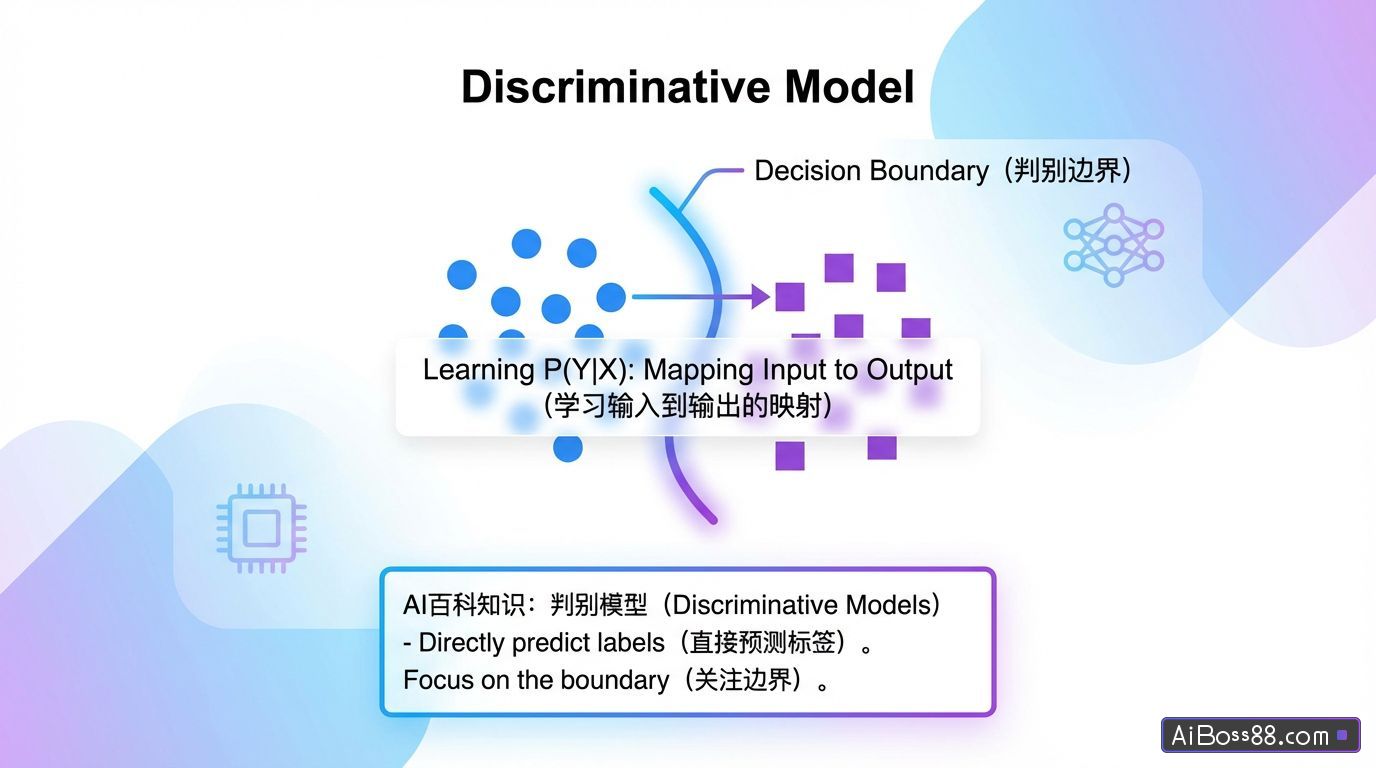
Discriminative models areMachine LearningOne of the core algorithms in the field for prediction and classification tasks. By learning the direct mapping between input features and output labels, it constructs a decision boundary that can accurately distinguish different categories. With the advent of the big data era and the improvement of computing power, discriminative models are increasingly used in image recognition,Natural Language ProcessingDiscriminant models have demonstrated enormous potential and value in various fields, including medical diagnostics. This article will delve into the working principles, main applications, and challenges of discriminant models, and look ahead to their future technological development prospects.
What is a discriminant model?
Discriminative models areMachine LearningIn physics, a class of algorithms used for prediction and classification, directly learns the mapping relationship between input data (features) and output labels (categories). They distinguish different categories by discriminant boundaries, focusing on the differentiation of data points, and are commonly found in logistic regression, support vector machines, and...Neural NetworksDiscriminative models are typically used in supervised learning, and their...High efficiencyIt exhibits excellent performance in classification tasks in terms of both accuracy and performance.
Working principle of discriminant model
The core principle of discriminative models is to learn the direct mapping between input features and output labels. By analyzing patterns in the training dataset, a decision boundary is constructed so that, given new input features, the corresponding label can be predicted. These models focus on maximizing classification accuracy and typically use probabilistic estimation to evaluate the strength of the association between input features and specific labels.
In practical applications, discriminative models form predictive models based on statistical patterns in the training dataset. When new data points are input, the model calculates the probability of them belonging to each category and selects the category with the highest probability as the prediction result. This method makes discriminative models very effective in handling classification and regression problems, especially when dealing with large amounts of data.fastAnd accurate predictions.
Main applications of discriminative models
Discriminant models have wide applications in many fields, including:
- Image recognition and classificationUsed to identify and classify objects in images, such as facial recognition and handwritten digit recognition.
- Text classification:automaticText documents can be categorized into predefined categories, such as spam detection and sentiment analysis.
- Medical diagnosis: Analyze patients' symptoms and examination results to assist doctors in diagnosing diseases.
- Credit assessmentIt predicts the default risk of loan applicants and helps financial institutions make credit decisions.
- Speech recognitionConverting speech signals into text information for use in...intelligentassistant andautomaticSubtitle generation.
- recommendsystemAnalyze user behavior and preferences.recommendRelated products or services.
- Anomaly detectionIt identifies unusual or abnormal patterns in data and can be used in fields such as credit card fraud detection and cybersecurity.
Challenges of Discriminative Models
While discriminative models perform well in practical applications, they also face some challenges:
- Data imbalance problemWhen there are far more data samples in some categories than in others, the discrimination model may be biased towards the majority class, resulting in a decrease in the ability to identify the minority class.
- Feature selectionThe performance of a discriminant model largely depends on the quality of its input features. Selecting appropriate features and eliminating irrelevant or redundant features is a challenge.
- Overfitting riskEspecially when the number of features exceeds the number of samples, the discriminative model may overfit the training data, resulting in poor performance on new data.
- Nonlinear problemsFor complex nonlinear relationships, linear discriminant models may not be able to effectively capture the true structure of the data, and more complex models are needed to improve prediction accuracy.
- Generalization abilityDiscriminative models are typically focused on optimizing specific tasks and may lack generalization ability on new or different datasets.
- Computational complexityFor large-scale datasets, especially those with high feature dimensions, the training and prediction process of discriminative models can become computationally intensive and time-consuming.
- Data dependencyThe performance of a discriminant model is limited by the quality and representativeness of the training data. If the training data is biased, the model's prediction results will also be affected.
- Explanatory issuesCompared to some generative models, discriminative models often lack intuitive interpretability, making it difficult to understand the specific reasons why the model makes decisions.
The Development Prospect of Discriminant Models
Discriminative models have broad development prospects, and withMachine LearningThe continuous advancement of technology, especiallyDeep learningBreakthroughs in the field have led to more accurate and precise discrimination models.High efficiencyThe development of discriminative models is moving in this direction. In the future, discriminative models may enhance their generalization ability and adaptability through techniques such as ensemble learning and transfer learning. With increased computing resources and optimized algorithms, their performance in handling large-scale datasets and complex problems will be even better. Researchers are also working to improve the interpretability of discriminative models, enabling them not only to provide accurate predictions but also to offer intuitive understanding for decision-making. This will facilitate the application of these models in more key areas, such as medical diagnosis and financial risk assessment.