What is Interactive Machine Learning (IML)? - AI Encyclopedia
Interactive Machine Learning (IML) is an active learning paradigm that involves human users in the learning cycle. In IML, users provide labels, demonstrations, corrections, and other inputs...
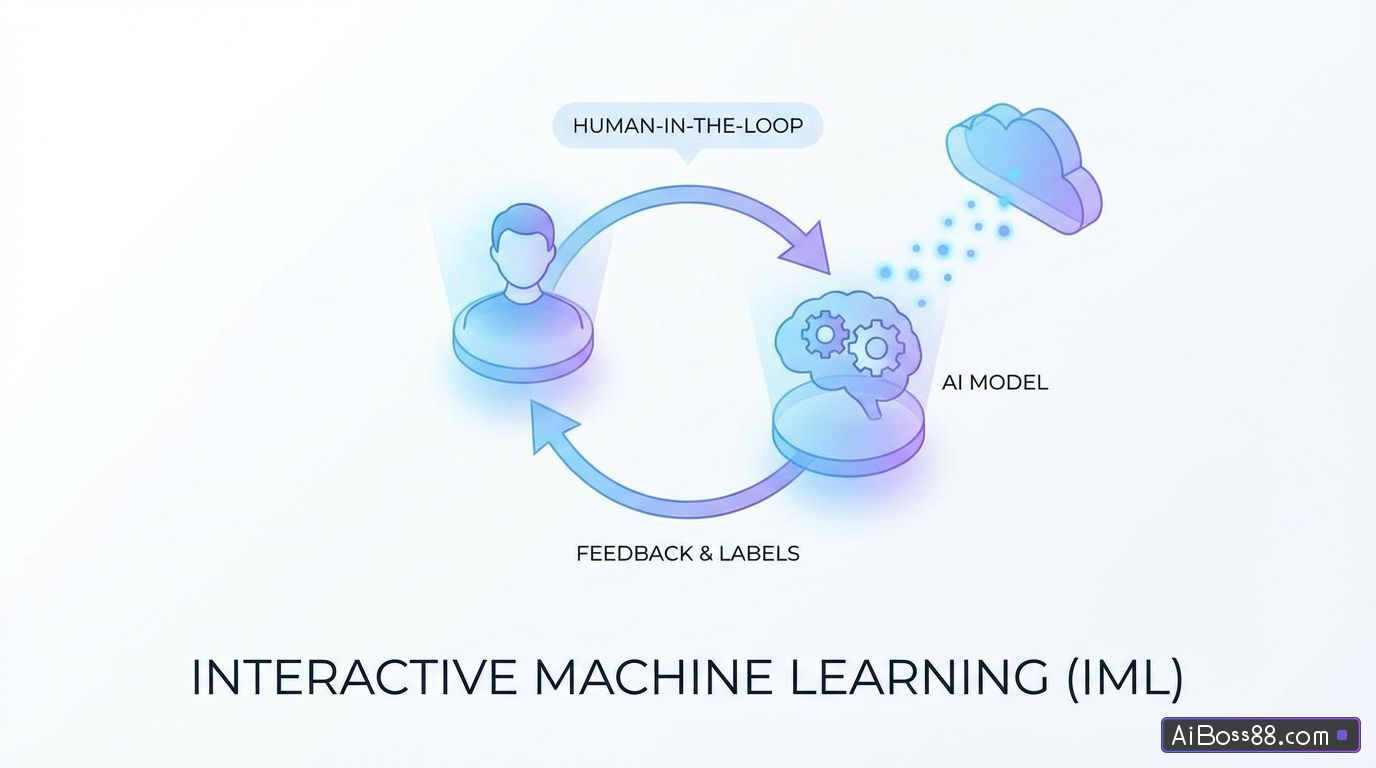
In today's data-driven world,Machine LearningIt has become a key force driving technological innovation. However, traditionalMachine LearningModels are often viewed as "black boxes," lacking direct interaction with human intuition and experience. Interactive...Machine LearningInteractive Machine Learning (IML) emerged to meet this need, directly incorporating users into the learning loop and enabling models to respond to human feedback in real time, thus ushering in a new era of human-machine collaboration. This learning approach not only improves algorithm efficiency but also makes the model's decision-making process more transparent and reliable, providing new ideas for solving complex problems.
What is interactive?Machine Learning
InteractiveMachine LearningInteractive Machine Learning (IML) is an active learning paradigm that incorporates human users into the learning cycle. In interactive...Machine LearningIn this interactive learning system, users interact with the learning algorithm by providing inputs such as tags, demos, corrections, rankings, or evaluations, while observing the algorithm's output and potentially providing feedback, predictions, or demonstrations.Machine LearningEmphasizing human-computer interaction and utilizing user input to optimize and improve...Machine LearningImprove model performance, enhance model transparency and trustworthiness.
InteractiveMachine LearningWorking principle
InteractiveMachine LearningThe working principle is to directly involve users in the learning process, enabling the learning algorithm to respond to and adapt to user behavior and feedback in real time. In this process, users not only provide data but also participate in the model's training and evaluation, interacting with the algorithm iteratively. For example, users can correct the algorithm's predictions or provide real-time guidance and feedback during model learning, allowing the model to more accurately capture user needs and preferences.
The advantage of this learning method lies in its ability to significantly improve learning efficiency and model accuracy. Because users participate in the learning process, the algorithm can learn the user's actual needs more quickly, reduce interference from useless data, and still build high-performance models even under resource constraints, such as limited data volume or computational power. InteractiveMachine LearningIt can also improve the interpretability of the model, because users can directly observe and understand the model's decision-making process, thereby increasing their trust in the model.
InteractiveMachine LearningMain applications
InteractiveMachine LearningThe main application areas include:
- Health and Medical CareIn medical diagnosis, interactive...Machine LearningIt can help doctors improve diagnostic accuracy by interactively adjusting and training models, for example, by analyzing medical images.
- recommendsystemInteractive content on e-commerce or content platformsMachine LearningIt can adjust based on users' real-time feedback and preferences.recommendAlgorithms provide more personalized services.
- Game developmentGame designers can base their work on interactive elements.Machine LearningTo optimize the gameAIThe behavior is trained more effectively through player interaction.intelligentThe game character.
- Robot LearningIn robot interaction, interactive...Machine LearningThis enables robots to learn new tasks through interaction with humans, improving their adaptability and flexibility in complex environments.
- Data labelingInteractiveMachine LearningIt can assist in the processHigh efficiencyThe data annotation work improves annotation quality and reduces labor costs through user participation.
- Educational TechnologyIn the field of education, interactive...Machine LearningIt can provide customized teaching content and exercises based on students' learning progress and comprehension level.
- User interface designInteractiveMachine LearningIt can help design more intuitive and user-friendly interfaces, and optimize the design through user interaction data.
- security systemIn the field of cybersecurity, interactiveMachine LearningIt can be used to detect abnormal behavior and improve the accuracy of threat detection by analyzing user feedback.
- Speech recognitionIn speech recognition systems, interactiveMachine LearningThe speech-to-text conversion quality can be learned and improved through user corrections.
- automaticdriveInteractiveMachine LearningIt can assistautomaticDriving systems make decisions in complex traffic environments and enhance system safety and reliability through interaction with the driver.
InteractiveMachine LearningChallenges
InteractiveMachine LearningWhile demonstrating great potential in many areas, it also faces some challenges:
- User engagement: Ensure users can participate effectively and continuouslyMachine LearningThe process is challenging, requiring the design of easy-to-use interfaces and experiences that motivate user engagement.
- Data quality and biasUser-input data may be biased or inaccurate, which may affect the model's learning and generalization abilities.
- Model transparency and interpretabilityTo gain user trust, iML systems need to provide transparency and interpretability in model decisions, which is especially important for complex models such as...Deep learningIt is especially difficult in the middle.
- The need for real-time interactioniML systems need to be able tofastResponding to user input and feedback places demands on the system's computing power and the algorithm's response speed.
- User privacy and data securityDuring the interaction process, user input may contain sensitive information, and how to protect user privacy and ensure data security is an important issue.
- Algorithm DesignDesigning algorithms that can fully utilize user input and learn effectively is a technical challenge, requiring consideration of the uncertainty and noise in user feedback.
- Evaluation and testingPerformance evaluation of iML systems is superior to traditional methods.Machine LearningIt is more complex because it involves the dynamics and subjectivity of human-computer interaction.
- interdisciplinary collaborationiML typically requires close collaboration among computer scientists, data scientists, psychologists, and domain experts, and building and managing an interdisciplinary team is a challenge.
- Resource constraintsIn resource-constrained environments, such as mobile devices or embedded systems, deploying an iML system requires consideration of limitations in computing resources and energy consumption.
- Cultural and linguistic differencesIn global applications, iML systems need to adapt to users from different cultural and linguistic backgrounds, which increases the complexity of the design.
InteractiveMachine LearningDevelopment prospects
InteractiveMachine LearningWith broad development prospects, it closely integrates human-computer interaction and algorithm optimization, and is expected to play a significant role in personalized...recommend,intelligentEducation, healthcareautomaticIt will play a greater role in fields such as driving. With technological advancements, interactive...Machine LearningThis will further enhance the user experience, increase the transparency and trustworthiness of the model, and address challenges such as data privacy and model interpretability, thus driving...Machine LearningTechnology towards moreintelligentIt is developing in a more humane direction.