What is Federated Learning? - AI Encyclopedia
Federated learning is a distributed machine learning technique that allows multiple participants to collaboratively train a model without sharing the original data. In this way, parties can protect data privacy and...
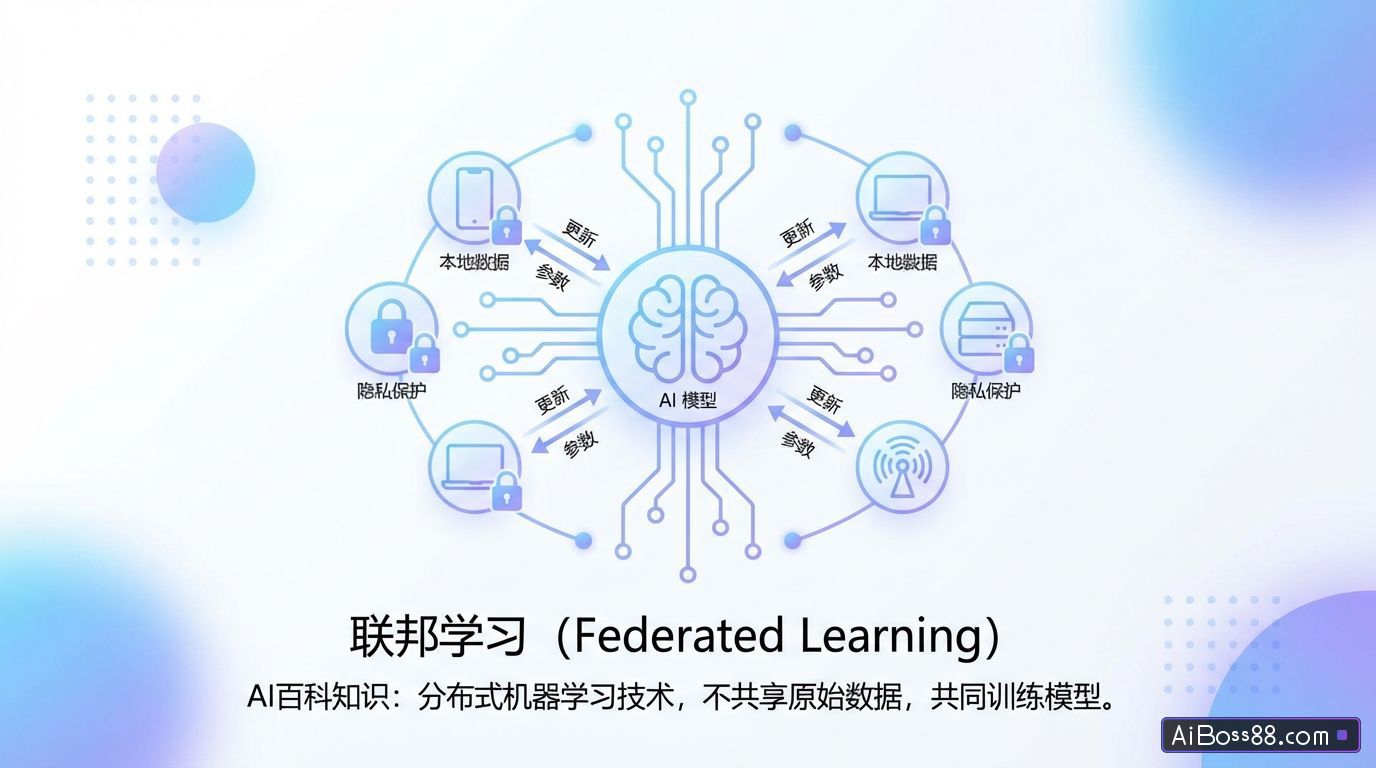
Federated learning trains models locally on the data and then sends model updates (such as gradients or model parameters) to a central server for aggregation, rather than directly transmitting the raw data. This approach protects data privacy while enabling the extraction of data value. This learning method solves the data silo problem, promotes cross-institutional and cross-industry data collaboration, and provides...artificialintelligentFederated learning has opened up new avenues for development. With continuous technological advancements and expanding application scenarios, federated learning is gradually becoming a driving force for advancement.intelligentA vital force in the technological revolution.
What is Federated Learning?
Federated learning is a distributed learning method.Machine LearningThis technology enables multiple stakeholders to collaboratively train models without sharing raw data. In this way, parties can work together to improve model performance while protecting data privacy and complying with data protection regulations. It is suitable for data silo scenarios, allowing enterprises to train models using distributed data sources while protecting user privacy.
How Federated Learning Works
The core working principle of federated learning is to achieve data privacy through a distributed collaborative mechanism.Machine LearningModel training. In this framework, individual participants (such as mobile devices, browsers, or distributed servers) train the model using local data and send model updates (such as gradients or model parameters) to a central server instead of sending the raw data. The central server then aggregates these model updates to improve the global model. This process iterates until the model reaches the desired performance metric.
Throughout the process, federated learning ensures data security and privacy through encryption techniques and privacy-preserving algorithms (such as differential privacy and homomorphic encryption), enabling data to be effectively utilized without leakage. This approach is particularly suitable for scenarios with stringent data privacy requirements, such as healthcare and financial services, allowing data to be processed locally and avoiding the privacy risks associated with centralized data storage and processing.
Main applications of federated learning
Federated learning has a wide range of applications; here are some key examples:
- Mobile device personalization:existintelligentOn smartphones and other mobile devices, federated learning can be used to train personalized applications and services, such as keyboard input prediction and personalization.recommendThe system does not require users' personal data to be uploaded to the cloud.
- healthcareIn the medical field, federated learning enables different medical institutions to jointly train models to improve the accuracy of disease diagnosis while protecting patients' privacy data from being leaked.
- Financial ServicesBanks and financial institutions can use federated learning to improve credit scoring models, fraud detection systems, and more, without having to share customers’ sensitive financial information.
- intelligentmanufactureIn an industrial environment, individual manufacturing sites can leverage federated learning to optimize production processes and improve efficiency.High efficiencyEfficiency and quality control, while protecting their respective production data.
- intelligentCityFederated learning can be used in areas such as traffic management and energy consumption optimization to improve city operations by analyzing data from different sources, while ensuring data security and compliance.
- Cross-company collaborationDifferent companies can collaborate on new products or services, such as joint market analysis and supply chain optimization, based on federated learning, while protecting their respective trade secrets.
- Privacy protection researchFederated learning provides an effective data analysis tool for research projects that require strict protection of participant privacy, such as sociological and psychological research.
- automaticdriving a carAutomakers can use federated learning to train...automaticThe driving system improves the safety and reliability of the system by collecting data from multiple vehicles, while ensuring data privacy.
Challenges of Federated Learning
Federated learning as an emerging fieldMachine LearningWhile paradigms have shown great potential in data privacy protection and distributed collaboration, they also face some challenges:
- Communication efficiencyFederated learning involves frequent model parameter exchanges, which can lead to high communication costs, especially when there are many participants or unstable network connections.
- Data heterogeneityThe data used in federated learning may have significant differences in statistical properties, which may lead to biases in the model training process and affect the model's generalization ability.
- Privacy protectionAlthough federated learning aims to protect data privacy, designing more secure privacy protection mechanisms, such as differential privacy and homomorphic encryption, remains a challenge.
- Security of models and algorithmsModels in federated learning may face adversarial attacks, and it is necessary to study how to improve the robustness of the models.
- Fairness and incentive mechanismsEnsuring that all participants benefit fairly from federated learning, and incentivizing them to contribute data and computing resources, are issues that need to be considered when implementing federated learning.
- Model convergence and stabilityIn a distributed environment, how to ensure the modelfastIt converges stably, especially when the computing capabilities of the participants vary.
- Regulation and complianceWith increasingly stringent data protection regulations, how to conduct effective federated learning while complying with various laws and regulations is a problem that needs to be solved.
- Technical implementation and standardizationFederated learning lacks unified technical standards and implementation frameworks, which poses certain difficulties for researchers and practitioners.
- Resource ManagementIn federated learning, how...High efficiencyManaging and scheduling computing resources, especially on resource-constrained devices, is a technical problem that needs to be solved.
- User engagement and acceptanceUsers may have reservations about how data is used and privacy protection measures are implemented in federated learning. Improving user trust and participation is key to promoting federated learning.
The Development Prospects of Federated Learning
Federated learning, as a cutting-edge distributed learning approach...Machine LearningFederated learning technology has broad development prospects. With the strengthening of data privacy protection regulations, the improvement of computing power, and the advancement of communication technologies, federated learning is expected to be widely applied in many fields, especially in mobile devices, healthcare, finance, and industrial manufacturing. It will promote the collaborative use of data and improve…Machine LearningThe model's performance is improved while protecting user privacy and data security. In the future, federated learning may become a key technology for building...intelligentService and promotionartificialintelligentFederated learning is a key technology for development, but it also faces challenges such as technology optimization, privacy protection, and regulatory compliance. With further research and practical experience, federated learning is expected to achieve standardization and scalability, providing a more secure and robust solution for data-driven decision-making.High efficiencyThe solution.