What is Swarm Intelligence? - AI Encyclopedia
Swarm intelligence is a distributed intelligent algorithm that simulates the collective behavior of biological groups in nature. By mimicking the collective behavior of social organisms such as ants and bees, it utilizes simple local interactions between individuals to generate...
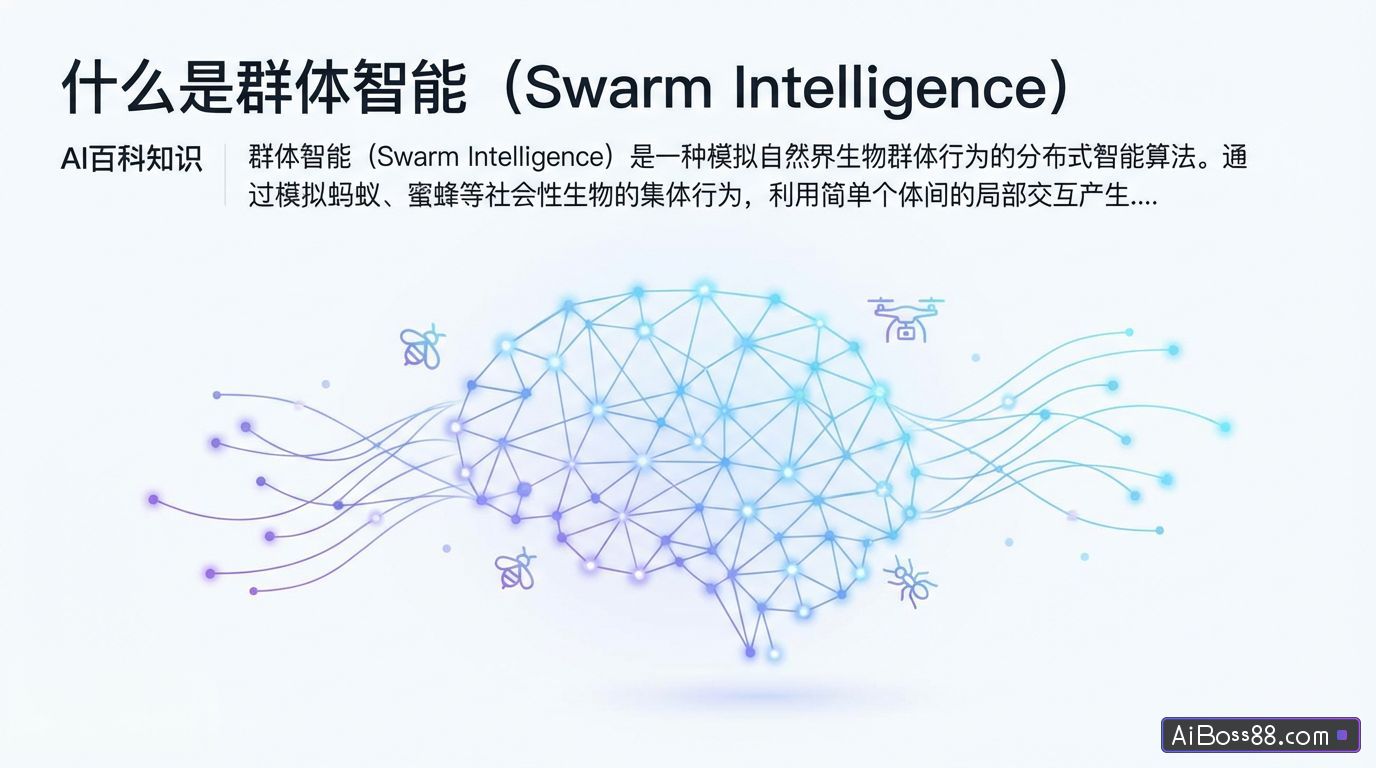
groupintelligentThe concept of Swarm Intelligence originates from in-depth observations of the behavior of biological groups in nature, revealing...SimpleThe complexity that individuals can generate through local interactionsHigh efficiencyThe collective wisdom of the group. In engineering and scientific research, the group...intelligentWith its unique characteristics of distributed processing, self-organization, and robustness, it provides a solution for optimization problems, path planning, and other tasks.Machine LearningThis provides new perspectives and methods for complex tasks. With the continuous advancement of technology, group...intelligentGradually becomingartificialintelligentIt is an important branch of the field, demonstrating enormous application potential and development prospects.
What is a group?intelligent
groupintelligentSwarm Intelligence is a distributed intelligence model that simulates the behavior of biological groups in nature.intelligentAlgorithm. By simulating the collective behavior of social organisms such as ants and bees, it utilizes...SimpleLocal interactions between individuals generate complex global interactions.intelligentBehavior. It requires no central control, possesses self-organizing, scalable, and robust characteristics, and is widely used in fields such as optimization problem solving and robot collaborative operations.
groupintelligentWorking principle
groupintelligentSwarm Intelligence works by analogy to the self-organizing behavior of biological communities in nature. Without a central command, individuals follow...SimpleThe rules and local information exchange between ants enable them to cooperate in solving complex tasks. For example, ants release pheromones when searching for food, and other ants choose paths by sensing the concentration of these pheromones. As more ants choose shorter paths, the positive feedback effect of the pheromones strengthens the optimal path. This is based on local interactions and...SimpleThe collective cooperation based on behavioral rules enables the group to demonstrate a high degree of [something unclear, possibly related to behavioral norms or rules].intelligentDecision-making and problem-solving abilities.
groupintelligentAlgorithms typically possess good robustness and scalability. Even if some individuals fail, the entire group can continue to operate and find solutions. As the group size increases, the algorithm's performance often does not significantly decrease; instead, it may even improve due to increased information exchange and collaboration. It demonstrates enormous potential and advantages in solving optimization problems, path planning, and distributed computing.
groupintelligentMain applications
groupintelligentIts main application areas are very wide. Here are some key application examples:
- Optimization problem solving:groupintelligentAlgorithms are often used to solve optimization problems such as the Traveling Salesman Problem (TSP), the workshop scheduling problem, and the Vehicle Routing Problem (VRP), by simulating the behavior of ant colonies or particle swarms to find the optimal or near-optimal solution.
- RoboticsIn multi-robot systems, swarmsintelligentUsed to coordinate the actions of multiple robots to achieve collaborative operations, such as search and rescue, exploration of unknown environments, and cargo handling.
- drone swarmDrone swarm usersintelligentThe algorithm is used for formation flying, collaborative monitoring, air traffic management, and cargo transportation.
- Data mining andMachine Learning:groupintelligentAlgorithms play a role in tasks such as data clustering, classification, and pattern recognition, improving the efficiency and accuracy of data processing.
- Network routingIn telecommunications networks, based on groupsintelligentThe routing algorithm can dynamically adapt to changes in network conditions and optimize the transmission path of data packets.
- supply chain management:groupintelligentIt helps optimize inventory management, logistics and production scheduling, and improves the responsiveness and cost efficiency of the supply chain.
- Social network analysisIn social networks, groupsintelligentIt can be used to analyze community structure, information dissemination patterns, and influence analysis.
- BioinformaticsIn bioinformatics, populationintelligentThe algorithm is used for complex computational tasks such as gene sequence analysis and protein structure prediction.
- Arts and EntertainmentIn the film, gaming, and music industries, groupsintelligentUsed for generating creative content, optimizing user experience, and personalization.recommend.
- Military and SecurityIn the military field, groupsintelligentUsed for tactical decision support, unmanned combat systems, and intelligence analysis.
groupintelligentChallenges
groupintelligentWhile demonstrating enormous potential and advantages in multiple fields, it also faces some challenges in practical applications:
- Algorithm parameter tuning:groupintelligentAlgorithms (such as ant colony optimization and particle swarm optimization) typically require tuning multiple parameters to achieve optimal performance. Inappropriate parameter selection can lead to inefficient algorithms or failure to find the optimal solution.
- Computational resource consumptionWhen dealing with large-scale problems, groupsintelligentAlgorithms can require significant computational resources and time, especially in real-time or dynamic environments.
- Convergence speed and stability: Ensure the algorithmfastConverging to the optimal solution while maintaining stability is a challenge. In some cases, the algorithm may converge to a local optimum rather than the global optimum.
- Adaptability and flexibilityThe algorithm needs to be able to adapt to changes in the environment and dynamic conditions, which requires the algorithm to have sufficient flexibility and adaptability.
- Communication overheadIn distributed systems, groupsintelligentThe algorithm relies on communication between individuals. In large groups, communication overhead can be a limiting factor.
- Robustness and fault toleranceThe algorithm needs to be able to handle problems such as individual failures or communication failures, so as to keep the overall performance unaffected.
- Theoretical basis and analysisDespite the groupintelligentThe algorithm performs well in practice, but its theoretical foundation and performance analysis are still incomplete, requiring further research to understand and predict its behavior.
- Privacy and security issuesEnsuring data privacy and security is a significant challenge in applications involving sensitive data.
- Multi-objective and multi-constraint problemsIn multi-objective optimization problems, the populationintelligentThe algorithm needs to balance the relationship between different objectives while satisfying multiple constraints.
- Algorithm interpretability and transparency:groupintelligentThe decision-making process of algorithms is often opaque, which can be an obstacle in applications that require interpretability, such as medical diagnosis.
groupintelligentDevelopment prospects
groupintelligentSwarm Intelligence, as a computational method for simulating the behavior of biological groups in nature, has broad development prospects. With the enhancement of computing power and the deepening of algorithm research, it is expected that swarm intelligence will become increasingly prevalent.intelligentIn optimizing algorithms, multipleintelligentbodysystem,automaticIt will achieve wider applications in areas such as decision support and complex network management.intelligentandMachine Learning,Deep learningThe integration of technologies such as data mining and pattern recognition will further promote its application in data mining, pattern recognition, and other fields.intelligentThe development of cutting-edge technologies such as control will also play a more important role in socio-economic systems, such as financial market analysis and transportation and logistics optimization. In the future, groups...intelligentIt is expected to demonstrate greater potential in improving system efficiency, enhancing decision-making quality, and promoting technological innovation.