What is Q-learning? - AI Encyclopedia
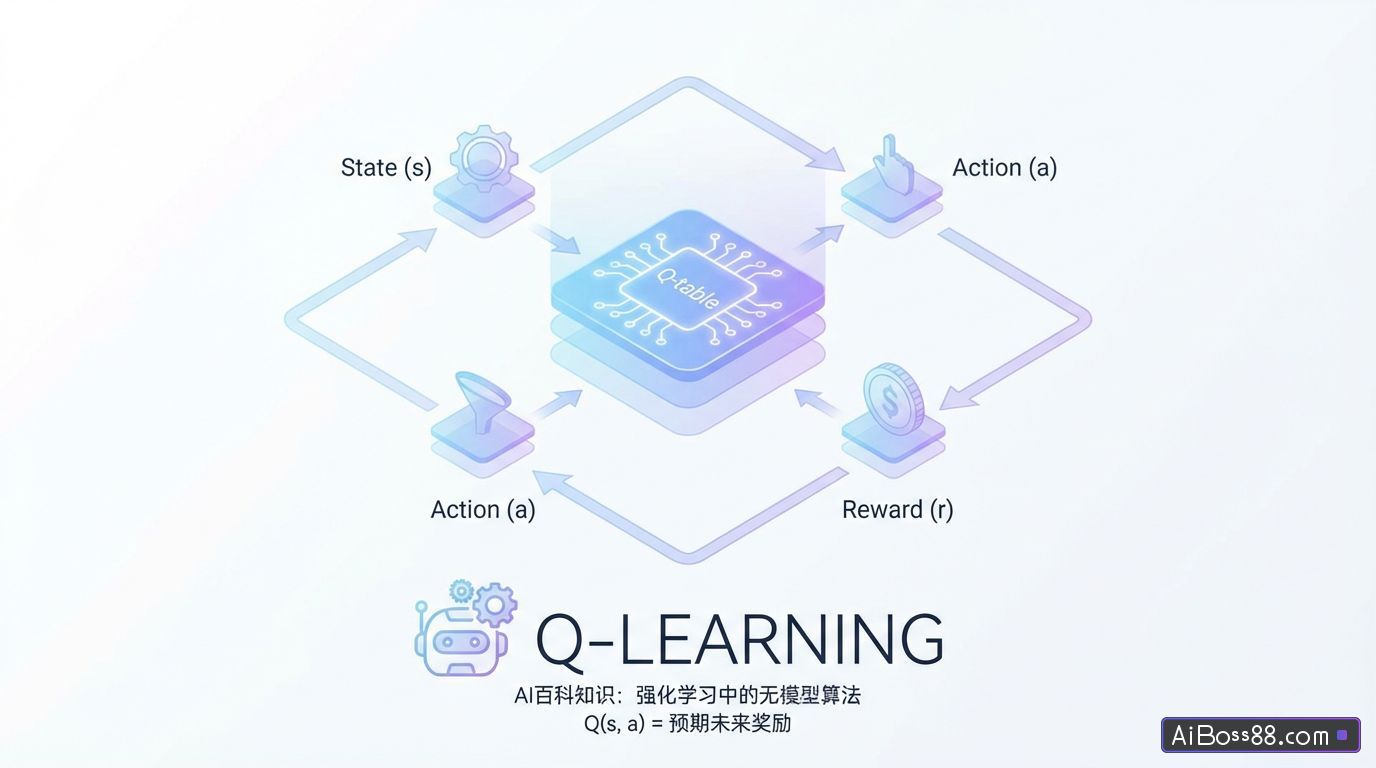
Q-learning in reinforcement learning is a model-free reinforcement learning algorithm that finds the optimal policy by learning an action-value function Q(s, a). Given a state, Q(s, a) represents the expected total future reward for performing action a...
With technological advancements, Q-learning in reinforcement learning has been continuously improved and expanded to adapt to a wider range of application scenarios, from...SimpleFrom casual games to complex robot control tasks, Q-learning has demonstrated immense potential. Following this introduction, we will delve into how Q-learning works, its key technologies, challenges, and future directions, aiming to provide readers with a comprehensive perspective on how this algorithm is used in modern...artificialintelligentIt plays a crucial role in the process.
What is Q-learning?
Q-learning is a model-free reinforcement learning algorithm that finds the optimal policy by learning an action-value function Q(s, a). Given a state, Q(s, a) represents the expected sum of future rewards for performing action a. The algorithm uses a Q-table or function to store these values and iteratively updates them according to the Bellman equation. Q-learning can handle uncertain transitions and rewards, requires no model information, and learns the optimal policy by exploring the environment. The core advantage of Q-learning in reinforcement learning is...SimpleIt is easy to implement and suitable for solving problems with discrete states and action spaces.
How Q-learning works
Q-learning is a model-agnostic reinforcement learning algorithm that aims to learn a policy that can tell...intelligentbodyWhich action should be taken in a given state to maximize the expected cumulative reward? This is achieved by constructing a Q-table, which records the value of each state-action pair, i.e., the expected long-term reward after performing a certain action.intelligentbodyThe system explores the environment by trying different actions and updates its Q-table based on immediate rewards received and estimates of future rewards. This process involves a learning rate that determines the extent to which new information influences Q-value updates.
Over time, the Q-learning algorithm learns the optimal policy by continuously updating the Q-value. The core of the algorithm is the Bellman equation, which defines the recursive update rule for the Q-value.intelligentbodyAt each time step, an action is selected, and the Q-value is updated based on the reward provided by the environment and the new state. This process is repeated until the Q-value converges.intelligentbodyQ-learning can select the optimal action in any state based on the Q-table, thereby maximizing long-term rewards. A key characteristic of Q-learning is that it can work without an environment model, meaning that it can learn policies without knowing the dynamics of the environment (such as state transition probabilities).
Main applications of Q-learning
Q-learning has wide applications in reinforcement learning. Here are some of the main application scenarios:
- gameQ-learning is widely used in various board games and video games.AIUnder development, applications include games like Go, chess, and Atari games. Through interaction with the environment, the algorithm can learn how to formulate strategies to win the game.
- Robot NavigationIn robotics, Q-learning can be used to train robots to plan paths and navigate in complex environments, such as avoiding obstacles, finding targets, or performing rescue missions.
- automaticdrive:automaticIn driving systems, Q-learning helps vehicles learn how to make decisions in different traffic conditions, such as when to accelerate, decelerate, or change lanes.
- Resource ManagementIn the fields of networking and energy, Q-learning can be used to optimize resource allocation, such as network traffic control and power distribution, to improve system efficiency and response speed.
- recommendsystemIn e-commerce and contentrecommendWithin the platform, Q-learning helps the system learn user behavior patterns, thereby providing personalized services.recommend.
- Natural Language ProcessingQ-learning is also usedNatural Language ProcessingTasks such as dialogue systems and machine translation improve the quality of interaction by learning language patterns.
- Health and Medical CareIn the medical field, Q-learning can be used to assist in diagnosis, treatment planning, and the optimal allocation of medical resources.
- Educational TechnologyIn the field of education, Q-learning can be used to develop...intelligentThe teaching system personalizes teaching content and methods by learning from student behavior and feedback.
Challenges of Q-learning
Q-learning, as a classic reinforcement learning algorithm, has achieved success in many fields, but it also faces some challenges and limitations:
- High-dimensional state space (curse of dimensionality)Q-learning faces challenges when dealing with problems with high-dimensional state spaces because it requires storing a Q-value for each state-action pair, which can lead to huge storage requirements when the state space is large.
- The trade-off between exploration and utilizationQ-learning requires balancing the relationship between exploring new actions to discover better strategies and utilizing known information to obtain immediate rewards. Inappropriate exploration can lead to inefficient learning or missing the optimal strategy.
- Choosing a learning rateThe learning rate is a crucial hyperparameter in Q-learning and requires careful tuning. If the learning rate is too high, it may lead to instability during the learning process; if it is too low, the learning speed will be very slow.
- Nonlinear and continuous action spaceQ-learning is natively applicable to discrete action spaces, but in continuous action spaces, actions need to be discretized, which may limit the accuracy of the policy.
- Generalization abilityQ-learning typically lacks generalization ability because it learns directly from specific state-action pairs rather than learning a policy that can generalize to new situations.
- Sample efficiencyQ-learning may require a large number of samples to learn effective strategies, especially in complex environments, which can lead to a slow learning process.
- Credit allocation problemIn multi-step decision-making processes, Q-learning needs to correctly allocate rewards to the series of actions that lead to the final outcome, which can be difficult to achieve in practice.
- Stability and convergenceIn some cases, Q-learning may struggle to guarantee convergence to the optimal policy, especially in non-stationary environments or tasks with sparse rewards.
The Development Prospects of Q-learning
Q-learning, as one of the cornerstones of reinforcement learning, has a promising future in its integration and innovation with other technologies, such as by combining...Deep learningTo handle high-dimensional state space problems, utilize multipleintelligentbodyThe system aims to improve learning efficiency and explore more complex strategies and credit allocation mechanisms to optimize the decision-making process. Algorithmic optimization and theoretical analysis of Q-learning will continue to advance to improve its stability, generalization ability, and sample efficiency in practical applications, thereby expanding its applications in games, robotics, and other fields.automaticdrive,recommendQ-learning is poised to play a greater role in multiple fields, including systems. With advancements in computing power and continuous improvements in algorithms, Q-learning is expected to achieve new breakthroughs in solving more complex and dynamic reinforcement learning problems.