What is an LLM (Large Language Model)? Definition, Training Methods, Reasons for Popularity, and Examples - AI Encyclopedia
The most important development in natural language processing is Large Language Modeling (LLM). In this article, we will provide a basic introduction to LLM, discussing its definition, training methods, reasons for its popularity, common examples of LLM, and more...
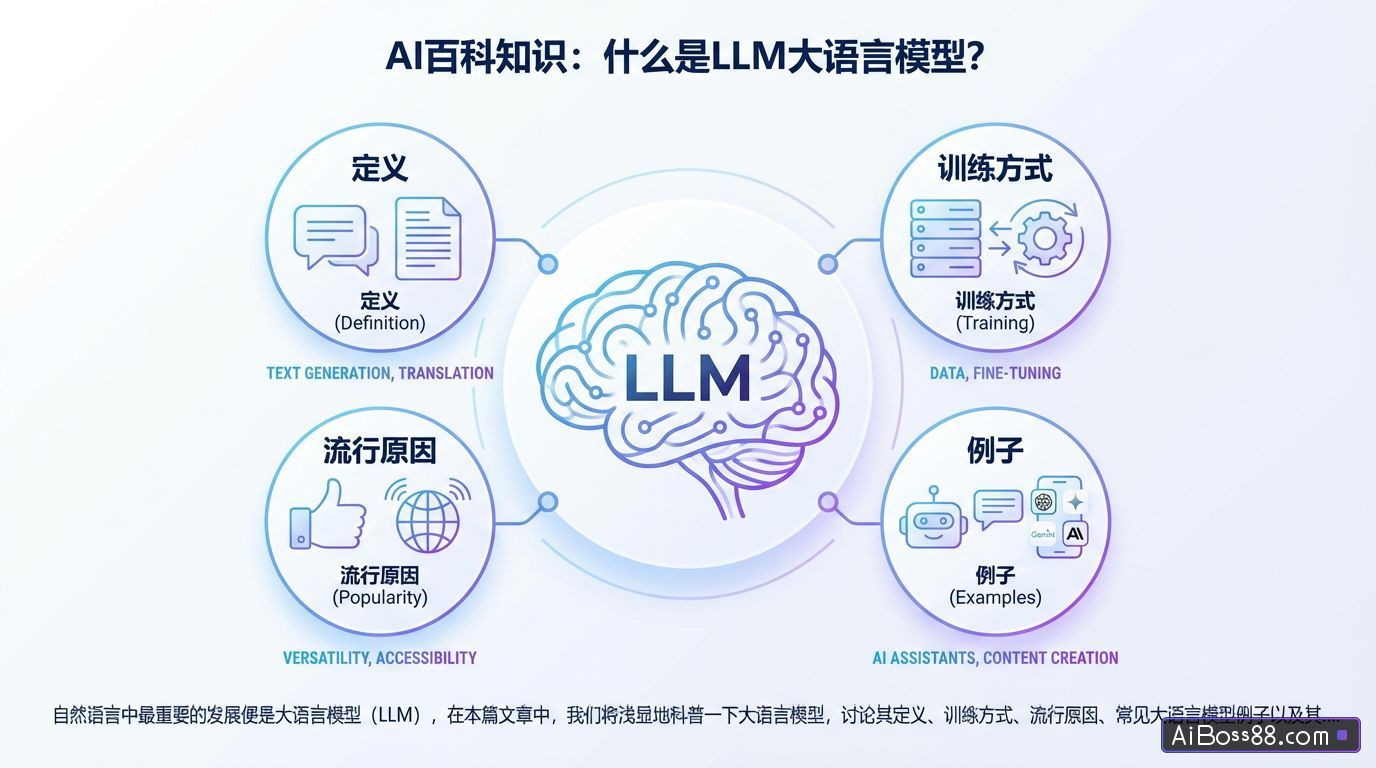
In recent yearsartificialintelligent(AIThe field has experienced tremendous growth, whileNatural Language Processing(NLP) is one of the achievementsfastThe most important development in NLP is the large language model (…).LLMThis technology could revolutionize the way we interact with technology, coupled with Openness.AIofGPTThe explosive popularity of -3 has brought large language models even more attention in the industry. In this article, we will...SimpleThis article provides a brief introduction to large language models, explaining their definition, training methods, reasons for popularity, common examples of large language models, and the challenges they face.
Definition of a large language model
Large Language Model (abbreviation)LLM), also known as a large language model, is a type ofartificialintelligentThese models are designed to understand and generate human language. They are trained on large amounts of text data and can perform a wide range of tasks, including text summarization, translation, sentiment analysis, and more.LLMTheir defining characteristic is their massive scale, containing billions of parameters that help them learn complex patterns in language data. These models are typically based on...Deep learningArchitectures, such as converters, contribute to their impressive performance across a wide range of NLP tasks.
Training methods for large language models
Training a language model requires providing it with a large amount of text data, which the model uses to learn the structure, syntax, and semantics of human language. This process is typically accomplished through unsupervised learning, using a technique called self-supervised learning. In self-supervised learning, the model generates its own labels for the input data by predicting the next word or token in the sequence, while also providing the preceding words.
The training process consists of two main steps: pre-training and fine-tuning.
- During the pre-training phase, the model learns from a huge, diverse dataset, typically containing billions of words from various sources such as websites, books, and articles. This phase allows the model to learn general language patterns and representations.
- During the fine-tuning phase, the model is further trained on a smaller, more specific dataset relevant to the target task or domain. This helps the model fine-tune its understanding and adapt to the specific requirements of the task.
Reasons for the popularity of large language models
Here are the main reasons why large language models are becoming increasingly popular:
- Performance improvements: The sheer size of large language models enables them to capture complex language patterns, resulting in impressive capabilities across a wide range of tasks, particularly in accuracy and fluency, often surpassing previous state-of-the-art methods.
- Transfer learning: Large language models can be fine-tuned for specific tasks, enabling them to quickly adapt to new domains using their general language understanding. This transfer learning capability significantly reduces the need for task-specific data and training time.
- Versatility: Large language models can perform a variety of tasks without requiring task-specific architectures or models. They can be used for text generation, translation, summarization, etc., making them highly flexible and versatile in various applications.
- High interactivity: The ability of large language models to understand and produce human-like responses enables them to interact with...artificialintelligentThe system allows for more natural and intuitive interaction, providing...artificialintelligentThe tools and applications that drive this offer new possibilities.
Common large language models
- GPT-3 (Open)AI): Generative Pre-trained Transformer 3 (GPT-3) is the most famousLLMOne of the best, boasting 175 billion parameters. This model has demonstrated remarkable performance in text generation, translation, and other tasks, generating a strong response globally. Currently, Open...AIIt has been iterated toGPTVersion -4.
- BERT (Google): Bidirectional Encoder Representations from Transformers (BERT) is another popular...LLMThis has had a significant impact on NLP research. The model uses a bidirectional approach to capture context from both sides of a word, improving performance on various tasks such as sentiment analysis and named entity recognition.
- T5 (Google): Text-to-Text Converter (T5) is a...LLMThis model limits all NLP tasks to text-to-text problems, simplifying the process of adapting the model to different tasks. T5 demonstrates superior performance in tasks such as summarizing, translating, and question answering.powerfulPerformance.
- ERNIE 3.0 WenxinLarge Model(Baidu): Baidu's ERNIE 3.0, a large language model, is the first to introduce large-scale knowledge graphs into pre-trained models with tens of billions and hundreds of billions of data points, and proposes a parallel pre-training method for massive unsupervised text and large-scale knowledge graphs.
Challenges of large language models
Despite the impressive capabilities of large language models, they still face several challenges:
- High resource consumption: TrainingLLMThe need for substantial computing resources makes developing and deploying these models challenging for smaller organizations or researchers. Furthermore, the training...LLMThe energy consumption involved has also caused some environmental problems.
- The output may be biased: because the training data may contain biases, andLLMIt can learn and perpetuate biases in its training data, resulting in biased outputs that may be offensive, discriminatory, or even erroneous.
- Limited Comprehension Capabilities: While large language models are capable of generating seemingly coherent and context-sensitive text,LLMSometimes, a lack of deep understanding of the concepts being written can lead to incorrect or meaningless output.