What is Embedding Learning? - AI Encyclopedia
Embedding learning is a technique that maps data to a low-dimensional vector space, making similar data points appear close to each other in the vector space. It is widely used in Natural Language Processing (NLP), Computer Vision, etc.
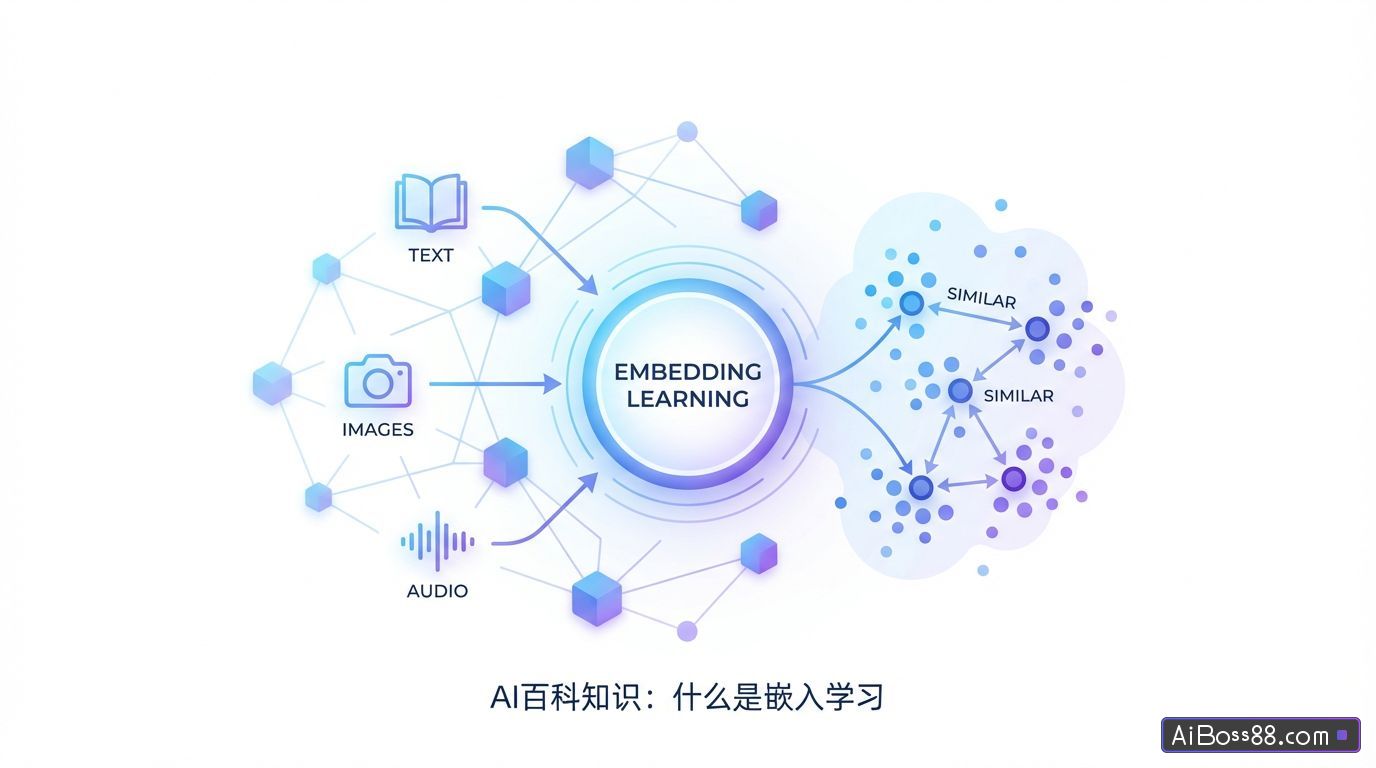
How machines understand and process massive and complex data has become a key issue.artificialintelligentA key challenge in the field. Embedding learning, as a bridge connecting raw data and machine understanding, provides an effective method for mapping high-dimensional data to a low-dimensional, dense vector space. It not only enables machines to capture subtle differences and deep connections between data but also significantly improves the efficiency and accuracy of data processing. From text to images, from sound to video, the applications of embedding learning are ubiquitous, changing the way we interact with machines and driving...intelligentThe system is moving towards a deeper understanding and a wider range of applications. Next, we will delve into the principles, applications, and methods of embedding learning.artificialintelligentThe future.
What is Embedded Learning?
Embedding learning is a technique that maps data to a low-dimensional vector space, making similar data points appear close to each other in the vector space. It is widely used in…Natural Language ProcessingIn fields such as Natural Language Processing (NLP) and Computer Vision, embedding is used to capture and represent the inherent features and relationships of data. Through embedding, models can process high-dimensional data more effectively, improving learning efficiency and performance.
How Embedded Learning Works
The core principle of embedding learning is to transform complex, high-dimensional data, such as text, images, or sound, into low-dimensional, dense vector representations. This is achieved by training a...Neural NetworksThe model achieves this by learning to map input data into a continuous vector space. In this space, similar data points (e.g., semantically similar words or similar images) are mapped to locations close to each other, allowing the model to capture and utilize the inherent connections between the data.
In practice, embedding learning typically involves an unsupervised or semi-supervised learning process. The model is pre-trained on a large amount of unlabeled data to learn the basic features and structure of the data. The pre-trained embeddings can be further fine-tuned to adapt to specific downstream tasks, such as classification, clustering, or...recommendIn this way, embedding learning can not only improve the model's understanding of the data, but also significantly improve the performance and accuracy of the task.
Main applications of embedded learning
Embedded learning has wide applications in many fields. Here are some of the main application scenarios:
- Natural Language Processing(NLP)In Natural Language Processing (NLP), embedding learning is used to transform words, phrases, or entire documents into vector representations, enabling machines to understand the semantics of language. It is crucial in tasks such as sentiment analysis, machine translation, text summarization, question answering systems, and chatbots.
- recommendsystemEmbedding learning helps construct vector representations of users and items, predicting items a user might be interested in by calculating the similarity between user vectors and item vectors, thus improving...recommendThe relevance and accuracy.
- Computer VisionIn image and video analytics, embedding learning is used to extract image features for tasks such as image classification, object recognition, and scene understanding.
- Speech recognitionEmbedding learning can convert speech signals into vector form, which can be used for speech-to-text conversion, speaker recognition, and sentiment analysis.
- knowledge graphEmbedding learning is used to map entities and relations to vector spaces to facilitate the construction and querying of knowledge graphs, supporting complex semantic queries and reasoning.
- BioinformaticsIn fields such as gene expression analysis and protein structure prediction, embedding learning helps extract useful features from complex biological data.
- CheminformaticsEmbedding learning is used for the representation of molecular structures, which helps in the discovery of new drugs and the design of materials in materials science.
- CybersecurityEmbedded learning can be used for anomaly detection, preventing network attacks by identifying abnormal patterns in network traffic.
- Social network analysisEmbedded learning can help analyze user behavior in social networks and is used for community detection, influence analysis, and other purposes.
- MultimodalstudyIn tasks that process data of multiple types (such as text, images, and sound), embedding learning can integrate data from different modalities into a unified vector space to facilitate cross-modal analysis and learning.
Challenges of Embedded Learning
While embedding learning has achieved remarkable results in many fields, it also faces some challenges:
- Processing of high-dimensional dataHigh-dimensional data (such as images, videos, and text) typically contain a large number of features, and directly processing this data requires enormous computational resources. Effective dimensionality reduction and feature extraction are key challenges in embedding learning.
- sparsity problem:existNatural Language ProcessingIn China, text data is often very sparse, and many words appear very infrequently in the corpus, which makes it difficult to learn effective word embeddings.
- Semantic ambiguity and polysemyThe polysemy and contextual dependence in language make it difficult for embedding vectors to accurately capture the full semantics of a word in different contexts.
- Data imbalanceIn some applications, the data distribution may be very unbalanced, with some categories having far more samples than others, which may cause the embedding model to be inaccurate in representing a few categories.
- computational efficiencyTraining large-scale embedding models requires significant computational resources and time, especially when dealing with large amounts of data and complex model structures.
- Overfitting riskIn embedding learning, the model may overfit the training data, resulting in a decrease in its generalization ability on new data.
- Explanatory issuesEmbedding vectors are often high-dimensional and difficult to understand intuitively. The lack of transparency in the model's decision-making process poses a challenge in applications requiring model interpretability.
- Dynamism and timelinessIn some applications, the distribution of data may change over time, such as social media trends. Embedded models need to be able to adapt to these changes in order to maintain their effectiveness.
- Cross-domain and cross-language generalization abilityHow to transfer knowledge gained from training an embedding model in one domain or language to other domains or languages is a problem that has not yet been fully solved.
- Security and privacy issuesWhen dealing with sensitive data (such as medical records and personal communications), embedding learning needs to ensure that data security and user privacy are not violated.
The Development Prospects of Embedded Learning
Embedded learning asartificialintelligentEmbedded learning is one of the core technologies in the field, with broad development prospects. With the improvement of computing power and the accumulation of big data, it will continue to play a significant role in...Natural Language ProcessingComputer visionrecommendDeepen applications in systems and other fields, and promoteMultimodalThe development of emerging research directions such as learning and cross-domain transfer learning will focus on improving the interpretability, adaptability, and safety of models.