What are Question Answering Systems? - AI Encyclopedia
Question answering systems (QA) are a type of information retrieval system in the field of artificial intelligence. They can understand questions posed by users in natural language and provide accurate and direct answers. They can process text, voice, etc.
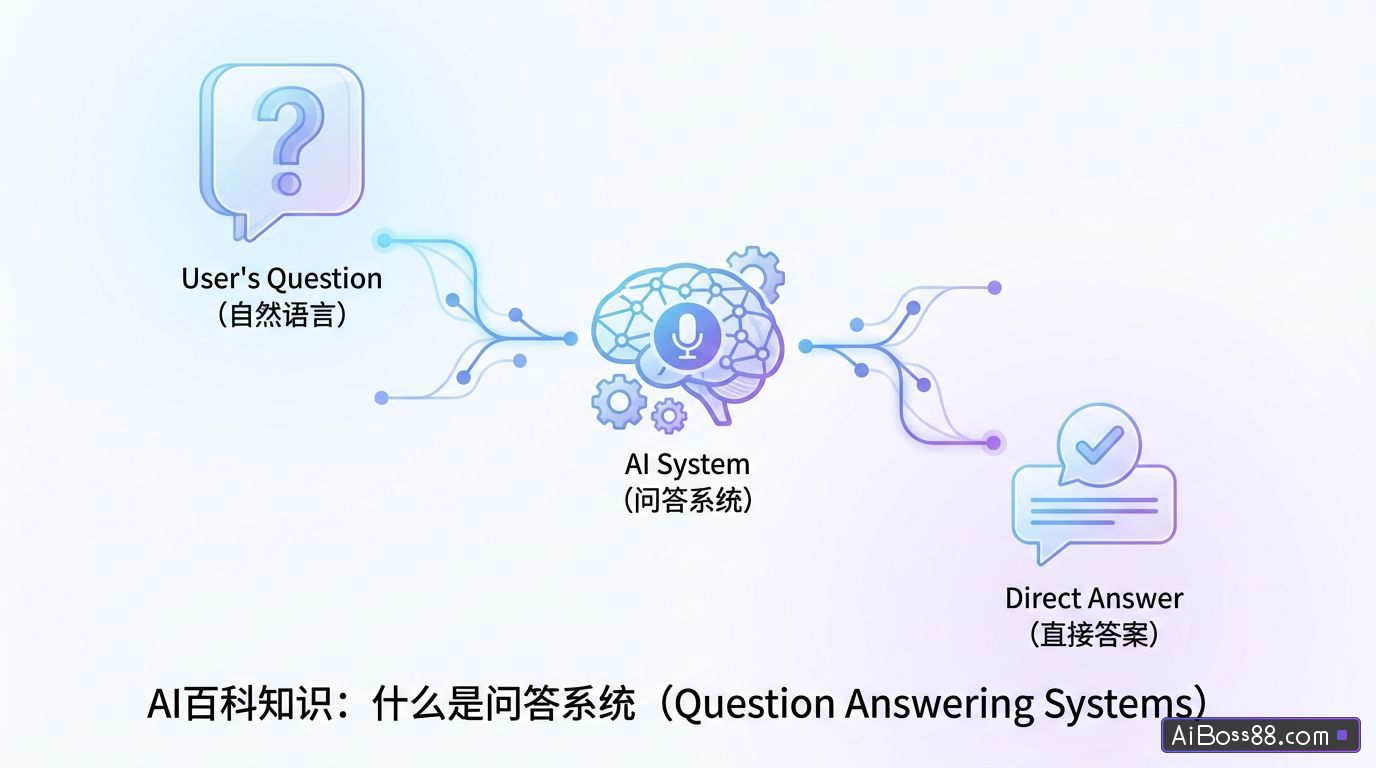
In this age of information overload, people yearn for...fastAccurately obtain the required knowledge. Question-answering systems, as...artificialintelligentThe remarkable achievements demonstrate how natural language processing can be used to understand the deeper intent behind user queries, thereby retrieving or generating precise answers from massive amounts of data. This significantly improves the efficiency of information retrieval and makes human-computer interaction more efficient.intelligentAnd nature. Question-and-answer systems are gradually permeating all aspects of our lives, becoming a bridge connecting humanity and information.
What is a question-answering system?
Question answering systems areartificialintelligentA question-answering system is an information retrieval system in this field that can understand questions posed by users in natural language and provide accurate and direct answers. It can handle various input formats, including text, voice, and images, and its answers may originate from structured knowledge bases or unstructured data sources. Question-answering systems are widely used in online customer service,intelligentIn fields such as assistants and search engines, the aim is to improve the efficiency and accuracy of information retrieval.
How Question-Answering Systems Work
The core working principle of a question-answering system involves two main steps: understanding the user's question and retrieving and generating the answer. In the understanding phase, the system...Natural Language ProcessingTechnical analysis of the question text identifies keywords, entities, and intents to determine the exact content of the user's query. This process may include techniques such as word segmentation, part-of-speech tagging, syntactic analysis, and semantic understanding.
During the retrieval and answer generation phase, the question-answering system retrieves relevant information from a pre-built knowledge base or through a search engine based on the understood question information. For knowledge base-based systems, answers are usually predefined, and the system directly provides matching answers. For retrieval-based systems, however, relevant information needs to be extracted from a large number of documents, and algorithms are used to evaluate the relevance and accuracy of the answers, ultimately presenting the most suitable answer to the user.
Main applications of question-and-answer systems
The main application areas of question-answering systems include:
- Online customer service:automaticAnswer user inquiries, reduce the workload of human customer service representatives, and improve service efficiency.
- Virtual Assistant:existintelligentmobile phones andintelligentIn home appliances, voice interaction helps users obtain information or perform tasks.
- Search enginesEnhance the search experience by providing direct answers rather than just links, thus improving how users retrieve information.
- Education and Learning: To assist students in learningautomaticAnswer academic questions and provide personalized learning support.
- Medical consultationIt provides medical information inquiry services to help patients understand their condition and treatment plans.
- Financial ConsultingIn banking and investment services, we provide information on financial products to help users make investment decisions.
- Government ServicesIt provides policy interpretations, service guides, and other information to improve the transparency and efficiency of government services.
- Enterprise internal knowledge managementHelping employeesfastObtain internal company information to improve work efficiency.
- intelligentDocument reading:automaticExtract key information from documents to help users understand and analyze document content.
- Multilingual translationIt helps users overcome language barriers by providing real-time translation services.
Challenges of Question Answering Systems
Question-answering systems face several challenges in practical applications, including:
- Natural Language UnderstandingAccurately understanding the intent and context of a user's question is a major challenge, especially for vague, complex, or unstructured questions.
- Polysemous words and handling of ambiguityWords may have multiple meanings, and the system needs to correctly interpret the meaning of words in specific contexts to avoid ambiguity.
- Knowledge base coverage and updatesThe system relies on the breadth and depth of the knowledge base; an incomplete or outdated knowledge base will affect the accuracy of the answers.
- contextual understandingIn multi-turn dialogues, the system needs to understand the dialogue history and context to provide coherent and relevant answers.
- Language diversityDifferent regions and communities use different language styles and expressions, and the system needs to adapt to this diversity.
- User Intent PredictionPredicting a user's true intentions is sometimes more complex than directly answering a question, requiring more advanced reasoning skills.
- Integration of cross-disciplinary knowledgeIt integrates knowledge from different fields into the question-and-answer system, providing comprehensive answers across disciplines.
- Interactive learningThe system needs to learn from user feedback, continuously optimize the quality of answers, and improve user satisfaction.
- Privacy and securityWhen processing sensitive information, the system must ensure the privacy and security of user data.
- MultimodalInput processingWith the development of technology, users may ask questions in various forms such as voice, text, and images, and the system needs to process input from multiple modalities.
- Real-time performanceIn certain application scenarios, such as online customer service, the system needs tofastResponding to user issues places demands on the system's real-time processing capabilities.
- ExplainabilityUsers may need to understand how the system arrives at a certain answer, and question-answering systems need to provide an explainable answer generation process.
The Development Prospects of Question Answering Systems
Question answering system asartificialintelligentKey applications in this field, with broad development prospects. With...Natural Language ProcessingWith continuous technological advancements, future question-answering systems will more accurately understand complex and diverse user queries, providing richer and more personalized answers. By integrating broader knowledge bases and data sources, the system will be able to handle a wider range of topics and domains.Machine LearningWith model optimization and improved computing power, question-answering systems will be able to achieve a more natural and fluid interactive experience, and will support multiple languages.MultimodalSignificant progress has been made in areas such as interaction and personalized services, thereby enabling...intelligentThey will play an increasingly important role in multiple fields such as assistants, online customer service, education, and medical consultation.