What is Harness Engineering? – AI Encyclopedia
Harness Engineering is a new paradigm for AI engineering, which refers to building a complete operating system around a large model, upgrading it from a one-time response tool to a long-term autonomous agent.
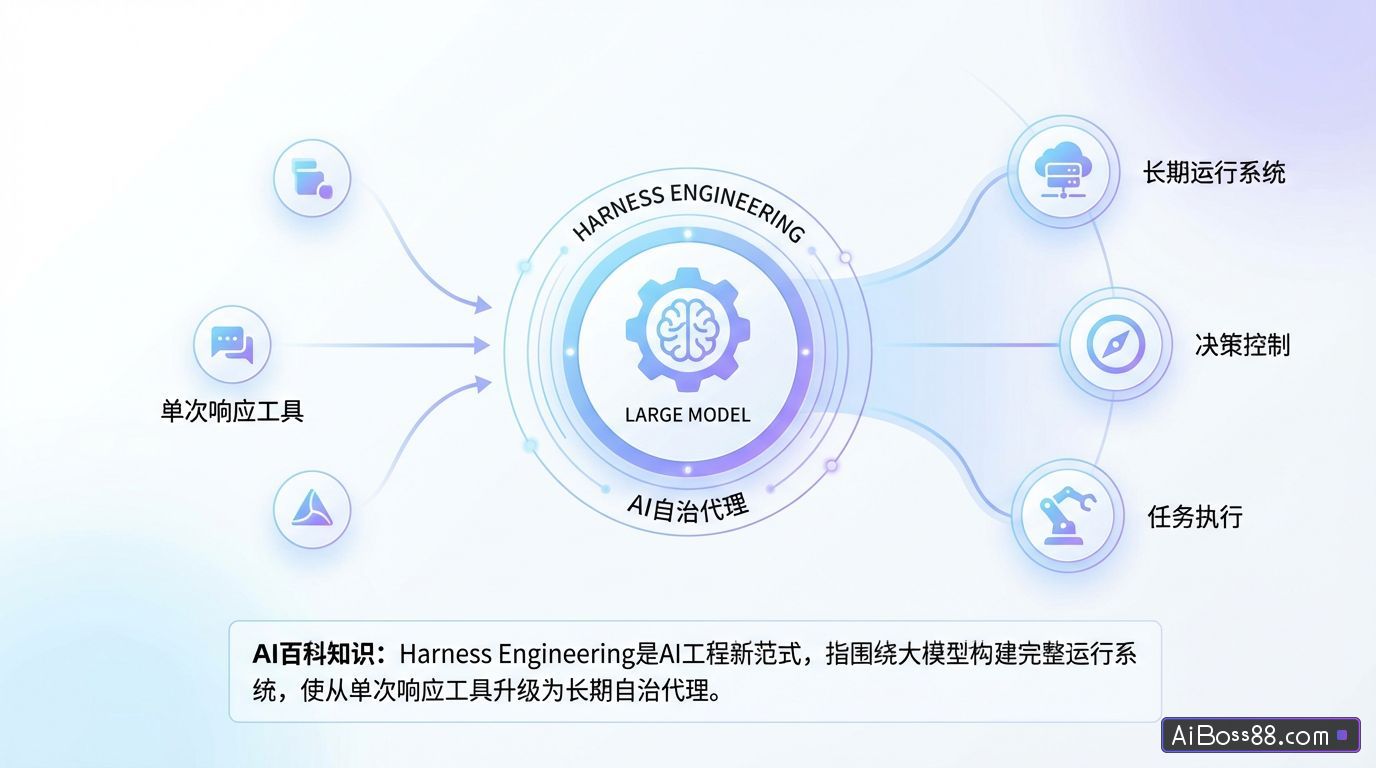
Harness Engineering isAIA new engineering paradigm refers to...Large ModelBuild a complete operating system to upgrade from a one-time response tool to a long-term autonomous agent. Harness Engineering's core consists of three layers:PromptThe Context layer receives instructions, the Harness layer provides environment awareness, and the Harness layer is responsible for system-level orchestration—through architectural constraints and multiple...AgentCollaboration, verification, and feedback loop mechanisms are used to achieve task completion.automaticDeconstruction, execution, and quality control. Essentially, it shifts human intervention from "operation within the loop" to "supervision within the loop," allowing...AIAutonomously advance complex workflows within a defined framework. As model capabilities mature, system design is becoming increasingly crucial.AIHarness Engineering, as a key bottleneck in reliability and efficiency, has become a crucial bridge connecting the potential of models with actual productivity.
What is Harness Engineering?
Harness Engineering isAIA new engineering paradigm refers to building a complete operating system around a model: context management, architectural constraints, feedback verification, and multiple...AgentCollaboration, etc. Analogous to horse harness—the model is the horse, the harness is the reins and the road, allowing…AIFrom single-response to long-term autonomy. The core of Harness Engineering lies in the fact that when the model's capabilities are sufficient, system design becomes the deciding factor.AIKey bottlenecks to reliability and efficiency.
How Harness Engineering works
- Three-tier architecture division of labor:PromptThe first layer is responsible for receiving user instructions, the Context layer provides dynamic environment information, and the Harness layer coordinates the operating rules and constraints of the entire system. The three layers work in a progressive manner, from "what to say" to "what to give" and then to "how to operate", forming a complete control system.
- Context EngineeringBy maintaining a streamlined knowledge base and real-time system status, the model is provided with just the right environmental awareness, avoiding information overload that could lead to performance degradation and ensuring that it has the necessary background to complete the task.
- Architectural constraint mechanismSet hard rules to block at critical nodes, such as code inspectors and structure tests, and change quality requirements from "recommendation" to "mandatory", physically preventing non-compliant output from passing.
- manyAgentCollaborative orchestrationThe system employs a triangular division of labor among planners, generators, and evaluators. Planners break down requirements, generators iteratively execute tasks, and evaluators independently identify and address flaws, forming an adversarial optimization mechanism similar to GANs to avoid a singular approach.AgentBlind spots in self-examination.
- Verification feedback closed loopEquip the model with perception capabilities such as browser tools so that it can directly observe the execution results. Through multiple iterations of generation-testing-repair, the feedback loop is shortened to the internal system, reducing human intervention.
- Dynamic growth logicHarness starts with an empty file and follows the evolutionary principle of "adding rules as you make mistakes". Each constraint corresponds to a failure case in a real scenario, eventually forming a highly customized and continuously self-updating engineering system.
Harness Engineering's main applications
- AIAuxiliary software developmentThrough multipleAgentCollaborate to complete the entire process of requirements analysis, code generation, and testing and acceptance.automaticTransformation, realizing the transformation from a single requirement to a deliverable product, typically such as Open...AI Codex's experiment of producing millions of lines of code and ONES, etc.AI Coding products.
- Complex Workflowautomaticchange: Building autonomous systems in vertical sectors such as finance, healthcare, and law, and solidifying industry best practices into Harness, enablingAIIt can continuously advance multi-step tasks without requiring manual intervention at each stage.
- Content production and creation: Build a complete pipeline from topic selection, material collection, first draft generation to quality review, and ensure consistent output style and compliance with standards through rule constraints and evaluation mechanisms to achieve large-scale content production.
- intelligentCustomer service and operations: Build a system with long-term memory and tool recall capabilitiesAgentThe system enables it to autonomously process work orders, query the knowledge base, perform repair operations, and request manual confirmation at critical junctures.
-
Scientific Research and Data AnalysisDesign a multi-step verification process to allowAIThe system independently completes hypothesis generation, experimental design, data cleaning, and result analysis, and controls the risk of hallucination through cross-validation.
Challenges facing Harness Engineering
- Long-term maintainable:AIWhile generating code quickly, it lacks structural clues left by unconscious human input, making later modifications difficult.fastThe technical debt generated by iterations may erupt in the future, and the maintenance costs are questionable.
- Experience transmission gapDesigning an effective Harness requires a lot of experience in learning from mistakes. The new generation of developers only calls Harnesses from the beginning without writing code, lacking a deep understanding of the underlying structure, making it difficult to judge the quality of the architecture or predict potential risks.
- System complexity out of controlHarness itself grows continuously as errors accumulate, and the rule files may become contradictory as they expand, requiring a dedicated "garbage collection" mechanism to continuously clean them up, increasing the system burden.
- Limitations of verification mechanismsModel self-validation has blind spots, and independent evaluators may miss some errors. Acceptance criteria for complex tasks are difficult to fully quantify, and critical errors may still seep into the production environment.
- Context resource constraintsThe model context window is limited, and too many Harness components will crowd out the actual task space. A continuous trade-off must be made between system integrity and execution efficiency.
The Development Prospects of Harness Engineering
- becomeAIEngineering Standard ParadigmAs model capabilities mature, the industry's focus is shifting from "training better models" to "designing better systems," and Harness Engineering is poised to become...AIThe default methodology for application development, similar to the role of DevOps in software engineering.
- Deep penetration of vertical industriesIn professional fields such as finance, healthcare, and law, autonomous systems that thoroughly understand complete workflows will emerge, achieving "expert-level" capabilities by solidifying industry best practices.AIProduct delivery by the team.
- Reconstruction of Human-Machine Collaboration ModeThe human role has completely shifted from "operator" to "supervisor" and "goal setter," making Harness quality the decisive factor.AIThe core variable of output reliability gives rise to new occupational divisions and skill systems.
- Mature toolchain ecosystemThe toolchain for designing, testing, and monitoring Harness willfastDevelopment lowers the barriers to entry, enabling more teams to build orchestration systems suitable for their own scenarios and promoting the democratization of technology.
- Establishment of empirical engineering methodologyTo address the challenge of "how to cultivate Harness designers," the industry will gradually develop teachable methodologies to transform tacit experience into explicit knowledge and mitigate the risk of talent shortage.