What is a Long Short-Term Memory (LSTM) Network? - AI Encyclopedia
LSTM, short for Long Short-Term Memory, was proposed by Sepp Hochreiter and Jürgen Schmidhuber in 1997. It is a network technology capable of remembering long-term information and using it for future computations...
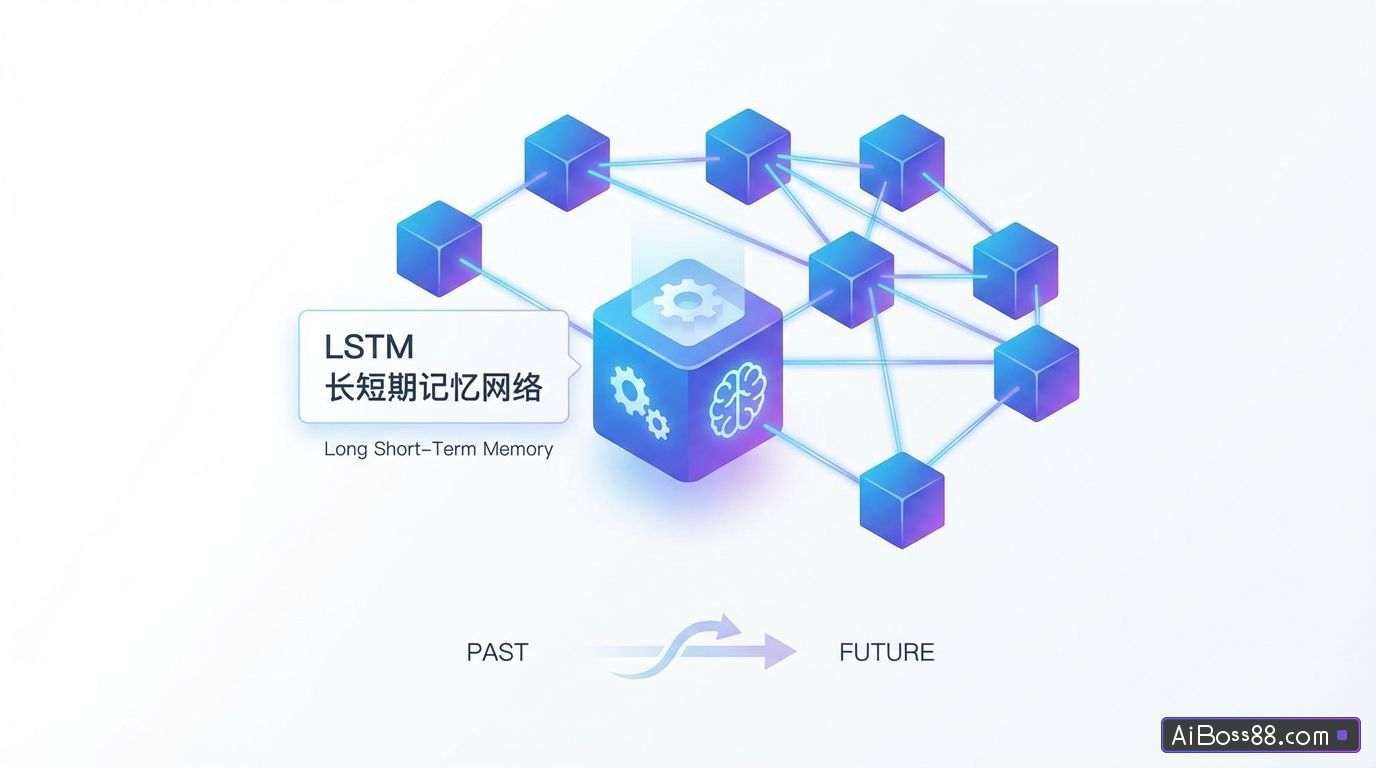
existartificialintelligentandMachine LearningIn the field of sequence prediction, Long Short-Term Memory (LSTM) networks have become a solution to the sequence prediction problem.powerfulTools. LSTM is a special type of loop.Neural NetworksLSTM (Laser-Based Neural Network) is capable of learning long-term dependencies in data, making it excellent for tasks such as language translation, speech recognition, and time series prediction. This article will detail the basic concepts and structure of LSTM, its comparison with traditional RNNs, its advantages and disadvantages, and its wide range of applications.
What is LSTM?
LSTM, short for Long Short-Term Memory, was proposed by Sepp Hochreiter and Jürgen Schmidhuber in 1997. It is a network technology capable of remembering long-term information and using it for future computation.Deep learningAlgorithm. LSTM was originally designed to solve traditional loop problems.Neural NetworksRNNs encounter the vanishing gradient problem when processing long sequences of data. LSTM addresses this by introducing a special structure—memory units—and a gating mechanism to control the flow of information, enabling it to learn and remember long-term information while ignoring unimportant information.
LSTM structure
The core of LSTM networks lies in their unique memory units and gating mechanism. Each LSTM unit contains three main gates: the input gate, the forget gate, and the output gate.
- Memory CellEach unit in an LSTM contains a memory unit, which serves as a carrier for information flowing through the network. The memory unit stores information and maintains it throughout the sequence processing. The state of the memory unit is called the cell state, which is updated through a series of complex operations.
- Forget GateThe forget gate is the first component of an LSTM unit. Its main task is to determine which information should be forgotten or retained from the cell state. The forget gate receives the hidden state from the previous time step and the input from the current time step, and generates a value between 0 and 1 using a sigmoid function, representing the degree of forgetting. If the output of the forget gate is close to 0, it indicates that information is retained; if it is close to 1, it indicates that information is forgotten.
- Input GateThe input gate consists of two parts: a sigmoid layer and a tanh layer. The sigmoid layer determines which values will be updated, and its output is between 0 and 1. The tanh layer creates a new candidate vector containing new information that may be added to the cell state. The input gate then multiplies the output of the sigmoid layer with the output of the tanh layer to determine the information that will ultimately be updated to the cell state.
- Output GateThe output gate is responsible for determining the value of the next hidden state, which is calculated based on the cell state and the previous hidden state. First, the output gate uses the sigmoid function to determine which information in the cell state is important, and uses the weighted sum of this information as part of the hidden state. Then, the output gate processes the cell state using the tanh function, generating an output vector. This vector is multiplied by the output of the sigmoid function to obtain the final hidden state.
Mathematical expression of gating mechanism
The operation of each door can be described by the following mathematical formula:
- Forgotten Gate:+
in 𝜎It is the sigmoid function.𝑊𝑓It is the weight matrix of the forget gate.[ℎ𝑡−1,𝑥𝑡]It is a combination of the previous hidden state and the current input.𝑏𝑓It is a bias term. - Input gate:=𝜎(𝑊⋅[ℎ−1,𝑏]+𝑏)
+
in 𝑖𝑡It is the output of the input gate.𝐶~𝑡It is a candidate cell state.𝑊𝑖 and 𝑊𝐶 It is a weight matrix.𝑏𝑖 and 𝑏𝐶 It is a bias term. - Update cell state:+
here 𝐶𝑡 It represents the cell state at the current time step. - Output gate:+
?
in 𝑜𝑡 It is the output of the output gate.ℎ𝑡 It is the hidden state of the current time step.
These gates operate using the sigmoid and tanh functions, producing values between 0 and 1 or between -1 and 1, thereby controlling the flow of information.
LSTM vs. RNN
Advantages and disadvantages of LSTM
Advantages of LSTM:
- Long-term dependency captureOne of the design principles of LSTM is to address the vanishing gradient problem encountered by traditional RNNs when processing long sequences of data. Through its unique gating mechanism, particularly the forget gate and input gate, LSTM can effectively capture and remember long-term dependencies. This means that LSTM can maintain a memory of early events in a sequence, which is crucial for tasks such as language modeling and machine translation, as these tasks require understanding long-distance dependencies in sentences.
- Avoid gradient vanishing:existDeep learningIn traditional neural networks, vanishing gradients are a common problem that makes deep networks difficult to train. LSTM avoids this problem by using its internal gating units, specifically the design of "constant error carousels," which allow the network to maintain gradient flow during backpropagation. This enables LSTM to learn complex sequence patterns, even those spanning many time steps.
- flexibilityLSTM's gating mechanism includes not only forget gates and input gates, but also output gates. These gates work together, giving LSTM high flexibility in processing various sequence data. The forget gate allows the network to forget irrelevant information, the input gate allows the network to update important information, and the output gate controls the network's final output. This flexibility enables LSTM to adapt to different task requirements, such as text generation and speech recognition.
Disadvantages of LSTM:
- Computational complexityThe internal structure of LSTM is much more complex than that of traditional RNNs, with each LSTM unit containing multiple gates and nonlinear activation functions. This complexity leads to higher computational costs, especially when training large networks. LSTM requires more parameters and computational resources, which may limit its application in resource-constrained environments.
- Training timeDue to the complexity of LSTM structures, training LSTM models typically requires a longer time. The computation at each time step involves the activation and updating of multiple gates, which increases the complexity of the training process. Furthermore, to achieve optimal performance, LSTMs may require more training data and more iterations.
- Overfitting riskLSTM due to itspowerfulThe memory capacity and complex structure of a model enable it to capture subtle patterns in data. However, this also introduces the risk of overfitting, especially with limited data. Overfitting means the model may learn noise in the data instead of the underlying data distribution, which reduces its generalization ability on unseen data. To avoid overfitting, regularization techniques, more complex model architectures, or ensemble learning methods may be necessary.
Applications of LSTM
Natural Language Processing(NLP)
existNatural Language ProcessingIn the field of LSTM, it has become a core technology for many applications. Due to its ability to capture long-range dependencies, LSTM is particularly well-suited for the following tasks:
- Machine translationLSTM can learn complex mapping relationships between different languages, achieving high-quality results.automatictranslate.
- Language model constructionLSTM can be used to build language models that can predict the probability of the next word in a text sequence, thereby improving text generation and understanding.
- Text SummaryLSTM can identify key information in text and generate short summaries of the content, which is very useful for information retrieval and content summarization.
LSTM plays an important role in speech recognition systems, as it can effectively process time-series audio data.
- Speech-to-text conversionLSTM can convert continuous speech signals into text, which is useful for creating...automaticSubtitles or voice input methods are very valuable.
- Command recognition:existintelligentIn assistants and voice control devices, LSTM can recognize and understand users' voice commands.
Time series forecasting
LSTM has demonstrated its effectiveness in the field of time series analysis.powerfulPredictive ability:
- Stock price predictionLSTM can analyze historical stock data and predict future market trends.
- Weather forecastBy analyzing meteorological data, LSTM can predict weather patterns and long-term climate change.
- Energy consumption forecastLSTM can predict electricity demand or renewable energy output, helping to optimize energy allocation.
Combined convolutionNeural Networks(CNN) and LSTM can process video data and achieve advanced video content understanding:
- Action recognitionLSTM can identify human actions and activities in videos, which is very useful in surveillance and behavior analysis.
- Scene ClassificationLSTM can classify video scenes, such as distinguishing different sports events or movie scenes.
LSTM also demonstrates unique advantages in anomaly detection:
- Fraud detectionLSTM can learn normal trading patterns and identify potential fraudulent activities.
- CybersecurityLSTM can monitor network traffic and detect abnormal network intrusion attempts.
existrecommendIn the system, LSTM can provide personalized...recommend:
- User behavior learningLSTM can analyze users' historical behavior, including purchase history and browsing history, to predict user preferences.
- dynamicrecommendLSTM can update in real time.recommendIn order to respond to changes in user behavior.
LSTM as an advanced loopNeural NetworksIts effectiveness has been proven in multiple fields.powerfulThe ability of LSTM and its variants to perform well. As research deepens and technology advances, LSTM and its variants will continue to play a crucial role.artificialintelligentPlaying an important role in the field and promotingintelligentSystem progress.