What are Policy Gradients? - AI Encyclopedia
Policy gradients are a method in reinforcement learning that directly optimizes the policy. In this method, the policy is parameterized as a differentiable function, and the policy gradient algorithm calculates the policy parameters...
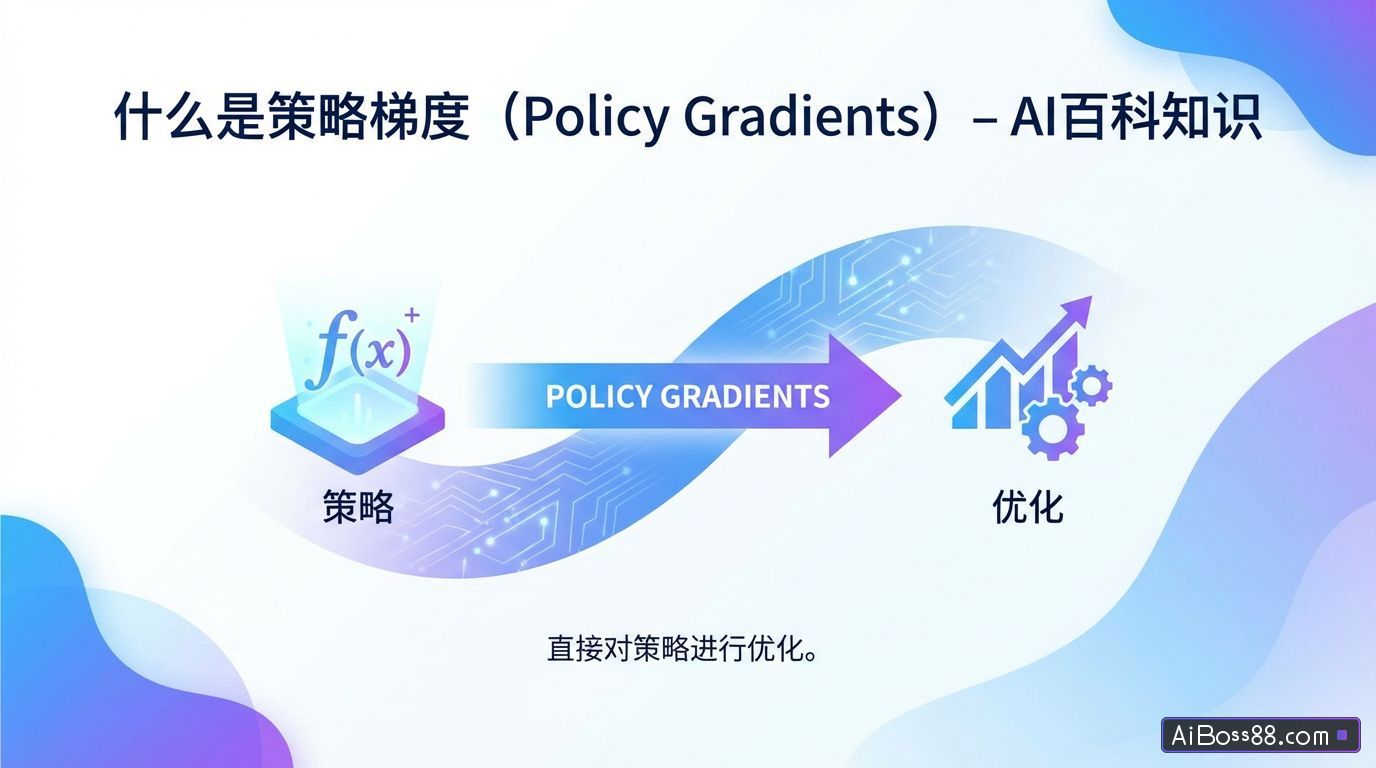
In explorationartificialintelligentIn uncharted territories, reinforcement learning plays a crucial role. Policy gradients, with their ability to directly optimize decision-making policies, have become a key approach for solving decision-making problems in complex environments.powerfulTools. Through continuous trial and error, learn how to make the best choices in changing situations, thereby maximizing cumulative rewards. As research progresses, policy gradients are gradually being unlocked.intelligentbodyIn games, robot control andautomaticThe potential of the system leads us towards a more...intelligentThe future of modernization.
What is policy gradient?
Policy gradients are a method in reinforcement learning that directly optimizes the policy. In this method, the policy is parameterized as a differentiable function, and the policy gradient algorithm optimizes the policy by calculating the gradients of the policy parameters and performing gradient ascent to maximize the cumulative reward. This method does not require calculating Q-values or value functions; it directly learns how to choose the best action given a state through sampling and gradient updates.
How policy gradient works
Policy gradients in reinforcement learning are directly optimized...intelligentbodyThe policy works by defining the probability of taking each possible action in a given state. The core idea is to represent the policy as a parameterized function, using...Neural NetworksTo approximate this, the policy gradient algorithm uses gradient ascent to adjust these parameters, aiming to increase the expected reward generated by the policy. Specifically, the algorithm calculates the gradient of the policy parameters with respect to the expected reward, updates the parameters along the gradient direction, and makes the policy more inclined to choose actions that bring higher cumulative rewards.
In practice, the policy gradient algorithm requires sampling a series of trajectories of states and actions, obtained through interaction with the environment. The algorithm then estimates the reward for each trajectory and computes a gradient estimate, which indicates how to adjust the policy parameters to increase the probability of generating similar trajectories.intelligentbodyIt can gradually learn which actions to take in different states to maximize long-term rewards. A key advantage of this approach is its ability to handle problems with continuous action spaces, which is difficult for traditional value-function-based reinforcement learning methods.
Main applications of policy gradient
The main applications of policy gradient methods in reinforcement learning include:
- Games and simulation environmentsPolicy gradients are widely used in various game and simulation environments, such as chess games and video games. In these applications,intelligentbodyIt is necessary to learn how to make decisions in complex environments to achieve victory or reach specific goals.
- Robot controlIn robotics, policy gradients help robots learn how to perform complex tasks, such as walking, grasping objects, or navigating, by optimizing their behavioral strategies through interaction with the environment.
- automaticdriving vehicles:automaticDriving systems can learn to make driving decisions under varying road conditions, such as lane keeping, obstacle avoidance, and path planning, based on policy gradient methods.
- recommendsystem:existrecommendIn the system, policy gradients can be used for optimization.recommendStrategy, through users andrecommendContent interaction is used to learn user preferences, thereby providing a more personalized experience.recommend.
- Natural Language Processing:existNatural Language ProcessingIn this domain, policy gradients can be used in dialogue systems and machine translation to help models learn how to generate more natural and context-aware responses.
- Financial transactionsThe strategy gradient method has also been applied to financial markets to help trading algorithms learn how to make buy and sell decisions under different market conditions and maximize investment returns.
- Resource ManagementIn resource allocation and management problems, such as power grid management and network flow control, policy gradients can help.intelligentbodyLearn how to effectively allocate resources, meet demands, and optimize performance.
Challenges of policy gradient
While policy gradient methods have applications in many fields, they also face some challenges:
- High-dimensional state spaceIn high-dimensional state spaces, policy gradient methods may encounter the curse of dimensionality, leading to low learning efficiency.
- Sparse rewardsIn many practical problems,intelligentbodyIt can take a long time to receive a meaningful reward, which slows down the learning process.
- The balance between exploration and utilizationPolicy gradient methods need to find a balance between exploring new policies and utilizing known policies, which may be difficult to achieve in practice.
- Strategy stabilityPolicy gradient methods may make policies unstable, especially when parameter updates are large, which may cause the learning process to diverge.
- Credit allocation problemIn multi-step decision-making processes, determining which actions contribute to the final outcome is difficult, i.e., the credit allocation problem, which affects the accuracy of gradient estimation.
- Computing resourcesPolicy gradient methods typically require significant computational resources, especially when using...Deep learningWhen modeling.
- Non-stationary environmentIn non-stationary environments, the dynamics of the environment may change over time, which requires policy gradient methods to adapt to these changes.
- Sample efficiencyPolicy gradient methods typically require a large number of samples to estimate gradients, which limits their application in environments with limited samples.
- Variance of policy gradientHigh variance in gradient estimation can lead to instability in the learning process, requiring techniques such as baselines or dominance functions to reduce variance.
- Overestimation problemPolicy gradient methods may overestimate the value of actions, especially when policy updates are large, which may lead to learning suboptimal policies.
The Development Prospects of Policy Gradient
Policy gradient methods in reinforcement learning are evolving towards improving sample efficiency, enhancing stability and adaptability, and better handling of high-dimensional and complex environments. With continuous algorithm optimization and increased computational power, policy gradients are playing an increasingly important role in...automaticChemicals, robotics, gamesintelligentIts application prospects in fields such as finance and investment are broad, and it is expected to achieve moreintelligentAnd adaptive decision-making systems. Combined withMultimodalData and interdisciplinary knowledge, policy gradients will further driveartificialintelligentInnovation and application.