What is Deep Learning? - AI Encyclopedia
Deep learning is a subset of machine learning. This article introduces what deep learning is, how it works, the differences between deep learning and machine learning, deep learning development frameworks, and more...
What isDeep learning
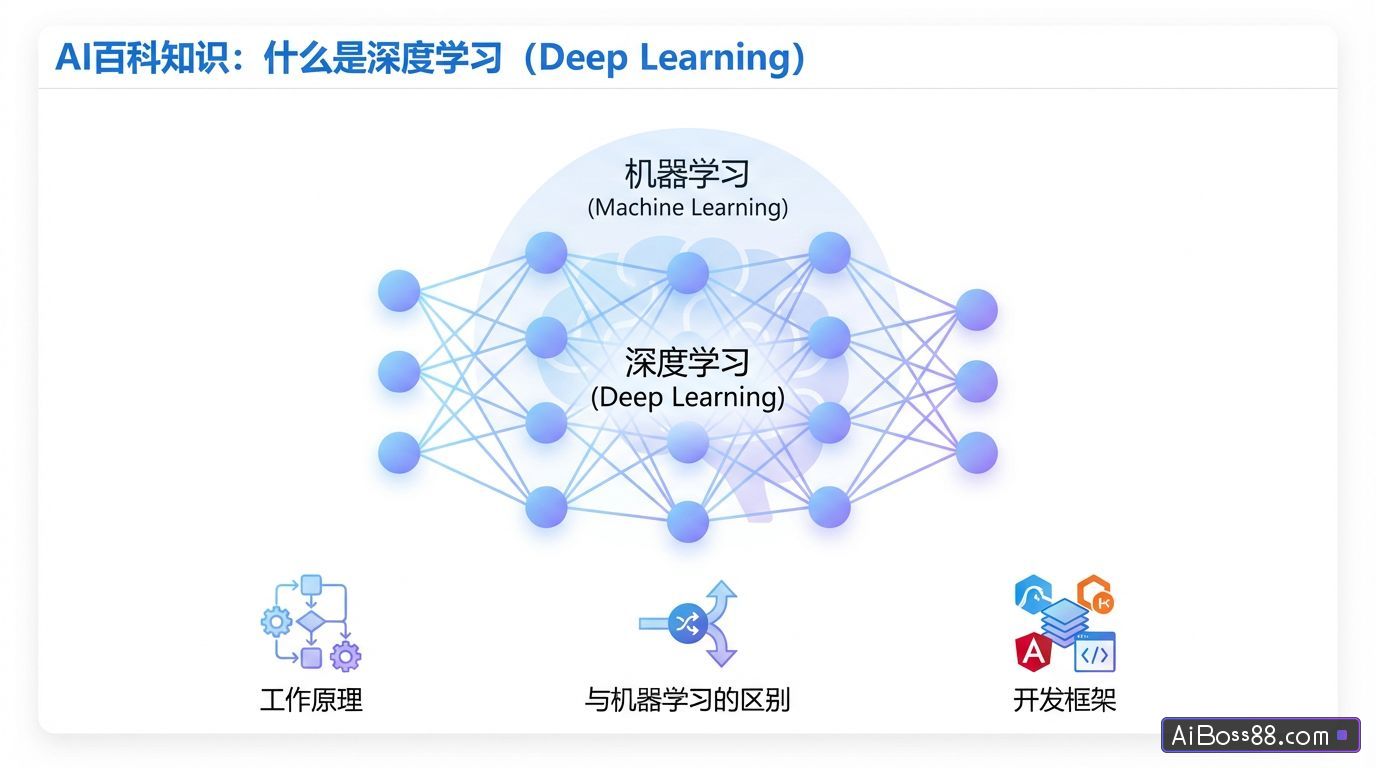
Deep learning(Deep Learning) isMachine LearningA subset of, andMachine LearningyesartificialintelligentOne branch that enables computers to learn from data and perform actions that would normally require human intervention.intelligentOnly tasks that can be completed.Deep learningUsing manualNeural NetworksAn algorithm inspired by the structure and function of the human brain that can learn from large amounts of data and make predictions or classifications.
Deep learningWorking principle
Deep learningThroughNeural NetworksIt creates multiple layers of neurons to work, where each layer can perform some computation on the input data and pass it to the next layer.
- The first layer is called the input layer, which receives raw data such as images, text, or sound.
- The middle layer, called the hidden layer, can extract features or patterns from the data and transform them into a higher-level representation.
- The last layer is called the output layer, which produces the final result, such as a label or score.
The connections between neurons are associated with weights, which determine the degree of influence each neuron has on another. The weights are initially randomized and adjusted during training using a process called backpropagation. Backpropagation involves comparing the network's output with the desired output (ground facts) and calculating an error metric (loss function). This error is then propagated back through the network and used to update the weights according to rules (optimization algorithms).
Deep learningThe training process requires a large amount of labeled data, meaning that each input example has an associated output value. For example, if we want to train a...Neural NetworksTo recognize handwritten digits, we need thousands of images of digits with corresponding labels (0-9). The network learns by looking for patterns and correlations in the data, which help minimize errors and improve accuracy.
Deep learningandMachine LearningDifferences
Deep learningAlthough it isMachine LearningIt is a subset of them, but they differ in terms of data requirements, computing power, feature extraction and performance.
- Data requirements:Machine LearningAlgorithms typically use structured data, meaning each input example has a fixed number of features that are predefined and organized into a table. For example, if we want to classify flowers based on their features, we need to measure features such as petal length, petal width, sepal length, and sepal width.Deep learningThe algorithm can process unstructured data without predefined features, such as images, text, or sound, and can vary in size and format.Deep learningAlgorithms canautomaticExtract features from raw data and learn hierarchical representations.
- Computational ability:Machine LearningThe algorithm can run on a standard CPU and does not require much memory or storage space. Deep learningThe algorithm requires high-performance GPUs or specialized hardware to process large amounts of data and complex calculations, as well as more memory and storage space to store the results and parameters during the process.
- Feature extraction:Machine LearningAlgorithms rely on technicians to define and select relevant features for each problem domain, a process that is time-consuming, subjective, and may fail to capture all aspects of the data.Deep learningThe algorithm extracts data from the raw data using multiple layers of neurons.automaticFeature extraction eliminates some of the manual work, which reduces human intervention and bias, and allows for more generalization and adaptation.
- performance:Machine LearningAlgorithms can achieve good results on many problems, but they may struggle with complex tasks involving high-dimensional inputs, nonlinear relationships, or noisy data.Deep learningAlgorithms can achieve state-of-the-art results for many challenging problems, such as computer vision.Natural Language ProcessingTechnologies such as speech recognition and machine translation sometimes surpass human performance. They can also outperform...Machine LearningAlgorithms handle noisy data better because they can learn robust representations from large amounts of data.
PopularDeep learningDevelopment framework
Deep learningFrameworks help data scientists and developers to more easily and effectively...High efficiencyBuild and deployDeep learningA software library or toolkit for models can abstract away the low-level details of the underlying algorithms and hardware, and provide tools for creating, training, testing, and deploying various types of models.Neural NetworksAdvanced APIs and features. Some of the most popular ones today.Deep learningThe framework is:
- TensorFlow: Developed by Googleopen sourceThe platform supports multiple languages including Python, C++, Java, and Go, and can run on CPUs, GPUs, TPUs, and mobile devices. It provides a flexible and scalable architecture for distributed processing and production environments.
- PyTorch: A technology developed by Facebookopen sourceThis framework is based on Torch, a scientific computing library for Lua. It supports Python as the primary language and can run on both CPUs and GPUs. It provides a dynamic computation graph, offering greater flexibility and interactivity than TensorFlow's static graph.
- Keras: A high-level API that can run on top of TensorFlow, Theano, or CNTK. It supports Python as the primary language and can run on both CPUs and GPUs. It provides...SimpleFurthermore, it features a user-friendly interface for building common types of...Neural NetworksFor example, convolutionNeural Networks (CNN) or recursionNeural Networks (RNN).
- SciKit-Learn: A popular Python... Machine LearningThe library also supports someDeep learningFunctions, such asNeural NetworksModels, feature extraction, dimensionality reduction, etc., can only run on the CPU.
- Apache MXNet: Aopen sourceThis framework supports multiple languages, including Python, R, Scala, and Julia. It can run on various devices, including CPUs and GPUs. It provides a declarative programming style that facilitates parallelization and optimization.
otherDeep learningFrameworks include Caffe (a computer vision application framework), Theano (a Python symbolic mathematics library), Deeplearning4j (a Java framework), MATLAB (a numerical computing environment), Sonnet (a library built on top of TensorFlow), and PaddlePaddle launched by Baidu.
Deep learningApplication scenarios
In image recognition,Natural Language ProcessingIn various tasks such as speech recognition,Deep learningIt can achieve a very high level of accuracy, sometimes even surpassing human performance. The following are...Deep learningHere are some examples of how its ability to learn from data and perform complex tasks can transform various industries and sectors:
- Computer Vision:Deep learningAvailable forautomaticDetect objects, faces, scenes, and activities in images and videos. For example,Deep learningPowering driverless cars that can recognize traffic signs, pedestrians, and other vehicles.
- Natural Language Processing:Deep learningIt can be used to analyze text and voice data for tasks such as sentiment analysis, machine translation, text summarization, question answering, and chatbots.
- Healthcare:Deep learningIt can be used to diagnose diseases, discover new drugs, analyze medical images, and personalize treatments. For example,Deep learningIt can help detect cancer cells from microscopic images.
- finance:Deep learningIt can be used to predict market trends, detect fraud, optimize investment portfolios, and provide customer service. For example,Deep learningIt can help analyze credit card transactions and flag suspicious activity.
- agriculture:Deep learningIt can be used to monitor crops, optimize yields, and detect pests and diseases. For example,Deep learningIt can help identify weeds from aerial images.
- Cybersecurity:Deep learningIt can be used to detect malware attacks. For example,Deep learningIt can help identify malicious files or network intrusions.