What is Self-Supervised Learning? - AI Encyclopedia
Self-supervised learning is a machine learning technique that enables models to learn from unlabeled data by training them through auxiliary tasks that generate labels. Self-supervised learning is used in natural language processing...
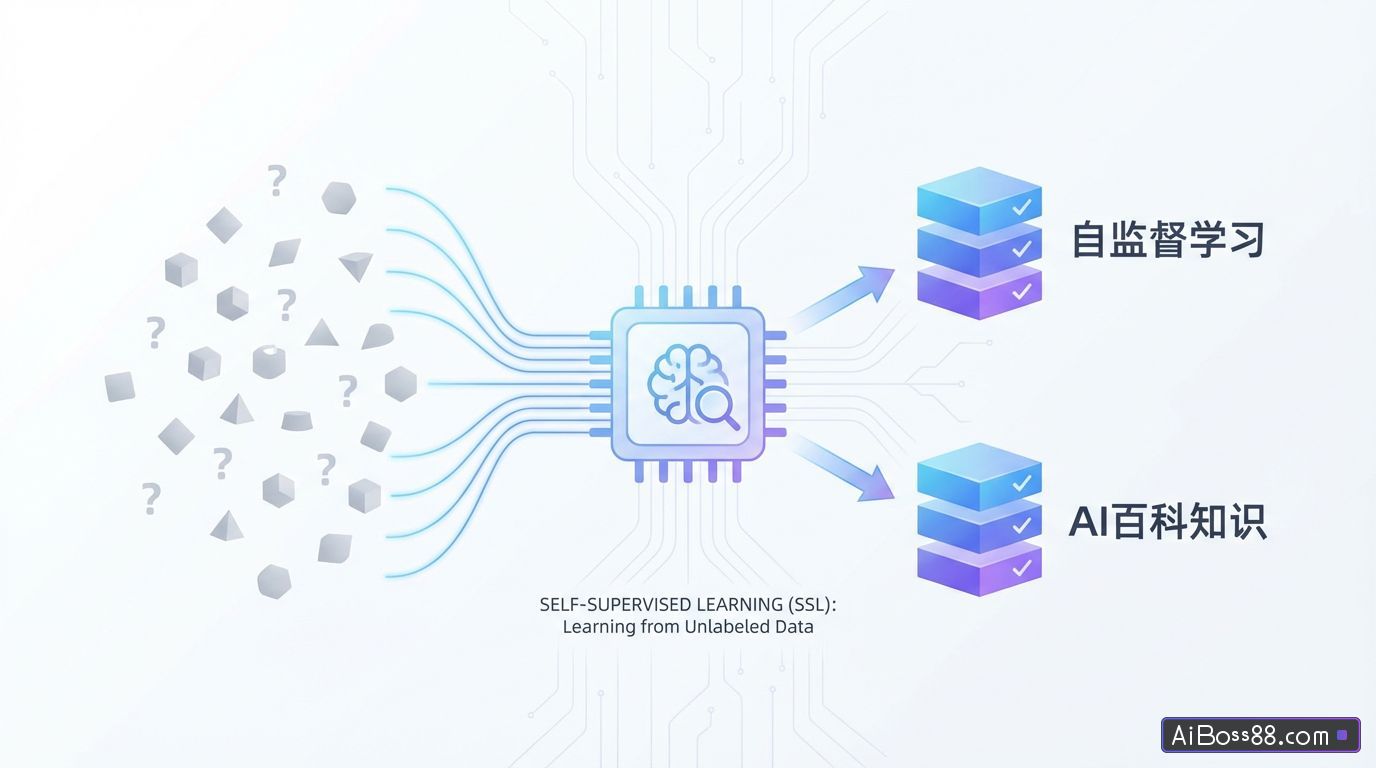
Self-supervised learning is an innovative approach.Machine LearningThis method enables models to learn from large amounts of unlabeled data without relying on expensive manual annotation. By constructing clever auxiliary tasks, the model teaches itself to extract useful information and patterns from the internal structure of the data. Self-supervised learning is revolutionizing the field.artificialintelligentThe boundary, atNatural Language ProcessingSelf-supervised learning has shown great potential in the field of computer vision, offering new avenues for addressing the high costs of data annotation and data privacy concerns. As research progresses, self-supervised learning is expected to unlock even more possibilities.intelligentApplications, drivingAITechnology is developing to a higher level.
What is self-supervised learning?
Self-supervised learning is a type of...Machine LearningThe technology enables models to learn from unlabeled data by training them through auxiliary tasks that generate labels. Self-supervised learning in...Natural Language ProcessingSelf-supervised learning is particularly useful in fields such as computer vision, reducing reliance on large labeled datasets and lowering the cost and time of data annotation. By extracting patterns and structures from the data itself, it learns effective data representations that can be transferred to various downstream tasks.
The working principle of self-supervised learning
Self-supervised learning trains a model by designing auxiliary tasks that leverage the inherent structure within unlabeled data. In these tasks, the model must predict certain parts or attributes of the data that are treated as labels but are actually derived from the data itself. For example, in…Natural Language ProcessingIn a sentence, a model might be asked to predict missing words, while in computer vision, a model might be trained to identify specific parts of an image or the relationships between images. This approach allows the model to learn rich feature representations without requiring manually labeled data.
The advantage of self-supervised learning lies in its ability to handle large-scale datasets and discover complex patterns and structures within the data. The general feature representations learned during the pre-training phase of self-supervised learning models can be transferred and fine-tuned across various downstream tasks, thereby improving model performance on specific tasks. Self-supervised learning is particularly valuable in domains where data labeling is costly or difficult to obtain, due to the reduced need for labeled data. Furthermore, these models are generally more robust to input perturbations and can generalize better to new, unseen data.
Main applications of self-supervised learning
Self-supervised learning has wide applications in many fields, including:
- Natural Language Processing(NLP)Self-supervised learning is used for pre-trained language models, such as BERT andGPTThese models perform well in tasks such as text classification, sentiment analysis, machine translation, question answering systems, and text generation.
- Computer VisionIn tasks such as image recognition, object detection, and image segmentation, self-supervised learning helps models learn visual features without requiring a large amount of manually labeled data.
- Medical Imaging AnalysisSelf-supervised learning is used to extract useful features from medical images to aid in diagnosis, such as identifying abnormal tissue or lesions.
- Video processingIn fields such as video content understanding, action recognition, and scene reconstruction, self-supervised learning helps to learn spatiotemporal features from video sequences.
- Speech recognitionSelf-supervised learning improves speech-to-text conversion systems and enhances robustness to different accents, background noise, and speaking styles.
- recommendsystemSelf-supervised learning can be used to improve [the learning process] by learning representations of user behavior and content features.recommendAlgorithms provide more personalized...recommend.
- Anomaly detectionIn fields such as industry, finance, and cybersecurity, self-supervised learning is used to identify anomalous patterns, helping to detect fraudulent activities or system failures.
- automaticdriveSelf-supervised learning helpsautomaticEnvironmental perception in driving systems, such as the recognition of roads, pedestrians, and vehicles.
Challenges of self-supervised learning
While self-supervised learning has enormous potential and wide applications, it also faces some challenges:
- Design effective auxiliary tasksThe success of self-supervised learning largely depends on the quality of the designed auxiliary tasks. Finding auxiliary tasks that truly reflect the needs of the downstream tasks is a challenge.
- Selection of negative samplesIn self-supervised methods based on contrastive learning, selecting appropriate negative samples is crucial for the model to learn to distinguish between different samples. Inappropriate selection of negative samples may lead to a decline in model performance.
- Overfitting riskSelf-supervised learning models may over-adapt to auxiliary tasks and neglect generalization ability, resulting in poor performance in real-world applications.
- Computing resource requirementsSelf-supervised learning typically requires significant computational resources for training, especially when dealing with large-scale datasets, which may limit its application in resource-constrained environments.
- Verification of generalization abilityVerifying the generalization ability of a self-supervised learning model is a challenge because the model's performance on auxiliary tasks may not be directly reflected in downstream tasks.
- Lack of theoretical foundationThe field of self-supervised learning lacks a unified theoretical framework to explain and guide model design and training, which introduces certain uncertainties into research and application.
- Imbalance of labeled dataIn some tasks, self-supervised learning may struggle to handle imbalanced labeled data, as it relies on generating labels from the data itself.
- Model interpretabilitySelf-supervised learning models are often considered "black boxes" because their internal workings and decision-making processes lack transparency, which is a problem in applications that require model interpretability.
- Data diversity and qualityThe effectiveness of self-supervised learning is affected by the diversity and quality of the training data. Bias and noise in the dataset can affect the representations learned by the model.
- Adaptability of downstream tasksWhen transferring a self-supervised learning model to a specific downstream task, additional adjustments and fine-tuning may be required to ensure that the model can effectively adapt to the new task.
The Development Prospects of Self-Supervised Learning
Self-supervised learning asMachine LearningSelf-supervised learning is an important branch of the field with broad development prospects. With continuous algorithm optimization and improved computing power, it is expected that self-supervised learning will further improve the generalization ability and robustness of models while reducing reliance on large amounts of labeled data. In the future, it may achieve breakthroughs in more fields, particularly in medical diagnosis.automaticDriving, PersonalizationrecommendSelf-supervised learning plays a crucial role in high-value applications such as systems. With further theoretical research, the principles and methods of self-supervised learning will mature, potentially solving current challenges and driving the entire field forward.artificialintelligentDevelopment of the field.