What is MCP (Model Context Protocol)? - AI Encyclopedia
The Model Context Protocol (MCP) is an open protocol that enables seamless communication between large language models (LLMs) and external tools and data sources. It achieves interfacing with various data sources through a unified protocol...
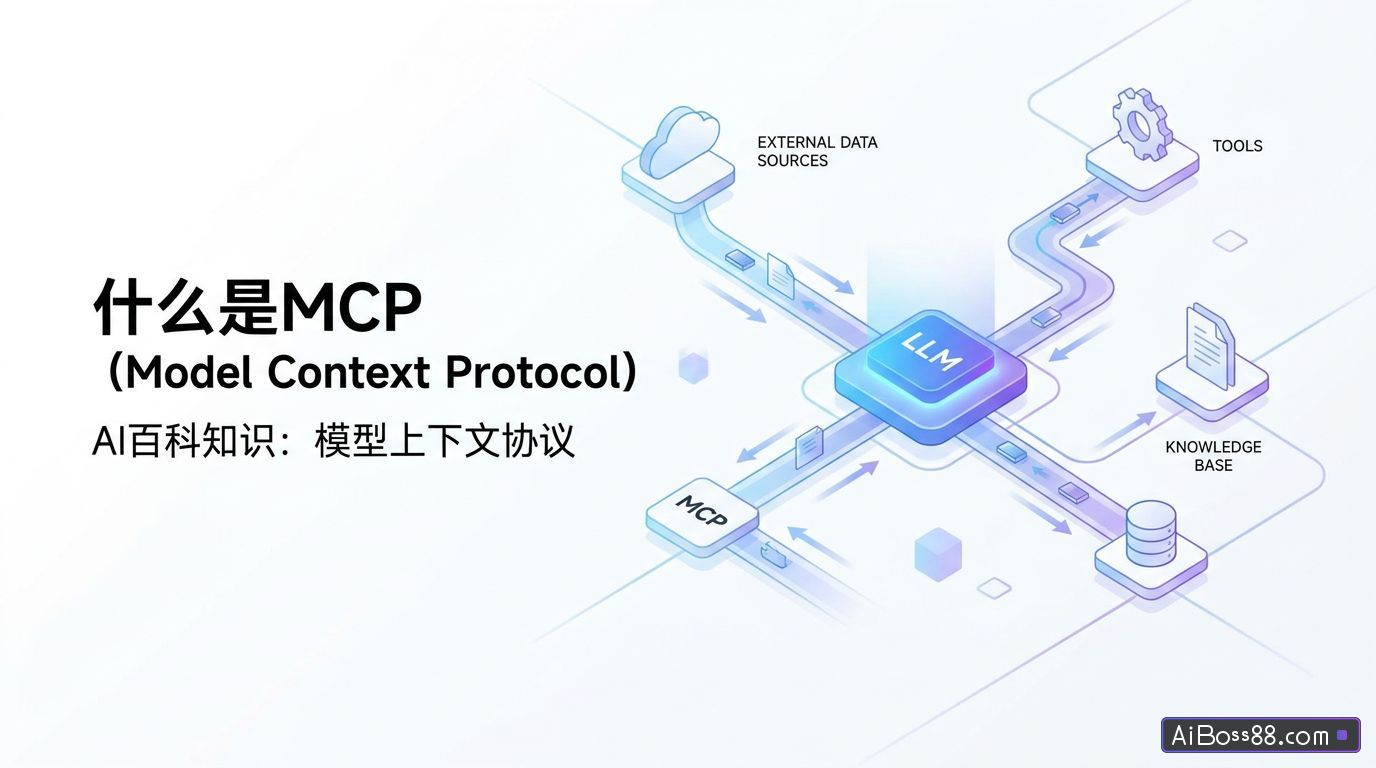
MCP (Model Context Protocol) is an open protocol introduced by Anthropic that allows large language models (LLMIt enables seamless communication with external tools and data sources. Employing a client-server architecture, it uses standardized interfaces to allow...LLMThe application is safe.High efficiencyMCP connects seamlessly to various data sources and tools, such as databases, file systems, and third-party APIs. Its core advantages lie in its uniformity, security, and scalability. Supporting tools, resources, and prompts, it helps users complete various tasks, such as file management, information retrieval, and communication assistance. The MCP protocol is...AIIt provides a standardized bridge for connecting with external data resources, and is expected to promoteAIFurther development and popularization of the application.
What is the Model Context Protocol?
The Model Context Protocol (MCP) is an open protocol that allows large language models (LLMIt enables seamless communication with external tools and data sources. A unified protocol facilitates plug-in access to various data sources, avoiding the need to write separate code for each data source. It ensures that sensitive information (such as API keys and user data) is adequately protected during data interaction.
How the Model Context Protocol Works
MCP (Model Context Protocol) works based on a client-server architecture, using a standardized communication protocol to implement large language models.LLMSeamless integration with external tools and data sources.
The core architecture of MCP consists of three main components:
- MCP Host: is used by usersAITools or applications (e.g.)Claude Desktop, IDE plugins, etc.), and also act as an MCP client to initiate connections to external resources.
- MCP ServerA lightweight service for connecting to specific data sources or tools (such as databases, file systems, third-party APIs, etc.). Each MCP server typically focuses on a specific resource or function.
- Protocol layer: Employs standard communication protocols such as JSON-RPC or gRPC to ensure secure message transmission between the host and server.fastAnd they are consistent.
The working principle and process of MCP:
- Initialize connectionThe client sends a connection request to the server to establish a communication channel.
- Send RequestThe client constructs a request message based on its needs and sends it to the server.
- Processing requestsAfter receiving a request, the server parses the request content and performs the corresponding operation (such as querying the database, reading a file, etc.).
- Return resultsThe server encapsulates the processing result into a response message and sends it back to the client.
- DisconnectAfter the task is completed, the client can either close the connection manually or wait for the server to time out and close it.
MCP supports two main communication mechanisms:
- local communicationData is transmitted via standard input/output (stdio), suitable for communication between clients and servers running on the same machine.
- Remote communicationBy combining SSE (Server-Sent Events) with HTTP, real-time data transmission across networks can be achieved, which is suitable for scenarios that require access to remote resources or distributed deployments.
MCP servers can provide three main types of functionality:
- ToolsIt can beLLMThe function being called requires user approval before it can be executed, such as retrieving weather forecasts or querying a database.
- ResourcesFile-like data that can be read by the client, such as API responses or file content.
- hint(Prompts)Preset templates to help users complete specific tasks, optimizedLLMThe output of .
Through the above design, MCP simplifiesAIThe integration process with external data sources and tools provides greater security and flexibility.
Main applications of the Model Context Protocol
- File Management:AIThe assistant can organize the user's download folder using MCP, and the user can use commands.AI"Organize the meeting minutes from last week on my computer."AIIt will directly access the file system to complete the categorization, archiving, and summary generation. Meeting notes will be converted into to-do items and synchronized to the user's calendar.
- Information InquiryDirectly search local documents or query PDF content. Users can ask...AIWhat are the conclusions of this report?AIIt will read and analyze PDF files to provide summaries. It will also retrieve weather, map navigation, or news briefings from the MCP server. For example, a user can ask, "What's the weather like in Beijing today?"AIThe weather API will be called to obtain and return the weather forecast.
-
Code repository managementIt integrates with Git and GitHub/GitLab to manage code repositories and perform code commits.
- Communication SupportSlack messages were drafted based on the report. For example, users could request...AI"Draft a Slack message based on this project report."AIAnalyze the report content and generate appropriate communication texts. Summarize the team chat content.AICanautomaticSummarize the key points of the discussion in the Slack channel to help users.fastUnderstanding team communicationup to dateprogress.
- Network services: Obtain weather, map navigation, or news briefings through the MCP server. For example, users can request...AI"Give me today's news summary."AIWill call the news API to getup to dateInformation and provides summaries.
- Development tool integration:AIThe driver's IDE can use MCP to connect to the MCP server of the code repository and documentation database to obtain...up to dateCode and documentation information, providing real-time code suggestions, bug explanations, and documentation links. For example, developers can request...AI"Show the documentation for this code"AIWe will consult the relevant API documentation and provide detailed explanations.
- Customer service chatbotChatbots need access to the company's knowledge base, customer data, and external databases to answer queries. For example, a customer might ask, "What is the status of my order?" The chatbot will access the order system through the MCP server and provide the answer.up to dateinformation.
- Personal Assistant:AIThe assistant manages the user's calendar, emails, and files, providing reminders, summaries, and organization features. For example, users can request...AI"Schedule a meeting for tomorrow morning."AIWe will check available time slots in the calendar and schedule meetings.
- Research toolsResearchers usedAITools for accessing academic databases, web searches, and managing references. For example, researchers can request...AI"Find information about climate change"up to dateResearch",AIThe academic search engine will be accessed and relevant literature will be provided through the MCP server.
Advantages of Model Context Protocol
-
Standardization and interoperabilityCreate a compatible and collaborative ecosystem to reduce dependence on specific vendors.
-
Simplified integrationReduce integration complexity; developers only need to integrate once to connect to any data source.
-
Enhance context awareness:AI The model can access real-time data and provide more relevant responses.
-
SecurityBuilt-in security mechanisms protect data security and user privacy.
-
Reduce development costsStandardize the development process to reduce development complexity.
-
Adaptability and scalabilitySupports new technologies and maintains compatibility with new models and tools.
Comparison of MCP with traditional APIs and function calls
-
Self-description toolMCP's tools come with metadata, reducing reliance on external documentation.
-
Communication modeMCP supports stateful, bidirectional, real-time communication, making it suitable for complex interactions.
-
Context processingMCP provides stronger context awareness and management capabilities.
-
InteroperabilityMCP is model-independent and aims to become a universal standard.
-
flexibilityMCP supports dynamic tool discovery and adaptation.
-
SecurityMCP has a built-in security mechanism to protect resources.
Challenges of Model Context Protocols
- Implementation of standardized access control and user authorization mechanismsMCP needs to ensure that sensitive information (such as API keys and user data) is adequately protected during data exchange. This requires implementing a standardized access control and user authorization mechanism to ensure that only authorized users can access the system.AIOnly then can the model access specific data sources or perform specific operations.
- Compatibility and scalability of communication protocolsMCP adopts a client-server (C/S) architecture and encapsulates message types such as requests, notifications, and responses based on JSON-RPC 2.0. To ensure compatibility between different systems and platforms, MCP must support multiple transport mechanisms, such as Stdio (local process communication) and HTTP+SSE (remote communication).
- MultimodalInteractive support for resourcesThe requirement for MCP is that it must not only process traditional text data, but also be able to process and understand multiple types of data. This increases the complexity of MCP in terms of data processing and analysis, requiring more advanced data processing technologies and algorithms to support it.
- Error handling and exception managementMCP defines standard error codes, such as
ParseError (-32700)andInvalidRequest (-32600)In practical applications, MCPs need to be able to handle various abnormal situations and provide clear error messages and solutions. This requires MCPs to be designed with all possible error scenarios in mind and to provide corresponding error handling mechanisms. - Complexity of integration and deploymentWhile MCP reduces development complexity, integrating and deploying it in practical applications can still present challenges. Developers may need to modify existing systems to support MCP, potentially involving complex configuration and debugging processes. MCP deployment also requires consideration of different operating environments and platforms, which may necessitate additional work to ensure compatibility.
- Performance and scalability issuesMCPs may encounter performance bottlenecks when handling large amounts of data or high-concurrency requests. To ensure system responsiveness and stability, MCPs need to optimize their data processing and communication mechanisms. As the number of users and data volume increases, MCPs need to have good scalability to support larger-scale applications.
- User experience and ease of useOne of the goals of MCP is to provide a unified interface that simplifies the user experience.AIThe interaction of the model. In practical applications, users may encounter situations where the operation is complex or difficult to understand.
- Community support and ecosystem buildingFor MCP to achieve wider application, more developers and enterprises need to participate in its development and promotion. This includes providing more MCP server implementations, development tools and tutorials, as well as building an active community to share experiences and best practices.
- The formulation of industry standards and normsAs an open standard protocol, the future development of MCP may be influenced by industry standards and specifications. To ensure the widespread adoption and compatibility of MCP, coordination with existing standards and specifications is necessary, which may require participation in the development of new industry standards. This necessitates industry cooperation and consensus, and may encounter some challenges and resistance.
- Challenges to security and privacyWith increasing awareness of data security and privacy protection, MCPs may face more stringent security and privacy requirements in future applications. This necessitates that MCPs continuously strengthen their security mechanisms, such as encryption, authentication, and access control, to meet evolving security needs.
- The speed of technological updates and iterationsMCP needs continuous updates and iterations to adapt to new technological trends, such as...MultimodalInteraction, distributed architecture, etc. This requires MCP developers and the community to...fastRespond to technological changes and update the implementation and specifications of MCP in a timely manner.
- Market competition and alternativesMCP's success in the market also depends on its competition with other technological solutions. Other similar protocols or technologies, such as APIs and SDKs, may exist in the market, potentially offering similar functionality or advantages. MCP needs to compete with these solutions in terms of functionality, performance, ease of use, and cost to gain market acceptance.
The Development Prospects of Model Context Protocols
The development prospects of MCP (Model Context Protocol) are promising, with...AITechnology andLarge ModelAs application scenarios continue to expand, more enterprises and developers will build diverse applications based on MCP, promoting cross-platform and cross-data source interconnectivity. With ongoing practice, the MCP protocol standard will be continuously improved, further enhancing security and scalability. From data querying and task collaboration to complex...automaticWith streamlined process management, MCP will play a key role in more vertical industries, providing...AI AgentThe times bring moreHigh efficiency,EvenintelligentThe solution. MCP refactors through standardized protocols.AIThe way data is interacted with lowers the development threshold, enabling...AIThe widespread adoption and application of technology have opened up more possibilities. It is projected that by 2025, 60% of...LLMThe application will use MCP for data integration. This demonstrates that MCP can improve development efficiency, stimulate broader developer community participation, and foster more innovation.AIapplication.