What are Adversarial Examples? - AI Encyclopedia
Adversarial examples are deliberately designed data points that introduce tiny, imperceptible perturbations into the original samples, causing machine learning models, especially deep learning models, to give incorrect results with high confidence...
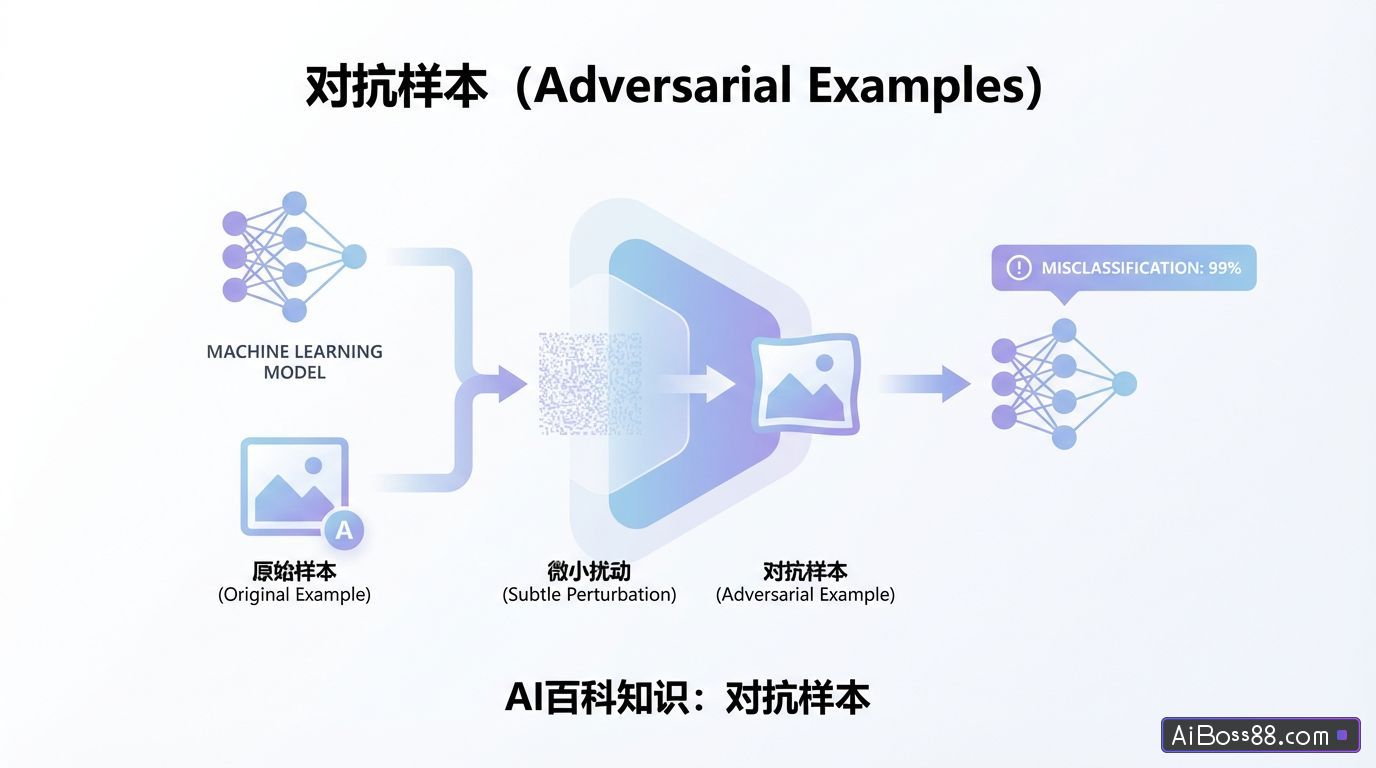
Adversarial Examples asMachine LearningA unique phenomenon in this field is that by subtly implanting imperceptible perturbations into the input data, it is possible to mislead...Deep learningThe model made an incorrect prediction. This reveals the current situation.artificialintelligentThe vulnerability of systems has also spurred in-depth research into improving model robustness. With the development of adversarial example techniques, these techniques are gradually becoming a driving force for advancement.artificialintelligentA vital force in safety and reliability research, for the futureintelligentThe design and deployment of the system have a profound impact.
What are adversarial examples?
Adversarial examples are deliberately designed data points that introduce tiny, imperceptible perturbations into the original samples, leading to...Machine LearningModels, especiallyDeep learningThe model makes incorrect predictions with high confidence. These samples appear identical to normal samples to human observers, but the model may make drastically different judgments. The existence of adversarial examples reveals...Deep learningThe fragility of models has spurred research into model robustness.
How adversarial examples work
The working principle of adversarial examples is based onDeep learningThe internal characteristics of a model, especially its high-dimensional representation of the input data, are crucial. These models typically contain multiple layers, each learning complex features of the data to extract information. Adversarial examples exploit the model's sensitivity to the input by deceiving it with carefully calculated, tiny perturbations. These perturbations are almost imperceptible to human vision but are enough to push data points near the model's decision boundary, causing them to be misclassified.
In practice, attackers calculate the gradient of the target model, which is an indicator of the loss function's sensitivity to the input data. By adjusting the input data in the direction that increases the loss function, adversarial examples can be constructed. This process can be one-step or multi-step iterative; the latter is often referred to as adversarial training. Generating adversarial examples usually requires a certain understanding of the model's structure and parameters; this type of attack is called a white-box attack. Even without information about the model's internal workings, effective adversarial examples can be generated through black-box attacks.
Main applications of adversarial examples
Adversarial examples inMachine LearningandDeep learningThe field has several major applications, including:
- Security Testing and EnhancementAdversarial examples are used for testing and enhancement.Machine LearningThe model's safety and robustness. By generating adversarial examples and evaluating the model's response to these examples, researchers can identify and fix potential weaknesses in the model.
- Model EvaluationAdversarial examples provide a way to evaluate a model's generalization ability. If a model performs poorly in predicting adversarial examples, it may indicate that the model relies too much on specific features in the training data rather than learning more general patterns.
- Combat trainingIn adversarial training, the model is trained to identify and resist adversarial examples. By incorporating adversarial examples during training, the model's resistance to such attacks can be improved.
- Data cleaningThe concept of adversarial examples is also used for data cleaning to identify and exclude data points that may mislead model training.
- semi-supervised learningAdversarial examples can be used for semi-supervised learning. By generating adversarial examples that closely resemble unlabeled data points, models can better learn the underlying structure of the data.
- Model interpretabilityAdversarial examples help us understand the model's decision-making process. By analyzing which small changes affect the model's output, researchers can gain a deeper understanding of how the model makes predictions.
- Attack Detection and DefenseResearch on adversarial examples has facilitated the development of more effective attack detection and defense mechanisms, protecting against attacks.Machine LearningThe system is protected from malicious attacks.
- artificialintelligentEthics and Policy MakingThe existence and influence of adversarial examples also affectartificialintelligentThis influences ethics and policymaking, prompting policymakers to consider how to ensure...AISystem security and reliability.
Challenges of adversarial examples
The research and application of adversarial examples face several major challenges:
- Detection difficultyAdversarial examples are often designed so subtly that they are almost visually indistinguishable from normal examples, making them difficult to detect by observation alone.
- Model robustnessImproving a model's robustness to adversarial examples is a complex process that requires a deep understanding of the model's decision boundaries and how to strengthen these boundaries through training.
- Generalization abilityEven if a model is robust to adversarial examples on the training data, it is difficult to guarantee that it will be equally effective on unknown data, which involves the model's generalization ability.
- Computing resourcesGenerating effective adversarial examples typically requires a large amount of computational resources, especially for complex models and high-dimensional data.
- The Evolution of Adversarial AttacksAs adversarial sample detection technology advances, attackers are constantly developing new attack strategies, leading to a continuous offensive and defensive confrontation.
- Evaluation of defense strategiesEvaluating the effectiveness of a model or defense strategy against adversarial examples is difficult because there is no unified standard or testing protocol.
- Data and model privacyResearch on adversarial examples may expose sensitive data and model information, which is particularly problematic when dealing with privacy-sensitive applications.
- Feasibility of practical applicationIn real-world applications, deploying models that can withstand adversarial examples can become complicated due to resource constraints, performance degradation, or real-time requirements.
- Ethical and legal issuesAdversarial examples could be used for malicious purposes, which has sparked discussions about...artificialintelligentAn important discussion on ethical and legal responsibility.
- Cross-domain impactResearch on adversarial examples not only affectsMachine LearningThis issue may also have implications for other areas, such as cybersecurity.automaticDriving a car, for example, requires interdisciplinary collaboration and understanding.
The Development Prospects of Adversarial Examples
Adversarial examples asMachine LearningEspeciallyDeep learningThis is an important research direction in the field, with broad development prospects. Future research will focus on developing more...High efficiencyAlgorithms are used to generate and detect adversarial examples, while improving the robustness of the model. Adversarial training and other techniques will be further optimized to enhance the stability and security of the model in practical applications. With further research, adversarial examples are expected to become a key technology for improving...AIA key tool for system generalization and interpretability, it will also spark further discussion on ethical and legal levels, and drive progress.artificialintelligentResponsible development.