What is Neural Network Pruning? - AI Encyclopedia
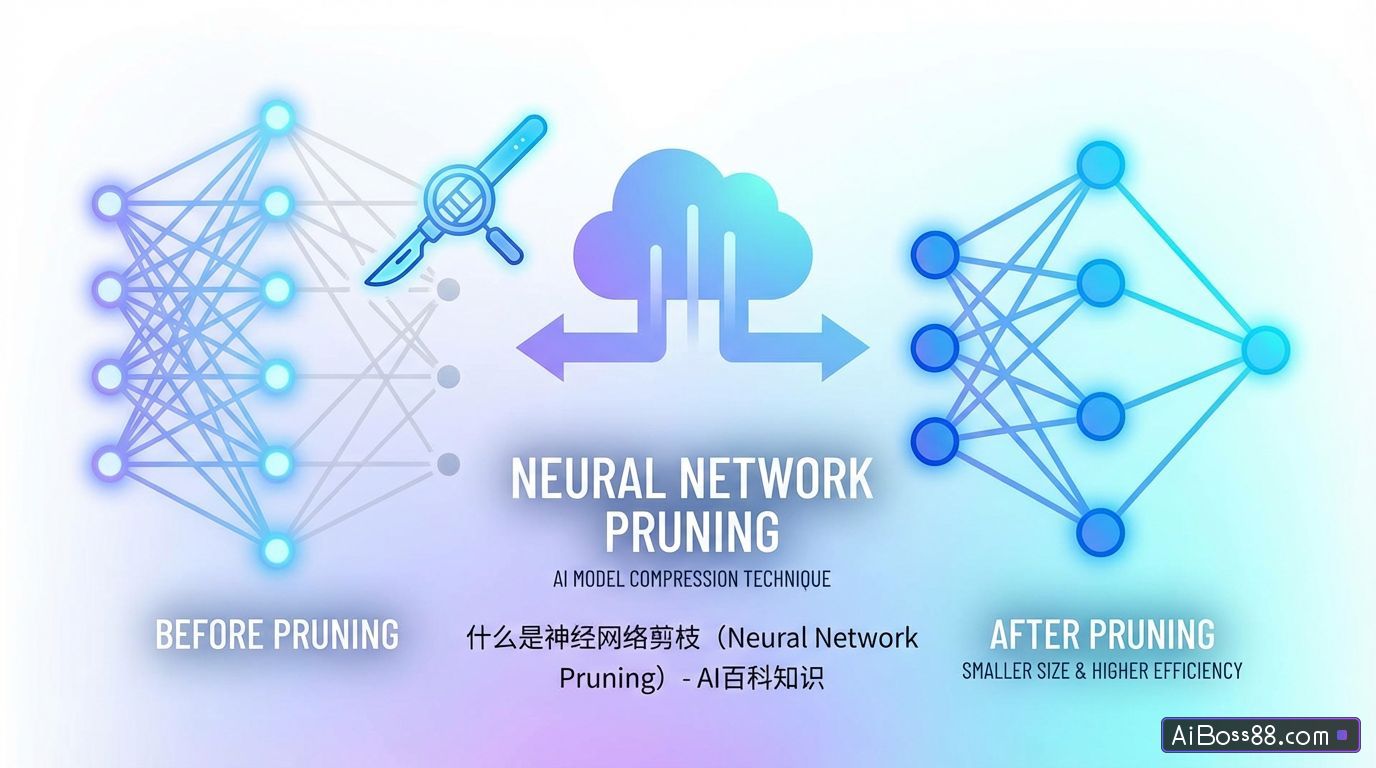
Neural network pruning is a model compression technique that reduces model size and computational complexity by removing unimportant weights or neurons from a neural network, thereby improving runtime efficiency. It is divided into...
existDeep learningfield,Neural NetworksNeural Network Pruning has become a key technique for optimizing models. As models grow increasingly large, effectively reducing computational burden and storage requirements while maintaining or even improving performance has become a research hotspot. Pruning techniques involve carefully removing...Neural NetworksRemoving less important weights or neurons can help improve the model's efficiency and enhance its applicability on resource-constrained devices. This paper will explore the principles and methods of pruning, as well as its potential and challenges in practical applications.
What isNeural NetworksPruning
Neural NetworksNeural Network Pruning is a model compression technique that removes...Neural NetworksLess important weights or neurons can be pruned to reduce model size and computational complexity, thereby improving runtime efficiency. This is divided into weight pruning and neuron pruning, which can be performed before, during, or after training. It reduces resource consumption while maintaining model performance, making it suitable for edge computing and real-time applications.
Neural NetworksThe working principle of pruning
Neural NetworksNeural Network Pruning works by identifying and removing weights or neurons that have the least impact on model performance. Weight pruning typically focuses on individual weights, setting thresholds to reset smaller weights to zero, thereby reducing the number of parameters in the model.Neural NetworksPruningSimpleIt is easy to implement, but may not significantly change the computational graph structure of the model. Neuron pruning, on the other hand, is more aggressive, reducing model complexity by removing entire neurons or filters. This may change the network architecture, but can more effectively reduce the consumption of computational resources.
Pruning can occur at any stage of model training: before, during, or after training. Pre-training pruning focuses on removing unnecessary connections during initialization; during training pruning uses sparsity as a training objective, gradually eliminating unimportant weights; post-training pruning is performed after the model has been fully trained, removing those weights with the least impact on final performance by analyzing their importance. Regardless of the method, fine-tuning the model is usually necessary after pruning to restore or maintain its performance.
Neural NetworksMain applications of pruning
Neural NetworksThe main applications of pruning include:
- Edge device deploymentIn resource-constrained equipment such asintelligentDeployed on mobile phones, embedded systems or IoT devicesHigh efficiencyPruning can significantly reduce model size and computational requirements, enabling these devices to run complex models.Neural Networks.
- Real-time applicationsWhen neededfastResponse application scenarios, such asautomaticIn driving, real-time video analytics, and speech recognition, pruning speeds up inference and reduces latency by reducing model complexity.
- Cloud service optimizationOn cloud platforms, pruning helps reduce server computing load and energy consumption, lower operating costs, and improve the ability to handle large numbers of requests.
- Model transfer and storageReducing model size can optimize model storage requirements and network transmission time, which is especially important for models that need to be frequently updated and distributed.
- Improve hardware utilizationGiven fixed hardware resources, the pruned model can be more...High efficiencyMake full use of existing hardware to improve throughput and energy efficiency.
- Enhancing model interpretabilityPruning helps reveal key features of a model by removing unimportant weights, thus improving the model's interpretability and transparency.
- Continuous learning and incremental learningIn continuous or incremental learning scenarios, pruning helps maintain model size, enabling the model to continuously integrate new data without consuming resources too quickly as the model grows.
- Hardware-specific optimizationPruning can improve the efficiency and performance of a model on a specific hardware architecture (such as GPU or TPU).
Neural NetworksChallenges of pruning
Neural NetworksWhile pruning brings many benefits, it also presents some challenges:
- Determine pruning strategyChoosing the right pruning strategy and threshold is a major challenge, as inappropriate pruning can lead to a significant drop in model performance.
- Maintain model performanceMaintaining or even improving the accuracy and generalization ability of a model while reducing its complexity is a process that requires careful balancing.
- Dynamics and sparsityAs the model is pruned, its dynamics and sparsity will change, which may affect the model's learning and inference processes.
- Hardware compatibilityAlthough pruning can improve model efficiency, not all hardware can effectively support sparse matrix operations, which limits the performance improvement brought by pruning.
- Calculation cost of pruningThe pruning process itself may require additional computational resources, especially when iterating and fine-tuning.
- automaticgeneralization and generalization:automaticStreamlining the pruning process and ensuring that pruning strategies work well on different models and datasets is a challenge.
- Fine-tuning after pruningThe pruned model needs fine-tuning to restore performance, but finding the best fine-tuning strategy can be both time-consuming and complex.
- The complexity of structured pruningCompared to unstructured pruning, structured pruning can be more complex because it involves deleting entire neurons or filters, requiring more sophisticated pruning strategies.
- Stability of pruningThe pruning effect may vary on different training cycles or different datasets, making the pruning process difficult to reproduce stably.
- Explanability of pruningWhile pruning can help improve the interpretability of a model, the pruning decision process itself may not be transparent enough to explain why some connections are preserved while others are removed.
Neural NetworksThe Prospects of Pruning Development
Neural NetworksThe prospects for pruning appear optimistic. With...Deep learningIts continuous penetration into various fields has led toHigh efficiencyWith the increasing demand for lightweight models, pruning techniques are becoming increasingly important due to their ability to reduce model size and improve computational efficiency without sacrificing too much performance. Future research may focus on developing more...intelligentandautomaticThere are various pruning algorithms that can dynamically adjust during training to better adapt to different hardware platforms and application scenarios. With advancements in hardware technology, especially those that can fully utilize model sparsity, the benefits of pruning will become even more significant, driving pruning techniques to become a routine step in model optimization.