What is a Vector Database? - AI Encyclopedia
Vector databases are database systems specifically designed for storing and querying vectors. They are used to represent multi-dimensional data points, such as data used in machine learning and artificial intelligence. In a vector database, data is represented as vectors, which...
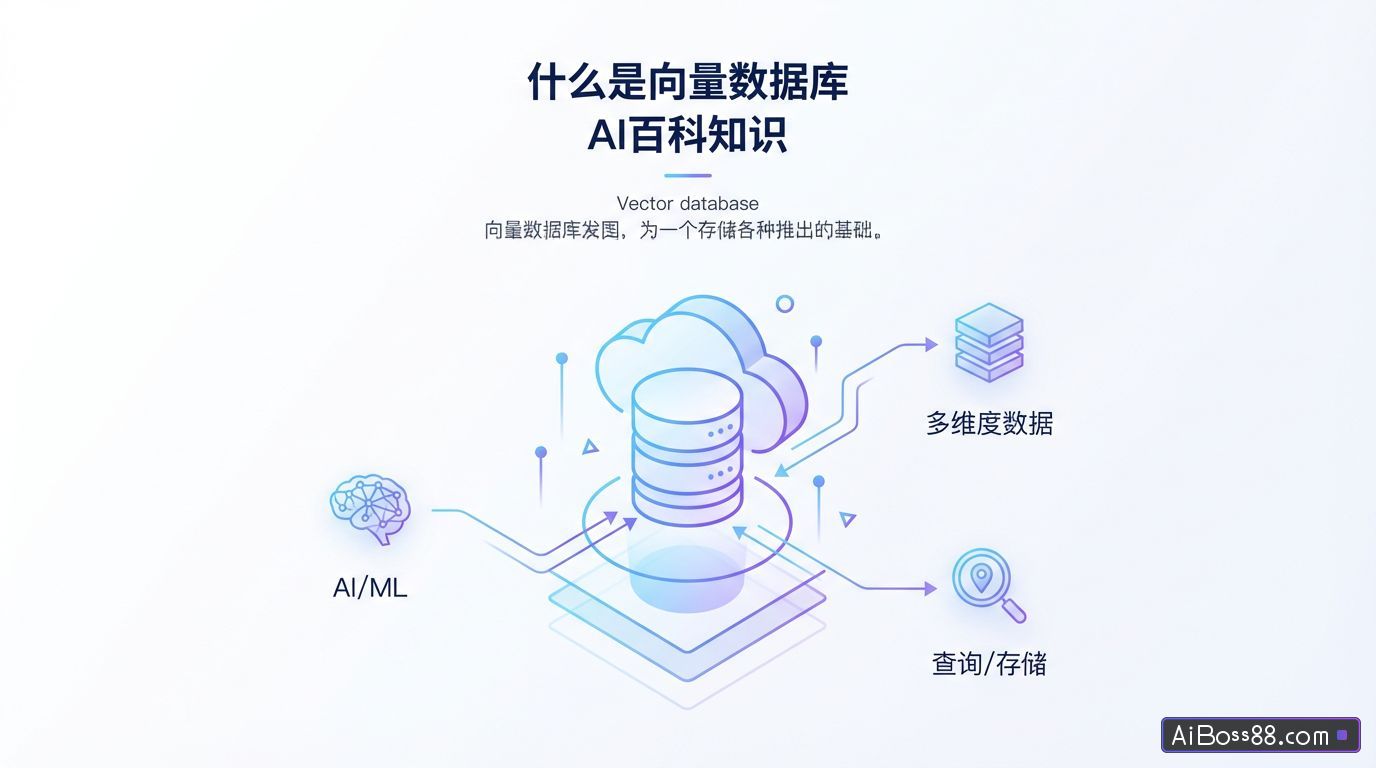
A vector database is a database system specifically designed for storing and processing vector data. It uses vectors as its basic data type and as the primary organizational form of data. Unlike traditional relational databases, vector databases employ a completely new data model and index structure, making the processing and analysis of large-scale vector data much more efficient.High efficiencyAnd convenient. The core of a vector database lies in its...High efficiencyThe vector database possesses similarity search and matching capabilities. To achieve this, it employs special indexes and algorithms when storing and querying vector data.
What is a vector database?
Vector databases are database systems specifically designed for storing and querying vectors. They are used to represent multi-dimensional data points, such as...Machine LearningandartificialintelligentThe data used in vector databases is represented as vectors, which can be compared and searched in a multi-dimensional space. Compared to traditional databases, vector databases can handle more unstructured data, such as images and audio, meeting a wider range of data processing needs.
How vector databases work
Vector databases are specifically designed to store high-dimensional vector data. These vectors can represent various types of data, such as images, text, or sound, and are represented as numerical arrays in a multidimensional space. Vector databases use embedding models to convert data (such as text, images, etc.) into numerical vectors, capturing the semantic or structural information of the data, facilitating processing.High efficiencyThe vector database performs comparisons and similarity searches. To accelerate similarity searches, it constructs specific index structures, such as KD-trees, ball trees, and LSH (Locality Sensitive Hash), to improve search efficiency. When a user initiates a query, the vector database uses the index structure...fastThe database searches and returns the data results most similar to the query vector. This involves distance calculation and similarity assessment; the database utilizes a pre-built index structure to accelerate this process, providing...fastAccurate search results.
Vector databases may also employ clustering algorithms, such as K-Means and DBSCAN, to organize vectors into cohesive groups based on common features, facilitating pattern recognition and anomaly detection. The query processors of vector databases differ from those of traditional relational databases, involving complex steps such as parsing, optimizing, and executing queries, handling complex operations like nearest neighbor identification and similarity search. Vector databases support horizontal scaling, capable of handling large-scale vector data, operating in distributed environments, and adapting to increasing data volumes. Data normalization is a crucial step in ensuring consistent performance for distance-based operations; commonly used techniques include min-max scaling and Z-score normalization. Hashing techniques transform high-dimensional data into a simplified, fixed-size format, optimizing vector indexing and retrieval processes. Noise reduction techniques aim to reduce irrelevant or redundant information, improving data clarity and relevance. Query expansion in vector databases enhances the effectiveness of search queries, while data visualization techniques such as PCA, t-SNE, and UMAP transform high-dimensional data into easily understandable visuals, aiding analysis and decision-making. These features enable vector databases to provide [performance/capability] when handling large-scale, high-dimensional vector data.High efficiencystorage,fastThe search and accurate similarity matching.
Main applications of vector databases
Vector databases have wide applications in many fields, especially inMachine Learningandartificialintelligentfield.
- Facial recognitionBy representing face images as vectors and performing similarity searches in a vector database, the following can be achieved:fastFacial recognition.
- recommendsystemThis involves storing vector representations of users and items in a vector database and providing personalized services to users through similarity search.recommendresult.
- Natural Language ProcessingIt represents text as vectors and performs similarity searches in vector databases for tasks such as semantic matching and document clustering.
- Image retrievalIt represents images as vectors and performs image similarity searches using a vector database, which can be used for applications such as image retrieval and image classification.
- Video searchA video similarity search application was built using the Zilliz vector database, which improved system performance by more than 10 times through advanced indexing algorithms.
- healthcareThe adoption of vector databases in healthcare could revolutionize patient care.
- e-commerceThe role of vector embeddings and vector databases in improving user experience in e-commerce.
- social mediaApplication of vector databases in social network analysis.
Challenges of vector databases
- Large-scale data processingWith the explosive growth of data volume, the scale of data that vector databases need to process is also constantly expanding. This requires vector databases to possess…High efficiencyIts distributed storage and computing capabilities support larger-scale data processing and higher concurrency.
- MultimodalData fusionFuture data processing will no longer be limited to single-modal data. Vector databases need to be able to process multiple types of data simultaneously, such as text, images, audio, and video, mapping data from different modalities to the same vector space through vectorization.MultimodalData fusion and analysis.
- Edge computing and the Internet of ThingsWith the development of the Internet of Things (IoT) and edge computing, vector databases will be widely used on edge devices. This requires vector databases to be able to implement local data processing on edge devices.fastProcessing and real-time analysis reduce reliance on cloud computing resources.
- artificialintelligentandMachine LearningDeep integrationVector databases andartificialintelligentandMachine LearningDeep integration will become a future development trend. Vector databases can not only serve as tools for data storage and management, but also directly support...Machine LearningAccelerate model training and inferenceAIApplication development and deployment
- Data consistency and reliabilityIn a distributed environment, ensuring data consistency and reliability is a significant technical challenge. Vector databases need to provide...powerfulIt provides transaction support and fault tolerance mechanisms to ensure the consistency and reliability of data in distributed systems.
- Storage and indexing of high-dimensional dataThe storage and indexing of high-dimensional data is one of the core challenges faced by vector databases. High-dimensional data requires a large amount of storage space, andHigh efficiencyThe indexing algorithms and data structures forfastRetrieval is crucial. Balancing storage space and retrieval efficiency is a key issue.
- Real-time data processingWith the development of the Internet of Things and edge computing, real-time data processing is becoming increasingly important. Vector databases need to provide...High efficiencyIts real-time data processing capabilities support real-time data insertion, updating, and querying.
- High efficiencyVectorization techniquesVector databases requireHigh efficiencyVectorization techniques convert various types of data into vector representations. With...Deep learningWith the development of vectorization technology, vectorization techniques will continue to improve, enhancing the accuracy and computational efficiency of vector representation.
The Development Prospects of Vector Databases
Vector databases, as an emerging database technology, have broad development prospects. Market demand, technological advancements, and applications across multiple fields have driven their development. Although vector databases face challenges such as data volume and dimensionality, balancing real-time performance and accuracy, navigating multi-domain applications, and addressing data security and privacy issues, continuous technological innovation and optimization promise for greater development and application in the future.artificialintelligent,Machine LearningBig data analytics, or image search,Natural Language ProcessingandrecommendVector databases have demonstrated enormous potential and application value in fields such as systems. In the future, vector databases will continue to...intelligentHuaheautomaticchange,MultimodalContinuous innovation and development in data processing, edge computing, distributed computing, data security, and privacy protection are providing more...High efficiencyMore reliable data processing and management solutions.