What are Activation Functions? - AI Encyclopedia
Activation functions are nonlinear transformation tools used in deep learning to transform neurons in artificial neural networks. They introduce nonlinear factors, enabling the neural network to learn and perform complex tasks. Without activation functions,...
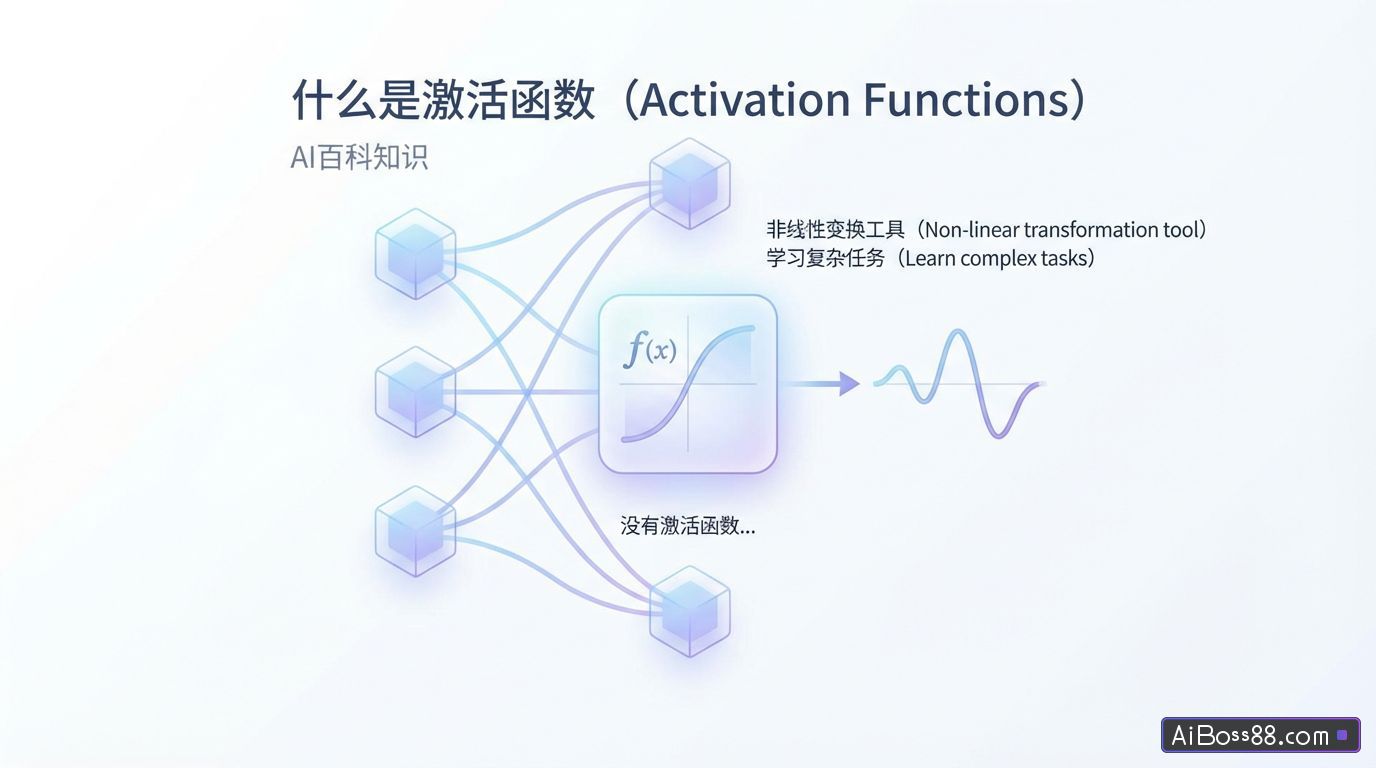
existDeep learningIn the grand edifice of architecture, activation functions are the cornerstones for building complex models. Activation functions endow...Neural NetworksNonlinearity enables machines to learn from data and perform highly complex tasks. From the basic Sigmoid to the modern ReLU and its variants, the choice and design of activation functions have a decisive impact on network performance. This paper will delve into the working principles of these key functions, the challenges they face, and their future development directions, revealing their role in...Deep learningAn indispensable role in it.
What is an activation function?
Activation functions areDeep learningChinese ArtificialNeural NetworksNonlinear transformation tools for neurons introduce nonlinear factors, making...Neural NetworksIt is capable of learning and performing complex tasks. It lacks an activation function.Neural NetworksThis approach can only perform linear transformations and cannot handle nonlinear problems. Activation functions include Sigmoid, Tanh, ReLU, etc., each with its own characteristics and applicable scenarios. Choosing the appropriate activation function is crucial to model performance.
How activation functions work
Activation functions are responsible for...Neural NetworksA nonlinear transformation is introduced into the neurons. After the input data is weighted and summed, the activation function processes these weighted sums to produce a new output. This process allows...Neural NetworksSimulating complex function mappings allows for the resolution of nonlinear problems. The choice of activation function is crucial to network performance, as it directly impacts the network's convergence speed and final performance.
Activation functions typically have specific mathematical forms. For example, the sigmoid function compresses the output to between 0 and 1, while the ReLU function provides a linear output for positive inputs and 0 for negative inputs. The design aims to optimize the network's learning process, such as by mitigating the vanishing gradient problem or improving computational efficiency. The derivative of the activation function is also crucial because it affects the propagation of gradients during backpropagation, thus influencing weight updates.
Main applications of activation functions
Activation function inDeep learningThe applications of this technology are mainly reflected in the following aspects:
- Introducing nonlinearity: Activation function makesNeural NetworksIt can learn nonlinear models. Because linear transformations can be represented as a more...SimpleLinear models without activation functions cannot effectively handle complex nonlinear problems.
- Feature TransformationActivation functions transform input data, mapping the original features to a new feature space, which helps the network learn more complex patterns and relationships in the data.
- Solving the vanishing gradient problemCertain activation functions, such as ReLU and its variants, are designed to reduce the vanishing gradient problem, making it possible to train deep networks.
- Increase the expressive power of the modelBy using different activation functions, it is possible to increaseNeural NetworksIts expressive power allows it to approximate more complex functions.
- Improve generalization abilityA suitable activation function helpsNeural NetworksBy learning more generalized features, it can also demonstrate good predictive performance on unseen data.
- Adapt to different types of dataDifferent activation functions are suitable for different types of data and problems. For example, the Softmax function is often used in the output layer of multi-class classification problems, while the Sigmoid function is suitable for binary classification problems.
- RegularizationCertain activation functions, such as Dropout, can be used as regularization techniques to help reduce overfitting of the model.
- accelerateNeural NetworkstrainingSome activation functions, such as ReLU, due to theirSimpleThe mathematical form can accelerateNeural NetworksThe training process improves computational efficiency.
Challenges of activation functions
- Gradient vanishing and explodingWhen using saturating activation functions such as Sigmoid or Tanh, the gradient may decrease rapidly as the number of network layers increases (gradient vanishing) or become very large (gradient explosion), leading to instability in the training process.
- Choose an appropriate activation functionThere are various activation functions, each with its own characteristics and applicable scenarios. An inappropriate choice may affect network performance, requiring experimentation and adjustment based on the specific problem.
- Computational complexitySome activation functions, such as Sigmoid and Tanh, involve complex exponential operations, which have high computational costs and may affect the network's speed and efficiency.
- Neuronal deathFor example, when using the ReLU activation function, if the input is consistently negative, the output will always be zero, and these neurons will no longer respond to any input, which is known as the "dead ReLU" problem.
- Non-zero centralized outputThe outputs of some activation functions, such as Sigmoid and Tanh, are not centered at zero, which may cause the gradient update direction to be biased in a certain direction, affecting training efficiency.
- Parameter dependencySome activation functions, such as Leaky ReLU and Parametric ReLU, contain learnable parameters, which increases the complexity of the model and the difficulty of training.
- Generalization abilityThe activation function may affect the model's generalization ability; an inappropriate choice may lead to overfitting or underfitting.
- AdaptabilityFixed activation functions may not be suitable for all types of data distributions and network structures, and more flexible activation functions are needed to adapt to different data characteristics.
Future prospects of activation functions
Activation functions are evolving towards adaptability and learnability, better suited to the needs of different data and tasks. Researchers are exploring how to design activation functions with better gradient properties, computational efficiency, and generalization ability.Neural NetworksStructural innovations, such as attention mechanisms and graphsNeural NetworksWith the rise of [the technology/mechanism], activation functions are also constantly evolving to match the characteristics of these new network architectures. Future activation functions may be more [adaptive/more sophisticated/etc.].intelligentThis allows for adjustments based on the network's performance during training.automaticAdjust its behavior.