What is Multimodal Deep Learning? Definition, Reasons, Applications, and Challenges - AI Encyclopedia
Multimodal deep learning is a subfield of artificial intelligence (AI) that focuses on developing models capable of simultaneously processing and learning from multiple types of data. This article explains its definition...
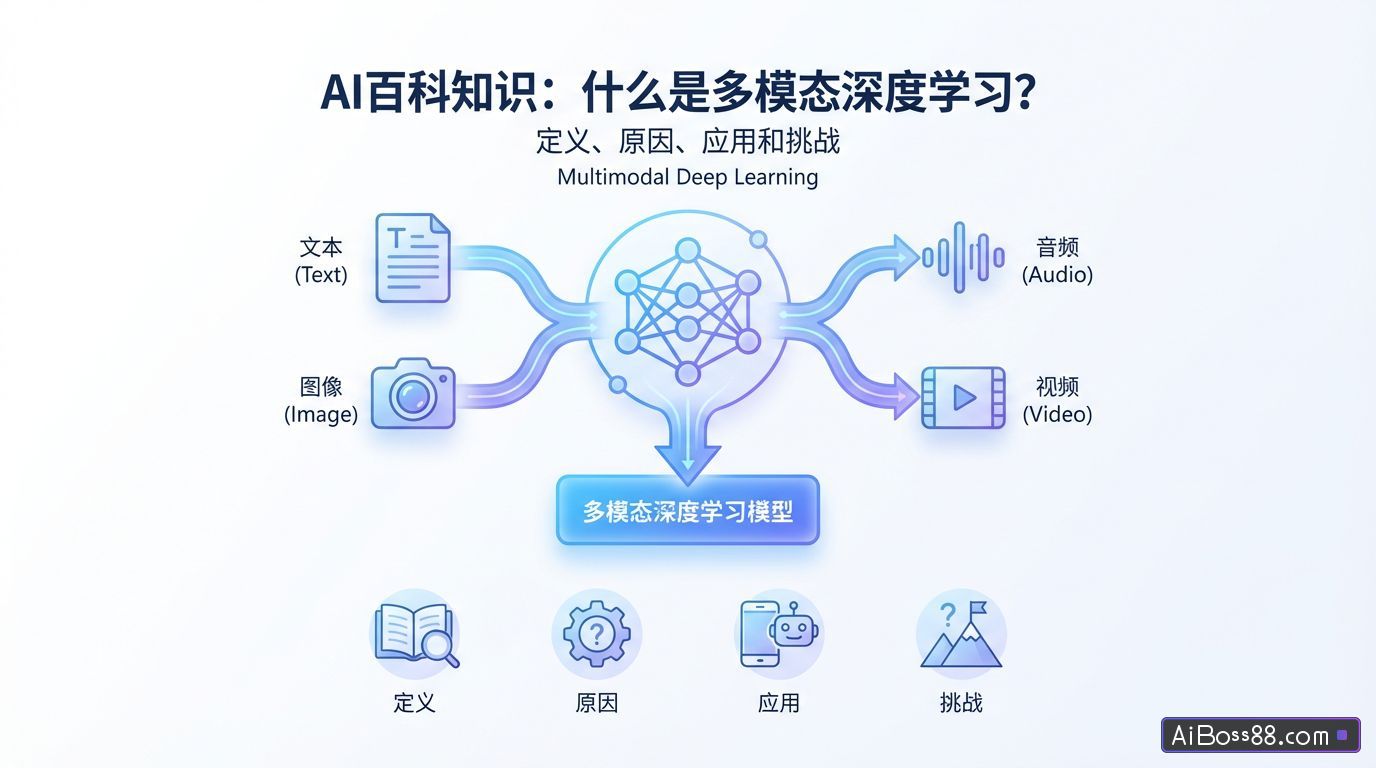
What isMultimodalDeep learning?
MultimodalDeep learning(English name: Multimodal Deep Learning) isartificialintelligent(AIThis is a subfield of [the field of data processing], focusing on developing models capable of processing and learning from multiple types of data simultaneously. These data types, or modalities, can include text, images, audio, video, and sensor data, among others. By combining these different modalities,MultimodalDeep learningAiming to create morepowerfuland multifunctionalartificialintelligentThe system is able to better understand, interpret, and take action on complex real-world data.
Why is it?MultimodalDeep learning?
The world we live in is essentiallyMultimodalThis is because we constantly process and integrate information from different sources, such as our vision, hearing, and touch. This ability to process and understand multiple types of information simultaneously is a significant advantage, enabling us to better navigate and interact with our environment.
However, traditionalDeep learningModels typically focus on processing and learning a single pattern. While these models have achieved remarkable success in various tasks, such as image recognition,Natural Language ProcessingWhile both are capable of speech recognition, they are limited in their ability to handle complex data in the real world that often involves multiple patterns.
MultimodalDeep learningThis limitation can be addressed by developing models that can understand and integrate multiple types of data. This integration can improve performance because the model can leverage complementary information from different patterns to make more accurate predictions or decisions.
MultimodalFusion Methods
existMultimodalDeep learningIn this context, various methods and architectures exist to address these challenges. Some of the most common approaches include:
- Early fusion: This method, also known as feature-level fusion, involves feeding features extracted from different modalities into...Deep learningThese features are concatenated or combined before the model. This fusion allows the model to learn a joint representation of the data, but may result in the loss of some specific pattern information.
- Late fusion: This approach, also known as decision-level fusion, involves training a separate model for each mode and then combining their outputs using a fusion layer or mechanism. This method allows for more modality-specific representations but may fail to capture complex relationships between modalities.
- Intermediate fusion: This method combines elements of early fusion and late fusion.Deep learningThe model integrates information from different modalities at different stages. This approach can capture more complex relationships between modalities while preserving modal-specific information.
- Multi-task learning: In this approach, a single model is trained to perform multiple tasks across different modalities. By sharing information across different tasks, the model can learn more...powerfulTo characterize and improve its overall performance.
MultimodalDeep learningApplication
MultimodalDeep learningIt has now been applied to a wide range of tasks and fields, including:
- Multimedia content analysis: Combining textual, visual, and auditory information can improve task performance, such as video summarization, content-based image retrieval, and sentiment analysis.
- Human-computer interaction: MultimodalDeep learningIt can be used to develop more natural and intuitive interfaces, such as speech recognition systems that can also interpret facial expressions or virtual assistants that can understand both spoken language and gestures.
- Healthcare: By integrating data from various sources, such as medical images, electronic health records, and wearable sensors,MultimodalDeep learningIt can improve the accuracy of diagnosis and enable more personalized treatment plans.
- Robots and Autonomous Systems: MultimodalDeep learningIt can help robots and autonomous systems better understand and navigate their surroundings by processing and integrating information from various sensors, such as cameras, LiDAR, and GPS.
MultimodalDeep learningChallenges
DevelopmentMultimodalDeep learningThe model presents several challenges, including:
- Alignment: Aligning data from different modalities can be difficult because they may have different formats, structures, and time resolutions. This misalignment presents a challenge when attempting to merge data from different sources.
- Representation: Finding suitable representations for different patterns and effectively integrating them is a key challenge. Each pattern may have unique characteristics, and developing a unified representation that captures the essential information of each pattern is crucial for effective learning.
- Fusion: Combining information from different patterns requires effective fusion techniques that capture the relationships between patterns while preserving their unique characteristics. Developing these techniques is...MultimodalDeep learningThis is an ongoing area of research.