What is Model Compression? - AI Encyclopedia
Model compression refers to reducing the size and complexity of deep learning models through various techniques, making them easier to deploy and run on resource-constrained devices. Model compression includes weight quantization, pruning, knowledge sharing, etc.
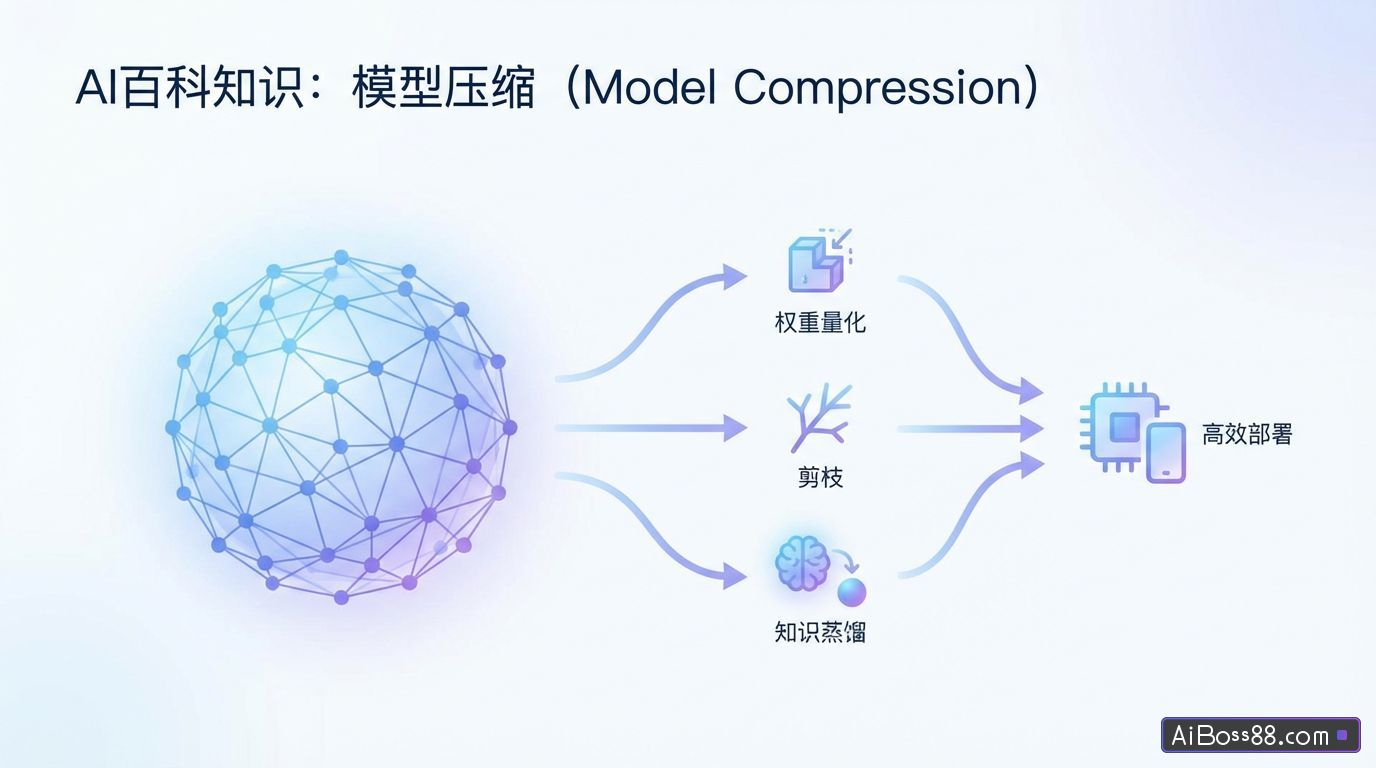
existartificialintelligentIn the wave of innovation, model compression has emerged as a leading technology.powerfulThe data processing capabilities of modern computing have become increasingly prominent, but this has also led to massive model sizes and high computational costs. Model compression technology has emerged to address this, simplifying model structures and reducing parameter precision to "slim down" the models, making them more suitable for deployment on resource-constrained devices while maintaining performance. This not only improves model performance but also...practicalSex can also expandartificialintelligentApplication Boundaries. Next, we will delve into the mysteries of model compression to see how it enables complex...Deep learningThe model became lightweightHigh efficiency.
What is model compression?
Model compression refers to reducing the size of a file using various techniques.Deep learningThe model's size and complexity are suitable for use on resource-constrained devices.High efficiencyDeployment and operation. Model compression includes weight quantization, pruning, knowledge distillation, low-rank decomposition, etc., which reduces the model's storage requirements and computational load while maintaining model performance as much as possible.
How model compression works
Model compression primarily achieves its effect by reducing model parameters and computational cost. A common method is quantization, which maps floating-point parameters in the model to a low-precision representation, such as INT8, thereby reducing model size and computational requirements. Pruning techniques simplify the model structure by removing unimportant weights or neurons, reducing the number of parameters, improving model sparsity, and further reducing storage and computational costs.
Another model compression method is structured pruning, which reduces model complexity by removing entire neurons or filters, leading to more significant speedups, but may also have a large impact on model accuracy. Knowledge distillation, on the other hand, trains a small "student" model to mimic the behavior of a large "teacher" model. The student model learns the output of the teacher model, achieving similar performance with a smaller architecture. Low-rank decomposition techniques reduce the number of parameters by decomposing a large weight matrix into the product of multiple smaller matrices, reducing the model's storage and computational requirements while maintaining model performance.
Main applications of model compression
The main applications of model compression include:
- Mobile and embedded devices:existintelligentDeployed on mobile phones, tablets and other portable devicesDeep learningThese devices have limited storage space and computing power.
- Internet of Things (IoT) devicesImplementing on resource-constrained IoT devicesintelligentAnalysis, such asintelligentHome and industrial sensors, among others, require low power consumption andHigh efficiencyThe model runs.
- Edge computingData processing is performed closer to the data source, reducing data transmission and the load on the central server, and improving response speed and data security.
- Real-time applicationsWhen neededfastIn responsive applications, such asautomaticModel compression can reduce latency and improve processing speed in applications such as driving cars and real-time video analytics.
- Cloud service optimizationBy reducing model size and computational requirements, the operating costs of cloud services can be lowered, while improving service scalability and efficiency.
- Cross-platform deploymentIt enables the same model to be deployed across different hardware and software platforms without requiring separate model optimization for each platform.
- Data privacy protectionData processing and analysis are performed on local devices, reducing the transmission of sensitive data and enhancing data privacy protection.
- Reduce energy consumptionIn energy-constrained environments, such as field monitoring equipment, model compression helps reduce energy consumption and extend equipment lifespan.
Difficulties in Model Compression
The main difficulties faced by model compression include:
- Accuracy lossCompression may remove some parameters or simplify the model structure, which may lead to a decrease in the accuracy of the model.
- The balance between compression and accelerationMaintaining or improving inference speed while reducing model size and computational cost is a challenge; excessive compression may impact performance.
- Hardware compatibilityDifferent hardware platforms support model compression to varying degrees, making it challenging to find a universal compression strategy that can adapt to multiple hardware platforms.
- Selection and design of compression algorithmsThere are various compression techniques, and choosing the right compression algorithm for a specific model and application scenario requires in-depth understanding and experimentation.
- Dynamism and AdaptabilityThe model needs to remain robust across different data and tasks; a compressed model may be less adaptable to new tasks.
- automaticmorphology and search space:automaticModel compression typically involves a huge search space, how toHigh efficiencyExploring these spaces is a technological challenge.
- Quantization errorDuring the quantization process, converting floating-point numbers to low-precision representations may introduce quantization errors, affecting model performance.
- sparsity utilizationWhile pruning can increase model sparsity, not all hardware can effectively utilize this sparsity to accelerate computation.
- Knowledge transferIn techniques such as knowledge distillation, how can we effectively transfer the knowledge of a complex model to a more...SimpleThis is a problem that needs to be solved in the model.
- Maintenance and updatesThe compressed model may be more difficult to maintain and update because its structure and parameters have been optimized and simplified.
The Development Prospect of Model Compression
Model compression has a promising future, and with technological advancements, more technologies are expected to emerge in the future.High efficiencyThe compression algorithm can better balance model size, speed, and accuracy. With the development of dedicated hardware and new...Neural NetworksThe exploration of architecture and model compression will enable broader cross-platform deployment, especially in edge computing and IoT devices.automaticCompression tools andintelligentModel optimization will further simplify the development process and promoteDeep learningApplications in more fields.