What is Fuzzy Logic? - AI Encyclopedia
Fuzzy logic is a mathematical method for handling uncertainty and fuzziness. It mimics the human brain's thought process, supporting logical values that lie between absolute true (1) and false (0). It expresses these values through membership functions...
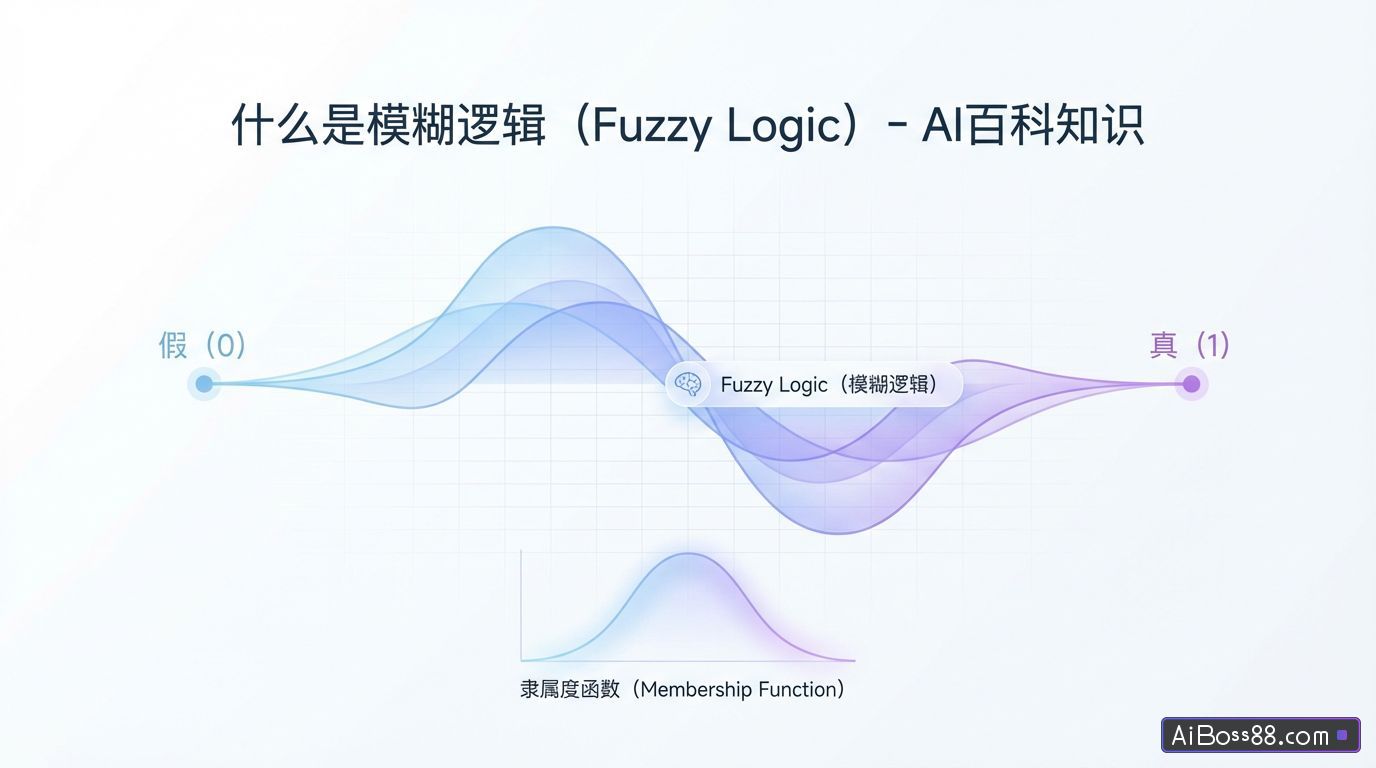
Fuzzy logic (Fuzzy LogicAs a key technology for solving fuzzy and uncertain problems in the real world, it is gradually becoming...artificialintelligentIt is a cornerstone of the field of complex systems control. By simulating the human ability to process fuzzy concepts, it provides new solutions to problems that traditional logic cannot solve. With the continuous advancement of technology, the application scope of fuzzy logic is expanding, and its importance in future scientific and industrial development is self-evident.
What is fuzzy logic?
Fuzzy logic (Fuzzy LogicFuzzy sets are a mathematical method for handling uncertainty and fuzziness. They mimic the thinking process of the human brain, supporting logical values between absolute true (1) and false (0). They express the degree of membership of an element to a fuzzy set through a membership function, and use fuzzy sets and fuzzy rules for reasoning. This approach is suitable for solving complex problems that traditional binary logic struggles to handle, and is widely used in control systems, decision support, and other fields.artificialintelligentIn fields such as...
How Fuzzy Logic Works
Fuzzy logic (Fuzzy LogicA membership function maps input variables to values between 0 and 1, representing the degree of membership of the input in a fuzzy set. Fuzzy sets and fuzzy rules are used for reasoning to handle uncertainties and fuzzy issues.
The reasoning process includes fuzzification, rule evaluation, and defuzzification. Fuzzification transforms the precise input into fuzzy values. Rule evaluation uses fuzzy logic operations to determine the activation rules and their degrees. The defuzzification stage converts the fuzzy output into precise values, typically achieved by calculating a weighted average of the output membership functions.
Main applications of fuzzy logic
Fuzzy logic has a wide range of applications, mainly including:
- control systemIn industryautomaticChemicals, home appliances (such as air conditioners and washing machines), automotive engine management systems andautomaticIn driving vehicles, fuzzy logic is used to improve the responsiveness and adaptability of the system.
- Decision support systemIn the fields of business, finance, and healthcare, fuzzy logic helps process incomplete or uncertain information, assisting in making more rational decisions.
- Pattern recognitionIn image recognition, speech recognition, and biometric systems, fuzzy logic is used to improve the accuracy and robustness of recognition.
- intelligentsystem:existintelligentHome furnishingsintelligentTransportation andintelligentpower grid, etc.intelligentIn the system, fuzzy logic is used to optimize system performance and improve energy efficiency.
- Signal processingFuzzy logic is used to improve signal quality in fields such as noise filtering, image compression, and sound processing.
- RoboticsFuzzy logic enables robots to better adapt to complex environments in robot navigation, obstacle avoidance, and operation control.
- Environmental controlIn environmental monitoring and pollution control, fuzzy logic is used to assess and regulate environmental conditions.
- medical equipmentFuzzy logic is used in medical imaging, diagnostic aids, and treatment devices to improve diagnostic accuracy and treatment effectiveness.
- Communication systemIn wireless communication and network management, fuzzy logic is used to optimize data transmission and network performance.
- Games and simulationsIn video games and simulation models, fuzzy logic is used to create more realistic and complex behavioral patterns.
Challenges of fuzzy logic
While fuzzy logic has wide applications in many fields, it also faces some challenges and limitations:
- Design complexityBuilding fuzzy logic systems requires specialized knowledge, and the design of appropriate fuzzy rules and membership functions can sometimes be both complex and time-consuming.
- Construction of the rule baseThe fuzzy rule base needs to be precisely defined and adjusted, which usually relies on expert experience and trial and error, and lacks a unified methodology.
- Parameter adjustmentThe parameter tuning of membership functions and fuzzy rules often requires a lot of experiments and simulations to obtain optimal performance.
- ExplainabilityThe decision-making process of fuzzy logic systems is not as transparent as that of traditional logic, which may pose an obstacle in applications that require a high degree of interpretability.
- Generalization abilityFuzzy logic systems may perform well in specific situations, but their ability to generalize to different or unknown situations may be limited.
- Computing resourcesAlthough fuzzy logic systems are relatively...SimpleHowever, sufficient computing resources are still required when processing large-scale or real-time data.
- andMachine LearningcombinationFuzzy logic and emerging technologiesMachine LearningThe integration of technologies is still in the development stage and requires further research and innovation.
- Verification and testingVerification and testing of fuzzy systems can be difficult because their behavior may not be easily predicted using traditional logic or mathematical methods.
- Maintenance and updatesAs the system environment and requirements change, maintaining and updating fuzzy logic systems may require continuous expert intervention.
- AcceptabilityIn some fields, especially those dominated by traditional logic and precise methods, promoting fuzzy logic may face challenges in terms of acceptance.
The Development Prospects of Fuzzy Logic
Fuzzy logic as apowerfulMathematical tools for handling uncertainties and fuzzy problems have broad development prospects. With the improvement of computing power and...artificialintelligenttechnologyfastDevelopment, fuzzy logic is expected to be compatible withMachine Learning,Deep learningAs technologies are more deeply integrated, improvements will be made.intelligentThe system's decision-making quality and adaptability. Fuzzy logic in...automaticApplications in fields such as chemical control, decision support systems, medical diagnostics, and environmental monitoring will expand further. Researchers will continue to explore more...High efficiencyMore advanced algorithms, more accurate models, and more intuitive design methods will improve the interpretability, generalization ability, and ease of use of fuzzy systems. Future research on fuzzy logic may focus on enhancing the rigor of its theoretical foundation, optimizing the performance of practical applications, and strengthening its compatibility with other systems.intelligentIn terms of the synergistic effect of technology.