What are Diffusion Models? - AI Encyclopedia
Diffusion models are a type of deep generative model that simulates the diffusion process of data from an ordered state to a disordered state, and conversely, the reverse diffusion process from a disordered state back to an ordered state.
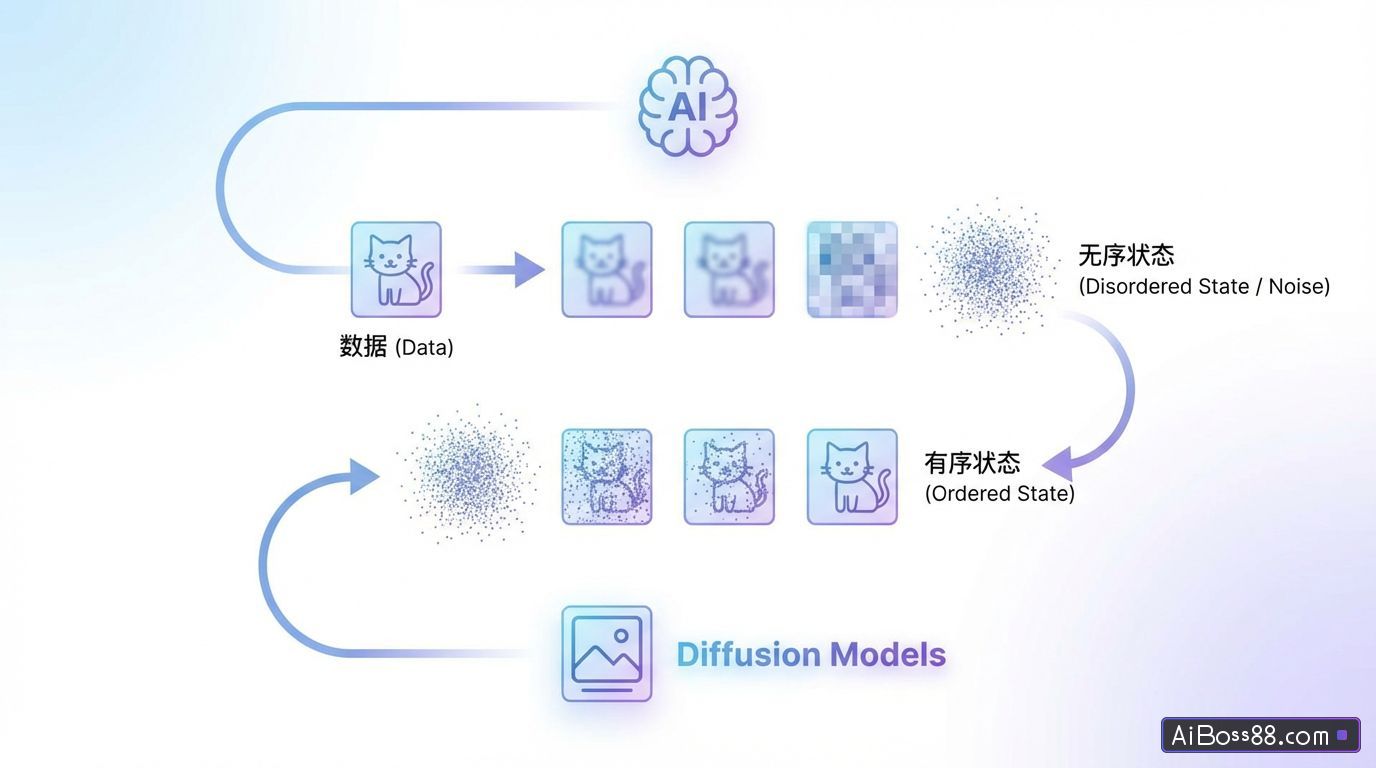
Diffusion models are inspired by the diffusion process in nonequilibrium thermodynamics. Their origins can be traced back to 2015 when researchers proposed deep generative models, laying the foundation for later diffusion models. In 2018, diffusion models were formally proposed, achieving more stable and diverse sample generation by learning the inverse process of data distribution. The technological development of diffusion models has gone through several important stages. Initially, diffusion models were used for image generation tasks, surpassing the original generative adversarial networks (GANs) to become the new state-of-the-art (SOTA) in this field. Subsequently, the application areas of diffusion models gradually expanded to...Natural Language ProcessingIt is used in multiple fields such as waveform signal processing.
What is a diffusion model?
Diffusion models are a type of deep generative model that simulates the diffusion process of data from an ordered state to a disordered state, and conversely, the reverse diffusion process from a disordered state back to an ordered state, thus realizing the generation of data from an ordered state.SimpleGeneration of distributed data from complex data distributions. This model produces high-quality results in multiple domains, including images, text, and audio.
How the diffusion model works
Diffusion models are a class of...powerfulDeep generative models are used in image synthesis, video generation, audio synthesis, 3D rendering, andMultimodalThese models have demonstrated superior performance in multiple fields, including generation. Based on diffusion processes in non-equilibrium thermodynamics, they simulate the diffusion process of data from an ordered state to a disordered state, and conversely, the reverse diffusion process from a disordered state back to an ordered state, thus achieving [the following is incomplete and requires further context: "from..."]SimpleThe generation of complex data distributions. The working principle of diffusion models can be divided into two main parts: the forward diffusion process and the reverse diffusion process.
During forward diffusion, the model gradually introduces noise into the data until the data is completely transformed into noise. This process can be viewed as a Markov chain, where each state depends only on the previous state. Specifically, the model achieves gradual noiseification of the data through the following steps:
- Starting from data point x0, noise is gradually added to generate a series of intermediate states x1, x2, ..., xT.
- The process of adding noise at each step follows a Gaussian distribution, making the final state xTxT approximate a standard normal distribution.
Backdiffusion is the inverse operation of forward diffusion, and its goal is to recover the original data from a noisy state. The process is also a parameterized Markov chain, achieving gradual denoising of the data through the following steps:
- Starting from the noisy state xT, noise is gradually removed to generate a series of intermediate states xT−1, xT−2, ..., x1 until the original data x0 is recovered.
- In each step, the model needs to learn how to predict the previous state from the current state, by training a...Neural NetworksThis allows the network to predict the noise added at each step.
Main applications of diffusion models
Diffusion models have demonstrated their effectiveness in multiple fields.powerfulApplication potential:
- Computer VisionIn the field of computer vision, diffusion models are used for tasks such as image generation, super-resolution, image inpainting, and editing. For example, models such as DALL·E2 and Imagen can generate high-quality images based on text descriptions.
- Natural Language Processing:existNatural Language ProcessingIn the field of Natural Language Processing (NLP), diffusion models have begun to be widely used in text generation tasks, demonstrating...powerfulThe generalization ability is evident. For example, the DiffusionLM model proposes a novel non-autoregressive language model based on continuous diffusion.
- Time series analysisIn the field of time series analysis, diffusion models have improved the accuracy and efficiency of time series analysis by introducing new structures and strategies. For example, the CSDI model uses a diffusion model based on conditional scores to replace the traditional autoregressive model in learning the conditional distribution.
- MultimodalResearch:existMultimodalIn this study, diffusion models combined multiple data types, such as images and text, to achieve cross-modal generation tasks. For example, the VQ-Diffusion model addressed the single-component bias problem present in previous generation models in the text-to-image task.
- interdisciplinary fieldsDiffusion models have also been applied to interdisciplinary fields such as bioinformatics and financial data generation, demonstrating their effectiveness.powerfulIts generalization ability.
Challenges of diffusion models
Diffusion models, as a cutting-edge deep generative model, have demonstrated outstanding performance and broad application potential in multiple fields. However, they still face a series of challenges in practical applications and further development.
- Slow sampling speedDiffusion models require a large number of iterative steps to gradually generate images or data, which results in relatively high computational costs.
- High computing costThe training and inference processes of diffusion models require significant computational resources. The need to process large amounts of intermediate data increases storage and processing demands, particularly in high-resolution image generation tasks.
- High demand for video memoryThe diffusion model has a large number of parameters, leading to high demands on video memory. Some...up to dateThe diffusion model requires more than 24GB of video memory when processing images with a resolution of 1024×1024.
- The training is quite difficult.The training process of diffusion models is relatively complex, involving a large number of hyperparameter adjustments and optimization strategy selections. Finding the optimal combination of hyperparameters often requires extensive experimentation and tuning.
- Lack of coding abilitySome diffusion models may lack encoding capabilities, preventing direct editing and manipulation of the latent space. This can limit their effectiveness in tasks requiring fine-grained control and modification of generated content.
- Challenges of real-time applicationsThe use of diffusion models in real-time applications is limited due to their slow sampling rate.
- MultimodalData processing: Diffusion model in processingMultimodalThere may be limitations when dealing with data. When processing more complex data...MultimodalWhen dealing with data, effectively integrating and generating data remains a challenge.
- Adaptability for specific domain applicationsThe application of diffusion models in specific domains may require customized adjustments and optimizations. The model needs to be able to understand and generate highly specialized data.
The Development Prospects of Diffusion Models
Diffusion model as apowerfulGenerative models have already demonstrated their unique value and potential in multiple fields. With further research and technological advancements, future research can focus on developing more...High efficiencyRegarding sampling methods, optimizations include time step size, parallel sampling, improved diffusion processes, and partial sampling. The likelihood estimation capability of diffusion models can be improved by designing weight functions for the loss function, optimizing noise progress, and learning inverse variance. Transforming data into a unified latent space and then diffusing it enables diffusion models to handle discontinuous data. This can be combined with large language models (…).LLMs) and diffusion model, usingLLMThe natural language understanding capabilities of s enhance temporal reasoning, providing a more comprehensive view of complex systems. The diffusion model...MultimodalApplications and interdisciplinary applications will be an important direction for development, such as in medical imaging, drug design, and materials science. Improvements in algorithms, including innovations in domain-specific application methods, will be key to the future development of diffusion models.