What is Dataset Distillation? - AI Encyclopedia
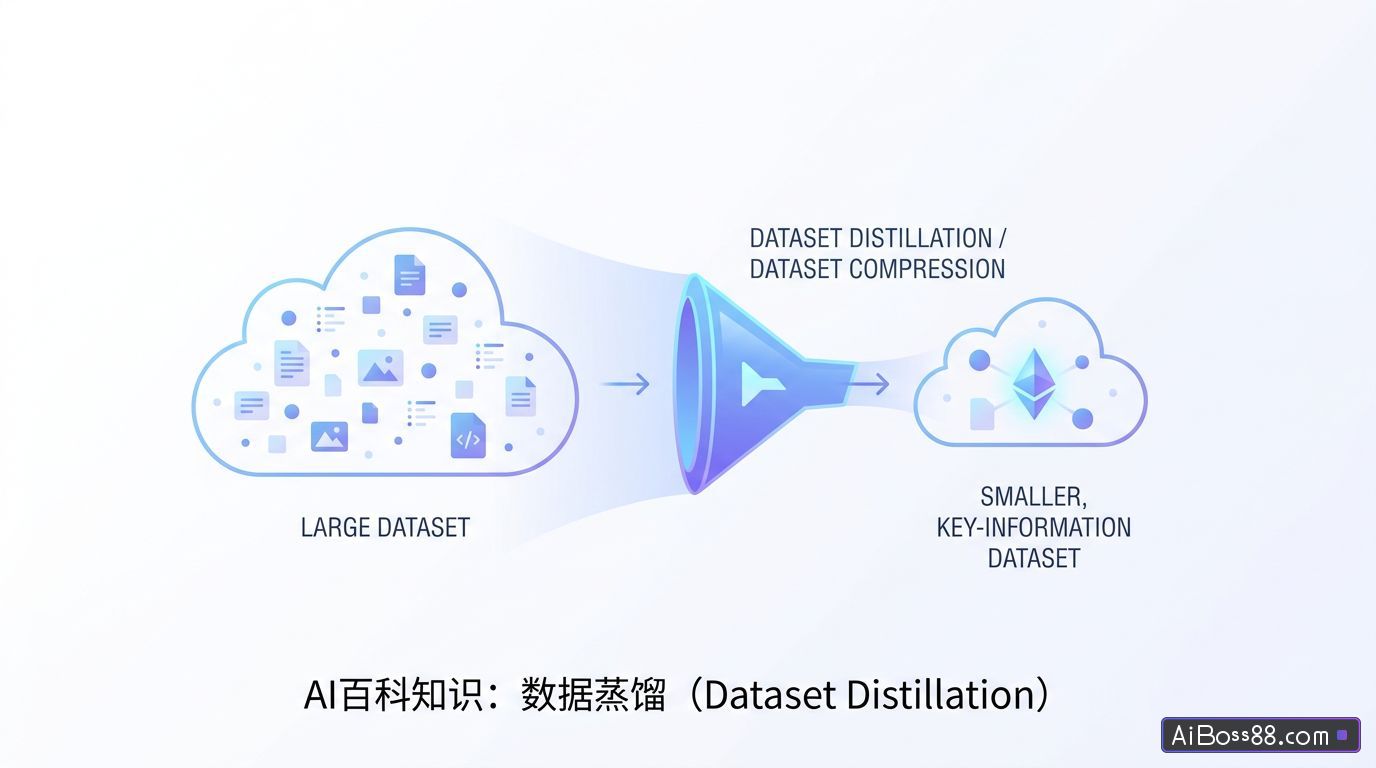
Dataset distillation, also known as dataset compression, is a technique designed to extract key information from large datasets and build a smaller dataset. This...
Dataset distillation, an innovative technique for compressing knowledge from large-scale datasets into small-scale synthetic data, is...fastIt has developed and demonstrated enormous potential. It not only provides new ideas for solving the storage, computation, and privacy challenges posed by large-scale datasets, but also offers solutions for multiple...Machine LearningThis has injected new vitality into the field's development. With ongoing research and continuous technological innovation, dataset distillation is expected to...artificialintelligentIt plays an increasingly important role in development.
What is data distillation?
Dataset distillation, also known as dataset compression, is a technique aimed at extracting key information from a large dataset and constructing a smaller dataset. This smaller dataset, although much smaller than the original, should enable the trained model to achieve performance comparable to a model trained on the original dataset. The core idea of data distillation is to use a series of algorithms and strategies to perform denoising, dimensionality reduction, and refinement on the original, complex dataset, resulting in a more concise and useful dataset.
The working principle of data distillation
Take a large-scale real training dataset as input. Generate a small-scale synthetic distillation dataset. Evaluate the performance of the model trained on the distillation dataset on a real validation/test set.Data selection and preprocessingIn this step, representative data points are selected from the original dataset. The data is preprocessed, such as through normalization and noise reduction, to improve the efficiency and effectiveness of subsequent processing.Feature extraction and representationUtilizing advanced feature extraction techniques, such asDeep learningThe model extracts key features from the data. These features should capture the core information of the data, providing a foundation for subsequent distillation processes.Knowledge compressionThe extracted features are further compressed using algorithms to form a smaller dataset. This process may involve techniques such as gradient matching, distribution matching, feature regression, or generative models.Model training and optimizationThe model is trained using a compressed dataset, and its parameters are tuned using an optimization algorithm. The goal is to minimize the size of the dataset while maintaining model performance.Performance evaluation and iterationThe model's performance was evaluated on independent real-world datasets to ensure the validity of the distillation dataset. Based on the evaluation results, the distillation process was iteratively optimized to further improve the quality of the dataset and the model's performance.
Gradient/trajectory matching-based methods optimize the synthetic dataset by matching the model's gradient information on the real and synthetic datasets. Distribution/feature matching-based methods ensure that the distribution of the synthetic dataset is as similar as possible to the distribution of the real dataset.Neural NetworksFeature regression methods, using pre-trained...Neural NetworksAs a feature extractor, it optimizes the synthetic dataset by regressing features from the real dataset. Generative model-based methods utilize generative models (such as GANs) to generate synthetic data that represents the original dataset.
Main applications of data distillation
Data distillation technology has wide applications in many fields. Here are some of the main application scenarios:
- Privacy protectionBy using distilled datasets, some data privacy issues can be mitigated because the original, personally identifiable data points may be excluded from the distilled version.
- Continuous learningIn continuous learning scenarios, dataset distillation can help the model.fastAdapt to new data while retaining a memory of old data.
- Neural Architecture SearchIn neural architecture search, dataset distillation can provide a smaller dataset to speed up the search process while maintaining the accuracy of the search results.
- Resource-constrained environmentIn environments where computing and storage resources are limited, dataset distillation can provide an effective solution, enabling researchers to engage in state-of-the-art basic model training and application development with limited resources.
- Federal LearningDistillation technology can help reduce communication costs in federated learning.
- Medical image analysisIn the context of sensitive medical data privacy, dataset distillation provides a new approach to data sharing.
Challenges of data distillation
The challenges facing data distillation technology in the future are multifaceted, and can be discussed in detail from the following key areas:
- Distillation of high-resolution and complex label spatial dataData distillation presents challenges when processing high-resolution images or data with complex label spaces. For example, in medical image analysis, high-resolution images contain rich details that are crucial for diagnosis.
- Interpretability and robustness of distillation dataThe synthetic datasets generated during data distillation often lack interpretability. In many applications, especially in healthcare and finance, the decision-making process of models requires a high degree of transparency and interpretability.
- Optimize stability and computational efficiencyThe optimization algorithms in data distillation need to handle a large number of parameters and complex objective functions. This requires not only high computational efficiency but also stability during optimization. Current data distillation methods may encounter vanishing or exploding gradients during optimization, which affects the quality of the distilled dataset and the final performance of the model.
- Cross-architecture generalization capabilityData distillation techniques aim to generate synthetic datasets that perform well across various network architectures. Existing distillation methods often perform well on specific network architectures but may be ineffective on others.
- Large-scale complex datasetsHigh efficiencydistillationAs the size of the dataset continues to grow, how...High efficiencyDistilling large-scale, complex datasets has become a challenge.
- OtherMachine LearningThe combination of technologiesData distillation technology and otherMachine LearningThe integration of technologies, such as meta-learning, self-supervised learning, and federated learning, is a promising research direction.
- Deployment and optimization strategies in actual production environmentsDeploying and optimizing data distillation technology in real-world production environments also presents a challenge. In practical applications, data distillation technology needs to consider factors such as data real-time performance, model update frequency, and computational resource limitations. How to effectively integrate data distillation technology into actual production environments, optimize deployment strategies, and meet the needs of real-world applications are problems that data distillation technology needs to solve in the future.
- Privacy protection and data securityProtecting data privacy and security during data distillation is a significant challenge. Especially in applications involving sensitive data, ensuring that personal privacy information is not leaked during distillation while simultaneously generating effective synthetic datasets is a crucial issue that data distillation technology must address.
- Data diversity and fairnessMaintaining data diversity and fairness during data distillation is also a challenge. During distillation, data characteristics of certain groups may be unintentionally lost, leading to a decline in model performance on those groups.
- Theoretical foundation and algorithm innovationThe theoretical foundation and algorithmic innovation of data distillation technology are key to its development. Current data distillation methods are not yet theoretically mature enough, and further research is needed to explore the theoretical limits and optimal strategies of data distillation.
The Development Prospects of Data Distillation
Despite significant progress in dataset distillation techniques, many areas still warrant further investigation. Research should focus on how to perform dataset distillation on larger and more complex datasets while maintaining performance.High efficiencyDistillation. Improve the interpretability of synthetic datasets, making them easier to understand and enhancing their robustness against various attacks. Develop a general dataset distillation method applicable to a variety of different task types (e.g., classification, detection, segmentation, etc.). Explore dataset distillation in conjunction with meta-learning, self-supervised learning, and other technologies.Machine LearningThe potential for technological integration. Researching how to better integrate dataset distillation techniques into real-world production environments and optimize deployment strategies.