What is LoRA? A comprehensive guide to the concept, principles, advantages, disadvantages, and main applications of low-rank adaptation.
Low-rank adaptation (LoRA) technology allows for the faster and more efficient adaptation of large language models to specific tasks or domains. This article will provide an overview of what LoRA is, its main components, how it works, its advantages, and its limitations...
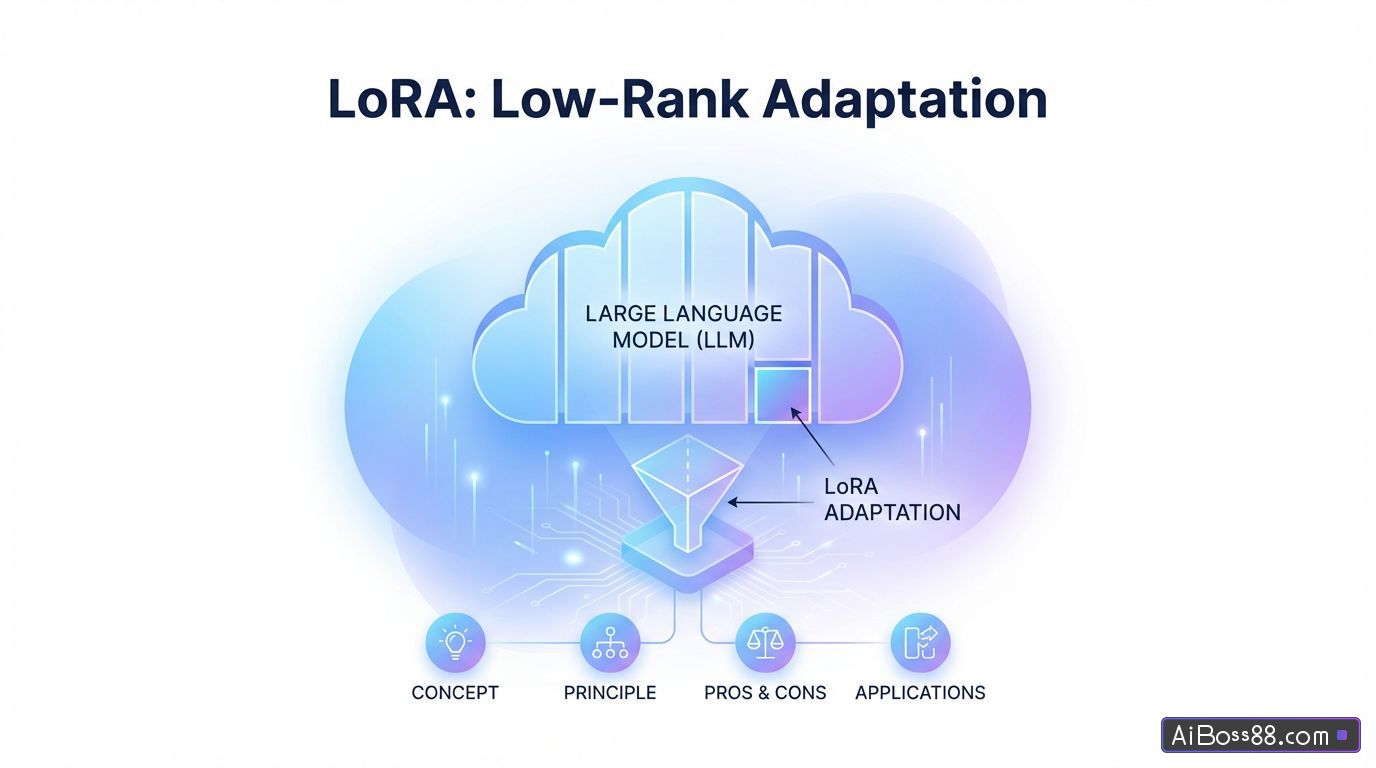
In recent yearsNatural Language ProcessingThe progress in NLP is largely due to the increasing number of...powerfulLanguage models, such as Open, are driving this.AI of GPT A series of large language models have been developed. However, training these models is not only computationally expensive but also requires significant amounts of data, energy, and time. Therefore, researchers have been exploring more efficient methods to fine-tune these pre-trained models to adapt them to specific tasks or domains without incurring the full cost of retraining.
One approach is Low-Rank Adaptation (LoRA), a technique that allows large language models to be adapted to specific tasks or domains more quickly and efficiently. This article will outline what LoRA is, its main components, how it works, its advantages and limitations, and its potential applications.
What is LoRA?
LoRA stands for Low-Rank Adaptation, a class of techniques that aim to reduce the complexity of large models by approximating their high-dimensional structures with low-dimensional structures. In the context of language models, this means creating a smaller, more manageable representation of the original model that can still perform well in a specific task or domain.
The idea behind low-rank adaptation is that, for many tasks, the high-dimensional structure of large models may contain redundant or irrelevant information. By identifying and removing this redundancy, we can create a more efficient model that retains its original performance but requires fewer resources for training and deployment.
Main components of LoRA
LoRA is a special technique used to adapt a pre-trained language model to a new task or domain using a low-rank approximation. It involves adding a low-rank matrix to the weight matrix of the pre-trained model, enabling the model to learn task-specific information more effectively.
The main components of LoRA include:
- Pre-trained language models: a type of large-scale language model, such asGPTOr BERT, which has been trained on different task and domain sets.
- Low-rank adaptation layer: A low-rank matrix is added to the weight matrix of the pre-trained model, which can be updated during fine-tuning to learn information specific to the task.
- Fine-tuning process: The process of updating the low-rank adaptive layer to minimize the loss on a specific task or domain.
The main idea behind LoRA is to leverage the general knowledge of pre-trained models while effectively learning the specific information needed for new tasks or domains.
How LoRA works
LoRA adapts to a pre-trained language model by introducing a low-rank matrix into its weight matrix. This low-rank adaptive layer is initialized with random values and updated during fine-tuning. The key steps of the LoRA adaptation process are as follows:
- Initialization: Start with a pre-trained language model and add a low-rank adaptation layer to its weight matrix. This layer is represented by a low-rank matrix that is initialized with random values.
- Fine-tuning: Train the model on a new task or domain, updating only the low-rank adaptation layers while keeping the weights of the pre-trained model fixed. This allows the model to effectively learn task-specific information without altering its general knowledge.
- Prediction: Using a tuned model to make predictions on new, unseen data from a target task or domain.
By focusing the adaptation process on the low-rank matrix, LoRA achieves more efficient fine-tuning, reducing computational and memory overhead compared to full fine-tuning.
Advantages and limitations of LoRA
Advantages of LoRA
- Efficiency: LoRA can be faster and more efficient.High efficiencyThis allows for fine-tuning of large language models because it only requires updating the low-rank adaptation layers, rather than the entire model.
- Resource savings: By reducing the complexity of the fine-tuning process, LoRA can help save computing resources, energy, and time.
- Flexibility: LoRA can be applied to various large-scale language models, such asGPTOr BERT, and it can be easily adapted to different tasks or domains.
- Performance: Despite its reduced complexity, LoRA delivers competitive performance compared to full fine-tuning, making it a viable alternative for many applications.
Limitations of LoRA
- Approximation error: Using a low-rank matrix to approximate the high-dimensional structure of the original model may introduce some approximation errors, which may affect the performance of the model on certain tasks.
- Task-specific performance: While LoRA can achieve competitive performance on many tasks, its performance may not be the best for all tasks or domains, especially those that require fine-grained understanding or have a training distribution that is very different from that of the pre-trained model.
- Scalability: Although LoRA reduces the complexity of fine-tuning, it may still require a lot of resources for very large models or when adapting to a large number of tasks or domains.
LoRA application scenarios
LoRA has a variety of potential applications, especially when resources are needed for large language models.High efficiencyUnder suitable circumstances. Some examples include:
- Domain adaptation: Adapting a pre-trained language model to a specific domain, such as medical or legal texts, to improve its performance on specific domain tasks.
- Task adaptation: Fine-tuning pre-trained language models for specific tasks, such as sentiment analysis, machine translation, or question answering.
- Transfer learning: using knowledge learned by a pre-trained model in one task to improve performance in another related but different task.
- Multi-task learning: Adjusting pre-trained models to perform multiple tasks simultaneously, thereby making more efficient use of computing resources.
LoRA offers a promising approach for effectively adapting large language models, enabling faster and more resource-efficient adaptation to a wide range of tasks and domains.High efficiencyFine-tuning. As the NLP community continues to push the boundaries of large language models, technologies like LoRA will play a crucial role in making these models more accessible and practical.