What is Nested Learning? - AI Encyclopedia
Nested Learning is a new machine learning paradigm introduced by Google that addresses the "catastrophic forgetting" problem faced by traditional large language models during continuous learning. Nested Learning integrates complex machine learning models...
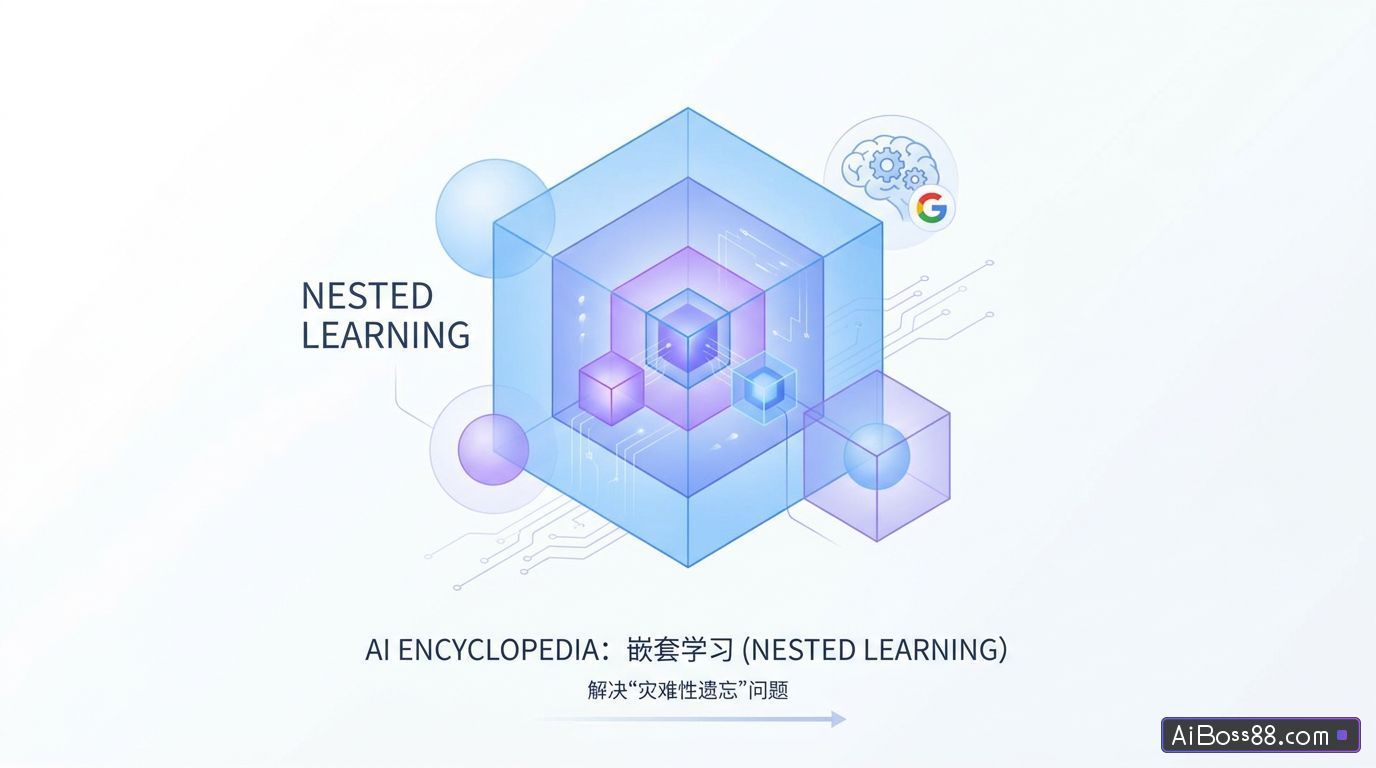
Nested Learning is a new type of learning technology introduced by Google.Machine LearningThis paradigm can solve the "catastrophic forgetting" problem faced by traditional large language models in continuous learning. Nested Learning addresses the complex...Machine LearningThe model is viewed as a multi-level, nested optimization problem system, with each level having its own independent context flow and update frequency. This design is inspired by the human brain's memory and learning mechanisms, achieving information flow through hierarchical collaboration.High efficiencyProcessing and storage. Nested Learning-based models (such as Hope) outperform traditional Transformer architectures in tasks such as language modeling and long contextual memory management, demonstrating...powerfulNested Learning's core innovations include deep optimizers, self-modifying models, and sequential memory systems, enabling dynamic learning and long-term memory management.AIThis provides new ideas for continuous learning and dynamic knowledge accumulation, and is expected to promote...artificialintelligentFrom static models to dynamic, adaptive modelsintelligentSystem transformation.
What is Nested Learning?
Nested Learning is a new type of learning introduced by Google.Machine LearningThe paradigm views the model as a multi-level, nested optimization problem, with each level having its own independent context flow and update frequency. Nested Learning borrows from the human brain's memory mechanisms to effectively alleviate the "catastrophic forgetting" problem in traditional models during continuous learning.
The technical principles of Nested Learning
-
Multi-level optimization system:
-
Nested optimization problemThe model can be viewed as a system of multiple optimization problems, each corresponding to a level in the model. These levels can be parallel or nested, and each level has its own optimization objective and update frequency.
-
Context FlowEach optimization problem has its own context flow, which is the set of information that each level depends on. The context flows of different levels can be updated independently, enabling learning across multiple time scales.
Main applications of Nested Learning
-
Language Modeling and GenerationNested Learning, through its multi-level optimization and deep memory system, can achieve more...High efficiencyIt can effectively process long text sequences, improve the predictive and contextual understanding capabilities of language models, reduce perplexity, and is suitable for generating high-quality natural language text, such as...intelligentApplications include writing assistants and content generation.
-
Common Sense Reasoning and QuestionsBased on a continuous memory system, the model can better manage long-term knowledge and short-term information, exhibiting higher accuracy in commonsense reasoning tasks and handling complex reasoning problems more precisely. It is applicable to various situations.intelligentScenarios such as question-and-answer systems and knowledge graph question-and-answer systems.
-
Continuous learning and adaptationNested learning solves the problem that traditional models tend to forget old tasks when learning new tasks. It is suitable for scenarios that require models to continuously update their knowledge, such as online education, real-time information processing, and dynamic knowledge updates. It can achieve continuous optimization and adaptive learning of the model.
-
Long context taskWhen processing long sequence information (such as long text, long audio, etc.), Nested Learning's hierarchical memory management mechanism can effectively improve the model's ability to process long contexts, making it suitable for tasks that require long-term memory, such as long text summarization and long audio recognition.
-
Multi-domain adaptation and transfer learningThe self-modifying nature of Nested Learning allows it to dynamically adjust its parameters based on data from different domains without human intervention. This makes it suitable for cross-domain learning and transfer learning scenarios, such as multilingual translation and cross-domain applications.recommendSystems, etc.
-
intelligentDialogue systemThrough multi-level optimization and dynamic adjustment capabilities, Nested Learning can improve the contextual coherence and response quality of dialogue systems, better understand and generate natural language dialogues, and is applicable to various scenarios.intelligentScenarios such as customer service and virtual assistants.
-
Knowledge Graph AugmentationNested Learning can be moreHigh efficiencyIt integrates and updates information in knowledge graphs, enhancing the model's understanding and reasoning capabilities regarding complex knowledge systems. This makes it suitable for knowledge graph-driven application scenarios, such as...intelligentrecommendKnowledge management, etc.
Challenges of Nested Learning
- Computational complexity and resource requirementsNested learning employs multi-level optimization and complex memory systems, leading to a significant increase in computational complexity. The training and inference processes require far more computational resources. This high computational demand limits its application in resource-constrained devices or scenarios, necessitating more advanced technologies.powerfulHardware support implementationHigh efficiencyrun.
- Model training and tuning difficultyMulti-level optimization problems complicate the model training process, increase the difficulty of parameter updates and convergence, and easily lead to training instability or difficulty in convergence. At the same time, the number of hyperparameters involved in the model increases, making the tuning process more complex and requiring a lot of experiments and experience to find the optimal configuration.
- Explainability and transparencyNested learning's multi-level structure and dynamic adjustment mechanism increase the complexity of the model, making it more difficult to understand its internal workings and decision-making processes.
- Generalization abilityDue to the complexity of the model structure and the large number of parameters, nested learning is more prone to overfitting, resulting in insufficient generalization ability on new data. Validating the model's generalization ability on different data distributions and tasks requires more experiments and validations, increasing the difficulty of research and development.
- Adaptation to real-world application scenariosIn real-world applications, different industries have varying requirements for model performance, stability, and security. Nested Learning needs further validation of its effectiveness and reliability in these applications.
The Development Prospects of Nested Learning
Nested learning is an innovative approach.Machine LearningThis paradigm has broad development prospects. Through multi-level optimization and hierarchical memory management mechanisms, it effectively solves the "catastrophic forgetting" problem of traditional large language models, significantly improving the model's performance in long-context tasks and continuous learning scenarios. This paradigm demonstrates [its potential] in theoretical research.powerfulNested Learning has the potential to achieve breakthroughs in practical applications such as language modeling, commonsense reasoning, and multi-domain adaptation. With the continuous maturation of the technology, Nested Learning is expected to drive...artificialintelligentFrom static models to dynamic, adaptive modelsintelligentThis systemic shift offers novel solutions to key challenges such as lifelong learning and complex reasoning in large language models. Nested Learning in...MultimodalIts ability to integrate, cross-domain applications, and model complex systems enables it to...intelligentNested Learning has broad application potential in fields such as dialogue, knowledge graphs, and education. Currently, it faces challenges such as computational complexity, model training difficulty, and interpretability. However, with advancements in hardware technology, algorithm optimization, and in-depth interdisciplinary research, Nested Learning is expected to achieve wider applications and greater technological breakthroughs in the coming years, becoming a driving force for advancement.artificialintelligentOne of the key forces for development.
AgentWhat is Context Engineering (ACE)? AIEncyclopedic knowledge
That's all...
-