What is a Discriminative Model? - AI Encyclopedia
Discriminative models are an important class of models in machine learning, primarily used for classification and regression tasks. Their core objective is to learn the mapping relationship between input variable x and output variable y, i.e., the conditional probability distribution P(y|x). (This is in contrast to generative models...)
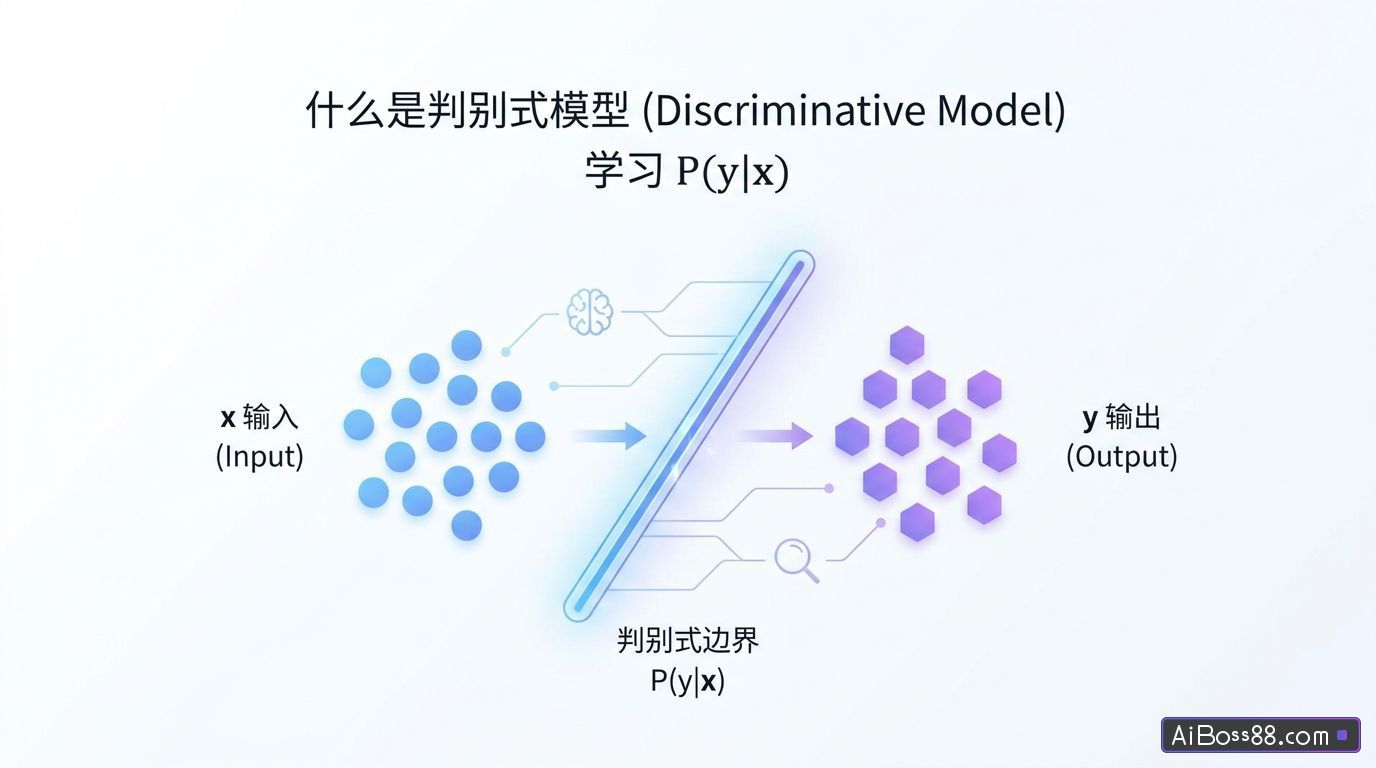
Discriminative models areMachine LearningDiscriminative models are an important class of models, primarily used for classification and regression tasks. Their core objective is to learn the mapping relationship between the input variable x and the output variable y, i.e., the conditional probability distribution P(y|x). Unlike generative models, discriminative models do not consider the joint distribution P(x,y) between the input variable x and the output variable y, but instead directly model the conditional probability P(y|x).
What is a discriminative model?
The discriminative model isMachine LearningThis is one type of model used to model the relationship between unknown data y and known data x. It predicts y by constructing a conditional probability distribution P(y|x), without considering the joint distribution between x and y.
How discriminative models work
The core of a discriminative model lies in learning the mapping relationship between input data x and output data y, i.e., the conditional probability P(y|x). This type of model does not focus on how the data is generated, but rather on how to predict the output data based on the known input data.
Direct modeling: Discriminative models directly model the conditional probability P(y|x), meaning the model learns how to predict the output label y based on the input features x. This makes the model very direct and effective in classification and regression tasks.High efficiencyDuring training, discriminative models adjust their parameters using optimization algorithms (such as gradient descent) to maximize the conditional probability P(y|x) on the training data. Parameter learning methods enable the model to accurately capture the relationship between inputs and outputs. Discriminative models are supervised learning models, requiring large amounts of labeled data for training. They are not suitable for unsupervised learning tasks, which require explicit input-output pairs to learn the mapping relationship. Compared to generative models, discriminative models achieve lower asymptotic errors because they focus on learning the direct relationship between inputs and outputs, rather than the data generation process. Discriminative models are highly flexible in design and can adapt to various complex data distributions and decision boundaries.
Main applications of discriminative models
Discriminative models are widely used in various fields, including but not limited to:
- Image classificationIn the field of image processing, discriminative models such as convolution...Neural NetworksCNNs are widely used for image classification tasks. The model can learn the mapping relationship from the pixel values of an image to the category label, achieving high-accuracy image recognition.
- Natural Language Processing:existNatural Language ProcessingIn Natural Language Processing (NLP), discriminative models such as logistic regression and support vector machines (SVM) are used for tasks such as text classification, sentiment analysis, and named entity recognition.
- Speech recognitionIn speech recognition systems, discriminative models are used to convert speech signals into text. The model achieves this mapping by learning the relationship between speech features and corresponding text labels.
- BioinformaticsIn bioinformatics, discriminative models are used to analyze gene expression data, helping researchers understand how genes influence specific traits in organisms. By learning the relationship between gene expression data and phenotypes, models can predict the phenotype of unknown samples.
- Medical diagnosisBy analyzing patients' medical records and symptoms, the model can predict whether a disease will be present.
- Financial risk assessmentIn the financial sector, discriminative models are used to assess the credit risk of loan applicants. By analyzing an applicant's financial history and credit record, the model can predict the probability of default, helping financial institutions make more informed lending decisions.
Challenges of Discriminative Models
- Model complexity and overfittingDiscriminative models require sufficient complexity to capture the intricate relationships between input data and output labels. However, overly complex models can lead to overfitting, where the model performs well on training data but poorly on unseen data.
- Optimization difficultyTraining discriminative models, especiallyDeep learningWhen developing a model, you may encounter optimization challenges such as local minima, vanishing gradients, or exploding gradients. These issues can affect the model's training performance and final result.
- Computing resource requirementsHigh-performance discriminative models, such asDeep learningModels require significant computing resources, including high-performance GPUs, ample memory, and storage space. These resource requirements can limit the complexity of the model and the size of the training data.
- Large amounts of labeled dataDiscriminative models are supervised learning models that require a large amount of labeled data for training. Acquiring this data can be costly and time-consuming.
- Data qualityData quality directly impacts model performance. Noise, mislabeled data, or imbalanced data distribution can all degrade model performance.
- Data diversityTo improve the model's generalization ability, the training data needs to be sufficiently diverse, including different scenarios, different backgrounds, and different changing conditions.
- Generalization and overfittingGeneralization ability refers to the predictive accuracy of a model on new data. Overfitting is one of the main problems affecting generalization ability. Overfitted models perform well on training data but poorly on new, unseen data.
- Adverse attacksDiscriminative models may be sensitive to adversarial attacks. Adversarial attacks involve adding small perturbations to the input data, causing the model to make incorrect predictions.
The Development Prospects of Discriminative Models
Discriminative models have a promising future, but they also face many challenges.Deep learningWith continuous technological advancements, discriminative models will become more sophisticated.powerfulThis will enable them to solve more complex problems. The development of big data and cloud computing will provide discriminative models with more...High efficiencyIts computing and storage solutions enable it to handle larger-scale data. Furthermore, edge computing and...intelligentAdvances in hardware will enable discriminative models to be processed in real time on edge devices, resulting in faster response times and lower latency.