What is Mode Collapse? - AI Encyclopedia
Mode collapse refers to a phenomenon during training where the generator initially produces fewer and fewer samples representing specific patterns in the dataset, ignoring other potential patterns. This results in a lack of diversity in the generated data...
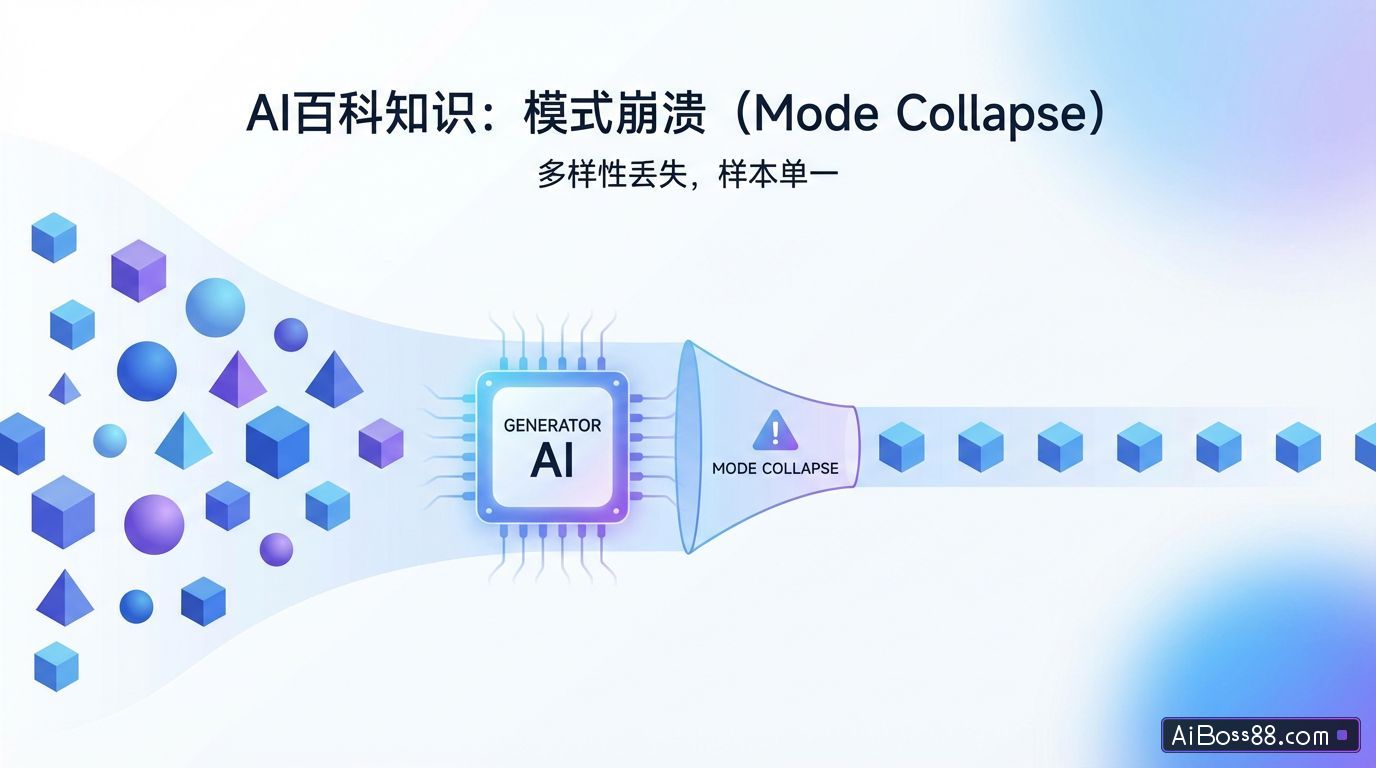
Generative Adversarial Networks (GANs) are a type of...powerfulofDeep learningModels can generate realistic images, audio, and video. During the training of these networks, a phenomenon called "mode collapse" can occur, severely impacting the diversity and quality of the generated data. Mode collapse refers to the phenomenon where GAN generators begin to repeatedly generate samples with only a few patterns, neglecting the exploration of a wider range of data distributions. This limits the model's creativity and reduces its effectiveness in practical applications. This paper will delve into the causes and effects of mode collapse, as well as the solutions proposed in current research.
What is mode collapse?
Mode collapse refers to a phenomenon during training where the generator initially produces samples with decreasing diversity, generating only samples representing certain specific patterns in the dataset while ignoring other potential patterns. This results in generated data lacking realism and diversity, failing to cover all possible patterns of the target distribution. Mode collapse is a common problem in GAN training, impacting model performance and the quality of generated samples.
How mode crashes work
Pattern collapse refers to a situation during GAN training where the generator network learns to generate data with specific patterns that can easily fool the discriminator network, while ignoring the generation of other diverse data. Because the generator only needs to generate a few patterns to fool the discriminator, it has no incentive to explore and generate a wider range of data distributions, resulting in a lack of diversity in the generated data.
When pattern collapse occurs, the generator tends to produce the easiest-to-create samples that the discriminator can accept, rather than the diverse samples that exist in the real world. This typically happens when the discriminator becomes overly sensitive.powerfulThis makes it difficult for the generator to learn strategies for generating more complex or diverse samples. The generator "breaks down" to generating only a few patterns instead of the entire data distribution, which limits the diversity and realism of the samples generated by GANs.
Main applications of pattern crash
While pattern collapse in Generative Adversarial Networks (GANs) is a problem that needs to be solved, it can be cleverly exploited in certain application scenarios. Here are some possible applications:
- Specific style generationIn the arts or entertainment industry, pattern collapse can be used to generate images with a specific style or theme, such as generating a series of paintings with a consistent style or portraits of a specific type of person.
- Data Augmentation:existMachine LearningIn this context, pattern collapse can be used to generate specific types of data to enhance the training set, especially in situations where data is scarce, by generating data with specific patterns to improve the model's generalization ability.
- Simulate specific scenariosIn simulation and game development, mode crashes can be used to generate environments or characters with specific characteristics, such as landscapes under specific weather conditions or characters with specific cultural backgrounds.
- Computer-aided designIn the field of product design, pattern collapse can be used to generate a series of product prototypes with similar design elements, helping designers...fastIterate and evaluate design concepts.
- Customized content generationIn the advertising and marketing field, pattern collapse can be used to generate content that aligns with a specific brand image or marketing strategy, such as generating a series of advertising images with a consistent style.
Challenges of pattern collapse
- Balance between diversity and qualityPattern collapse results in insufficient diversity in the generated samples, but it's also necessary to maintain the quality of the generated samples, meaning they need to appear realistic enough. Solving pattern collapse requires finding a balance between generating diverse samples and maintaining sample quality.
- Training stabilityThe training process for GANs is inherently complex, and mode collapse can further increase training instability. Therefore, more stable training algorithms need to be designed to reduce the occurrence of mode collapse.
- Assessment difficultiesBecause mode collapse involves sample diversity, evaluating the performance of GAN models becomes more difficult. Effective evaluation metrics and methods need to be developed to detect and quantify mode collapse.
- Theoretical understandingThe mechanism of pattern collapse is not fully understood and requires deeper theoretical analysis to understand its root causes in order to design more effective solutions.
- Algorithm ImprovementExisting GAN variants and training techniques may not be sufficient to completely solve the pattern collapse problem, and further research and development of new algorithms and strategies are needed.
- Computing resourcesSolving pattern collapse may require more computational resources, as it may necessitate more complex model structures or longer training times.
- Limitations of practical applicationsIn practical applications, pattern collapse may cause the generated samples to fail to meet specific requirements, limiting the application potential of GANs in certain fields.
- The complexity of data distributionThe distribution of data in the real world is often very complex, which increases the difficulty for GANs to capture all possible patterns, especially in high-dimensional data spaces.
The Prospects of Pattern Collapse Evolution in Generative Adversarial Networks
The pattern collapse problem in generative adversarial networks remainsDeep learningGenerative Adversarial Networks (GANs) are an active research topic in the field. As research progresses, future prospects may include more effective training strategies, improved loss functions, and a deeper understanding of the internal workings of GANs. These advancements are expected to reduce or eliminate pattern collapse and improve the diversity and realism of generated samples. Furthermore, with increased computational resources and algorithm optimization, the application potential of GANs in areas such as artistic creation, data augmentation, and personalized content generation will further expand, driving innovation and development in related industries.