What is a Sequence-to-Sequence Model? - AI Encyclopedia
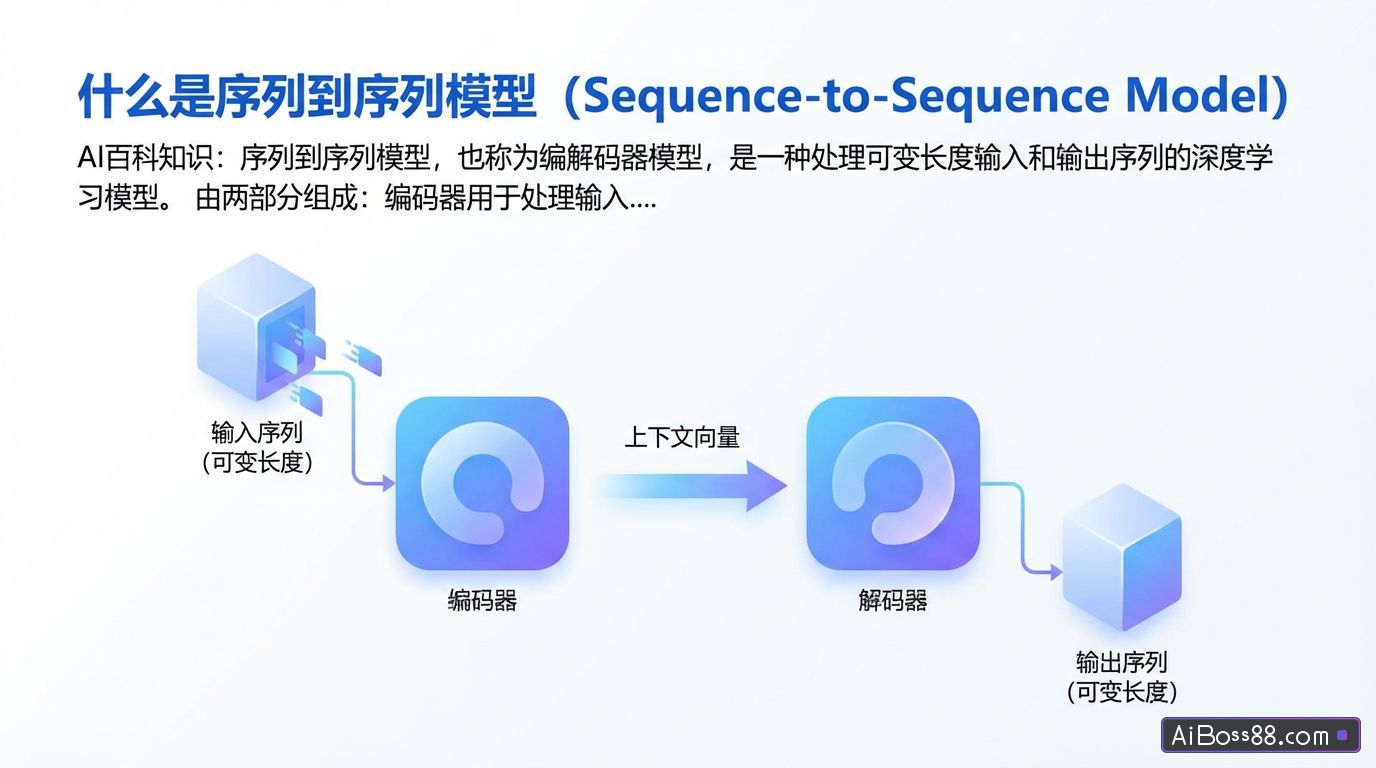
A sequence-to-sequence model, also known as an encoder-decoder model, is a deep learning model that handles variable-length input and output sequences. It consists of two parts: an encoder for processing the input...
Sequence-to-sequence models have become a mainstay for processing various sequence data tasks. They have demonstrated exceptional capabilities in applications such as machine translation, speech recognition, and text summarization. By transforming the input sequence into a fixed-size context vector, and then having a decoder generate the output sequence, they address the dependencies and temporal order issues inherent in sequence data.Deep learningWith the development of technology, sequence models are constantly evolving, from basic loops...Neural NetworksFrom (RNN) to complex structures that incorporate attention mechanisms, it has driven...Natural Language ProcessingPushing the boundaries of Natural Language Processing (NLP) opens up possibilities for solving more complex problems. This article will delve into the working principles, challenges, and future development directions of sequence-to-sequence models, revealing how this technology is shaping...artificialintelligentThe future.
What is a sequence-to-sequence model?
A sequence-to-sequence model, also known as an encoder-decoder model, is a method for handling variable-length input and output sequences.Deep learningThe model consists of two parts: an encoder that processes the input sequence and generates a fixed-size context vector, and a decoder that uses this vector to generate the output sequence. Sequence-to-sequence models are widely used in machine translation, text summarization, speech recognition, and chatbots, and are particularly adept at capturing long-term dependencies in sequence data.
How Sequence-to-Sequence Models Work
Sequence-to-sequence models transform an input sequence into a context vector containing key information through an encoder. A decoder then uses this vector to generate an output sequence. These models are widely used in machine translation, text summarization, and speech recognition. During training, the model learns to optimize its parameters by minimizing the difference between the output and real sequences. The introduction of attention mechanisms further enhances the model's ability to handle long sequences and capture key information.
Sequence-to-sequence models are mainly used in
The main application areas of sequence-to-sequence models include:
- Machine translation: Converting text from one language to another, such as translating from English to Chinese.
- Text Summary:automaticGenerate short summaries of long articles or documents.
- Chatbot: Develop dialogue systems that can understand and generate natural language responses.
- Speech recognitionConverts speech signals into text data for transcription and command recognition.
- automaticQuestion and Answer System: Build a system that can understand questions and generate accurate answers.
- Image description generationGenerate descriptive text for images or videos.
- Text EnhancementFor example, predicting or generating the remaining text given a portion of the text.
- Speech SynthesisConvert text into spoken language output.
- Handwriting recognition: Recognize and transcribe handwritten text.
- BioinformaticsExamples include protein sequence analysis and gene expression pattern recognition.
Challenges of sequence-to-sequence models
While sequence-to-sequence models have achieved significant results in many fields, they still face some challenges in practical applications:
- The ability to process long sequencesLong sequences can lead to information loss because a fixed-size context vector may struggle to capture all the important information, especially when the input sequence is very long.
- Vanishing gradient and exploding gradientThis is a common problem with deep RNNs, and Seq2Seq models may also be affected, making the model difficult to train.
- Dependence on large amounts of labeled dataSeq2Seq models require a large amount of labeled data for training, which may be expensive or difficult to obtain in some fields.
- Computational resource consumptionSeq2Seq models, especially those using LSTM or GRU, may require significant computational resources and time for training.
- OverfittingThe model may overfit on the training data, resulting in poor generalization ability on unseen data.
- Decoding strategyIn the decoding stage, effectively generating a coherent and accurate output sequence is a challenge, especially when there is no clear end signal.
- Evaluation and optimization indicatorsChoosing appropriate evaluation metrics and optimization objectives for a Seq2Seq model can sometimes be difficult, especially when it comes to the naturalness and accuracy of the generated text.
- ExplainabilitySeq2Seq models are generally considered black box models, as their decision-making process is difficult to explain.
- Real-time performanceIn applications requiring real-time responses, the Seq2Seq model may need to be optimized to meet latency requirements.
- Multilingual andMultimodaldeal withEffectively integrating and processing this data when dealing with multiple languages or different types of input (such as text and images) is a challenge.
The Development Prospects of Sequence-to-Sequence Models
along withDeep learningWith continuous technological advancements, sequence-to-sequence models are moving towards greater...High efficiencyandpowerfulThis trend is one of development in the future. We can expect to see improvements in handling longer sequences and enhancing model interpretability by optimizing attention mechanisms, while cross-modal learning and end-to-end training will reduce reliance on complex data preprocessing. Furthermore, by improving performance in low-resource environments, enhancing model robustness and generalization capabilities, and optimizing real-time performance, sequence-to-sequence models will be better suited to diverse application scenarios. Personalized services, combined with reinforcement learning, and...open sourceThe development of the framework will further promote sequence-to-sequence models inNatural Language ProcessingAnd applications in a wider range of fields, forartificialintelligentIt paves the way for future development.