What is Self-Attention? - AI Encyclopedia
Self-attention is an advanced attention mechanism that allows models to correlate and weight different parts within a sequence when processing sequential data, thereby capturing long-distance dependencies within the sequence.
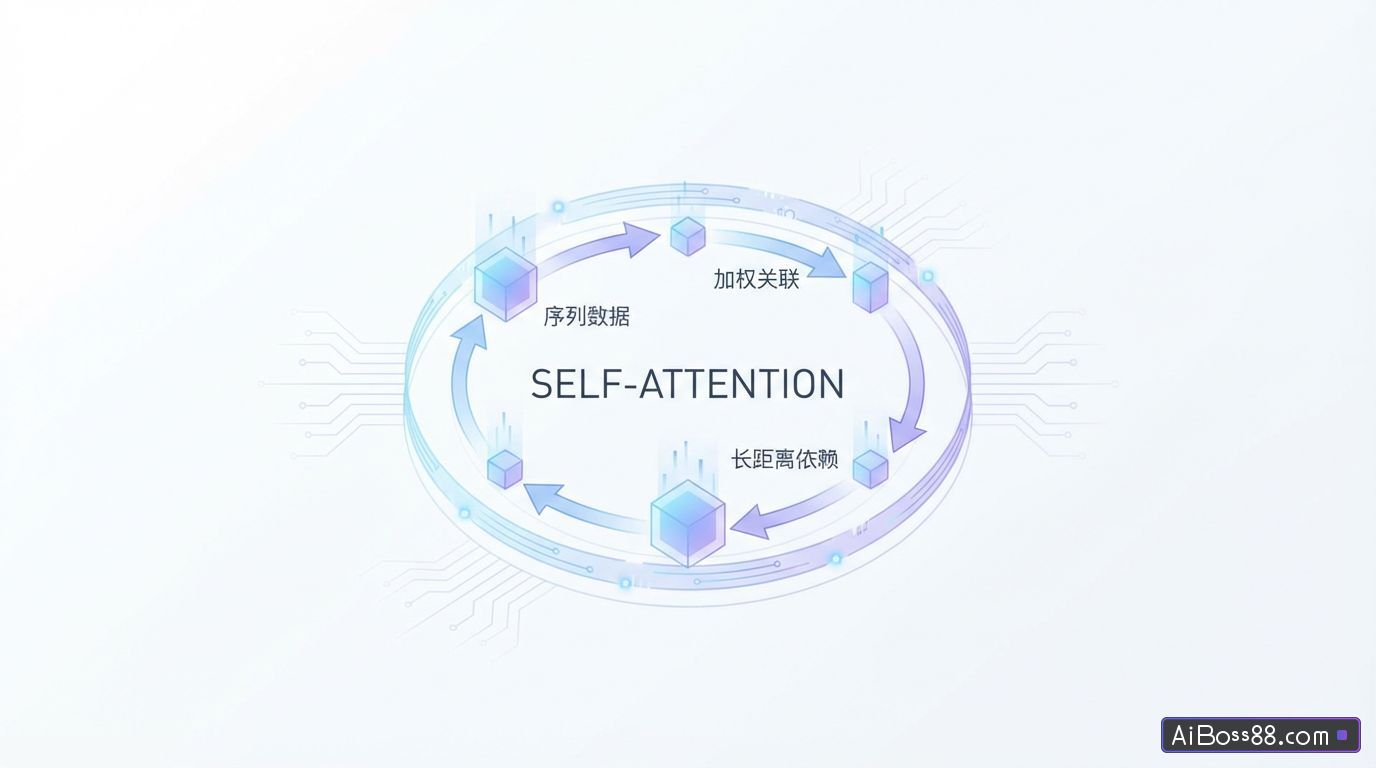
existNatural Language ProcessingIn the vast field of machine learning, self-attention's ability to capture long-range dependencies in sequential data has garnered significant attention. It endows models with extraordinary insights into the context of text, revolutionizing tasks such as machine translation and text summarization. This article will take you through the mysteries of self-attention mechanisms, revealing how it is revolutionizing the way we communicate with machines.
What is self-attention?
Self-attention is an advanced attention mechanism that allows models to associate and weight different parts within a sequence when processing sequential data, thereby capturing long-distance dependencies within the sequence. This mechanism...Natural Language ProcessingSelf-attention is particularly important in the field of Natural Language Processing (NLP), enabling models to better understand contextual information in text. It generates a representation of the sequence by calculating the attention score of each element in the sequence to all other elements, and then using these scores for a weighted sum. This method is widely used in Transformer models, significantly improving the performance of tasks such as machine translation and text summarization.
How Self-Attention Works
The core of self-attention lies in enabling the model to compare each element (such as a word or sentence fragment) in the input sequence with itself to determine which elements should be given higher weight when generating the output. It achieves this by generating three vectors for each element in the sequence: query, key, and value. The model calculates the similarity between the query vector and all key vectors, resulting in an attention score matrix that indicates the importance of each element in the sequence to the other elements. The scores are then normalized using a softmax function to obtain the attention weight for each element.
The model uses these normalized attention weights to perform a weighted summation of the value vectors, generating an output representation for each element. Each element's output not only contains its own information but also incorporates information from other relevant elements in the sequence. This characteristic of the self-attention mechanism allows the model to process all elements in the sequence in parallel, effectively capturing long-distance dependencies within the sequence, which is particularly important for understanding and generating natural language.
Main applications of self-attention
The main applications of self-attention mechanisms are concentrated inNatural Language ProcessingIn the field of NLP, it has particularly excelled in the following aspects:
- Machine translationSelf-attention mechanisms can handle long-distance dependencies, enabling models to better understand the context of source language text during translation, thereby improving the accuracy and fluency of translation.
- Text SummaryBy analyzing the internal structure and key information of the entire document, self-attention helps generate more coherent and information-rich summaries.
- Language Models and Text GenerationThe self-attention mechanism enables the model to take into account more distant contextual information, generating more natural and relevant text.
- Question and Answer SystemIn question-answering systems, self-attention helps the model better understand the question and related documents, providing more accurate answers.
- Text classification and sentiment analysisSelf-attention mechanisms improve the accuracy of classification and sentiment analysis by capturing complex patterns and nuances in text.
- Speech recognitionIn the process of converting speech to text, self-attention helps to better understand the contextual relationships in the speech sequence and improve the accuracy of recognition.
- Image recognition and processingAlthough self-attention was originally designed for text, its principles have also been applied to image recognition and processing tasks, such as identifying image content by processing different regions of an image.
- MultimodalstudyIn tasks that combine text, images, and other types of data, self-attention mechanisms help models understand the complex relationships between different data types.
Challenges of self-attention
While self-attention mechanisms perform well in processing sequential data, they also face some challenges and limitations:
- computational complexityThe computational complexity of self-attention operations is O(n^2), where n is the length of the sequence. For long sequences, this can lead to a significant increase in computational cost, especially in resource-constrained environments.
- Number of parametersSince each sequence position requires a separate query, key, and value vector, the number of parameters in a self-attention model can grow rapidly, increasing the training and storage costs of the model.
- ExplainabilityWhile the attention weights generated by the self-attention model provide a certain degree of interpretability, the internal working mechanism of the model is still relatively complex and difficult to understand intuitively.
- Long sequence processingFor very long sequences, self-attention models may encounter problems such as vanishing or exploding gradients, which can affect the training performance of the model.
- Location information missingSelf-attention mechanisms do not contain positional information of elements in a sequence, which may make it difficult for the model to capture the sequential features of the sequence, such as the grammatical structure of words in a sentence.
- Generalization abilityIn some cases, self-attention models may overfit the training data, leading to a decline in their generalization ability on new data.
- Parallelization LimitationsWhile self-attention can process elements in a sequence in parallel, some implementations may still be limited by hardware parallelization capabilities, especially when dealing with very long sequences.
The Development Prospects of Self-Attention
The self-attention mechanism has broad development prospects and will continue to serve as a key mechanism for...Natural Language ProcessingAs a core component of sequence modeling tasks, it drives progress in multiple fields, including machine translation, text understanding and generation, and speech recognition. With further research, it is expected that more optimizations and variations will be proposed to address computational efficiency and scalability issues. The principles and applications of self-attention mechanisms will also be extended to more types of data and tasks, such as image processing, video analysis, and...MultimodalLearning. Improving the interpretability and generalization ability of the model, and exploring self-attention and other methods.Machine LearningThe integration of technologies will also become an important direction for future research.