What is Agentic Context Engineering (ACE)? - AI Encyclopedia
Agentic Context Engineering (ACE) is an innovative framework proposed by researchers at Stanford University, SambaNova Systems, and the University of California, Berkeley. It works by dynamically optimizing input information (i.e., "context") to...
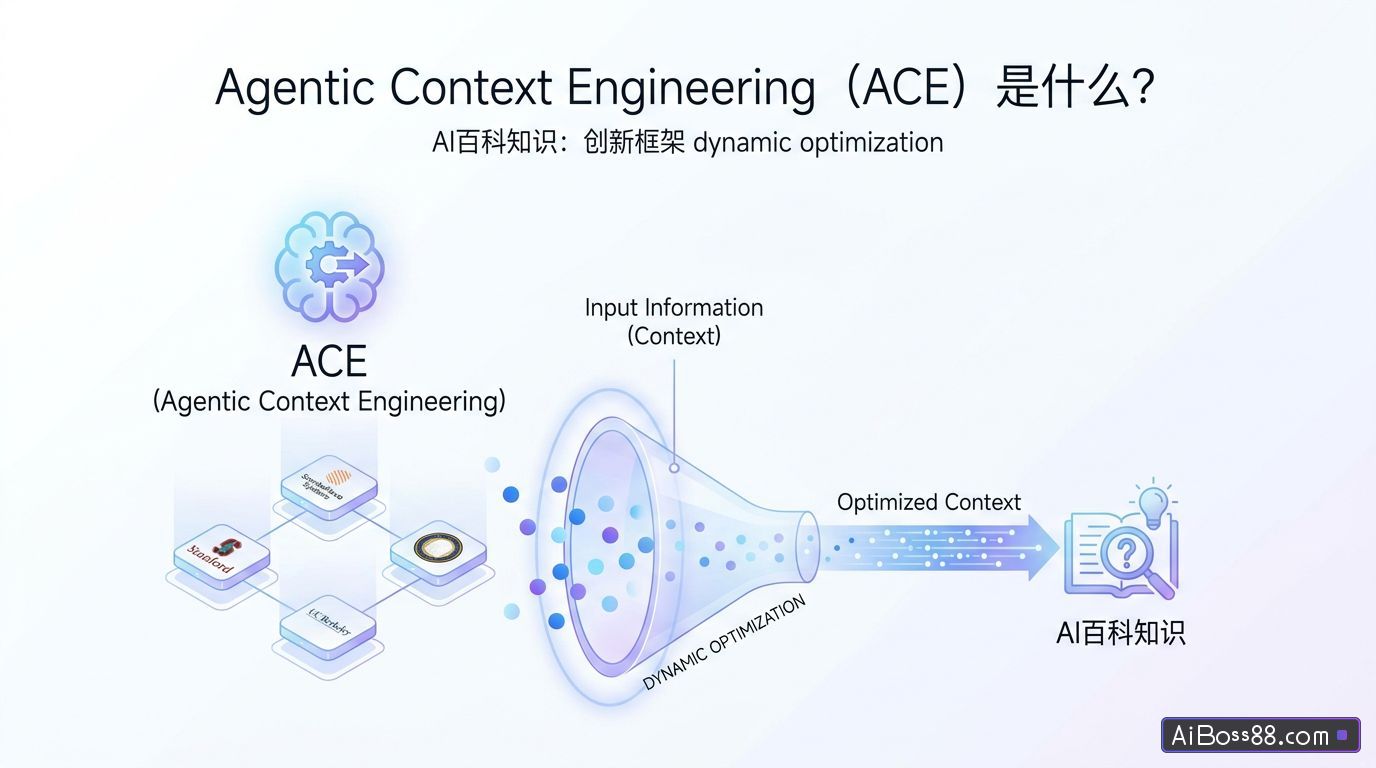
AgentContext Engineering (ACE) is an innovative framework proposed by researchers from Stanford University, SambaNova Systems, and the University of California, Berkeley. It improves large language models by dynamically optimizing input information (i.e., "context").LLMACE improves the performance of language models by optimizing the input context without changing their original parameters. It works through three modules: a generator produces solutions, a reflector extracts lessons learned, and an integrator integrates these lessons into a structured knowledge base. This approach solves the problem of time-consuming and labor-intensive traditional fine-tuning while avoiding knowledge loss caused by context simplification. Experiments show that ACE achieves [performance improvements].intelligentbodyIt performs exceptionally well in scenarios such as task and financial analysis, offering significant performance improvements at a lower computational cost. This technology provides...AIContinuous learning in a system offers new ideas.
What isAgentic Context Engineering
AgentContext Engineering (ACE) is a new type of...AITechnology enables language models to improve their performance by optimizing the input context without altering their original parameters. Through iterative processes of generation, reflection, and planning, domain strategies, agent tactics, and operational evidence are continuously accumulated, refined, and organized.
AgentHow IC Context Engineering Works
- Modular architectureThe ACE framework breaks down context management into three modular roles:
-
GeneratorFor the newintelligentbodyQuery the generated reasoning trails or problem-solving traces, try the task and explore the reasoning path to reveal which strategies are effective and which fail.
-
ReflectorThe generator's output is evaluated by comparing successful and unsuccessful trajectories. Through natural language evaluation and reflection, specific domain insights are extracted, identifying not only "what works" but also the sources of systemic failure.
-
CuratorIncremental, localized delta updates are used to integrate the refined insights into the global context store. Instead of rewriting the entire context, planners use lightweight techniques such as semantic deduplication and deterministic merging to reconcile new information with previous scripts.
-
Metadata: Unique identifier, and "useful/harmful" counter.
-
ContentSuch as reusable strategies, domain concepts, or common error patterns.
-
GrowthNew entries are appended to the context, while existing entries are revised in place through metadata updates (such as counter increments).
-
RefineDeduplication is performed by comparing entries through semantic embedding. This means that similar entries are identified and merged or deleted to reduce redundancy. Refinement can be performed actively (after each Delta update) or passively (only when the context window exceeds the limit).
-
Modular entry structureThe context is maintained as a fine-grained list of independently searchable and updatable "entries," supporting targeted context planning and runtime.High efficiencySearch.
-
Incremental update logic:supportfastAdapt to new domains, tools, or mission objectives without requiring a complete retraining or system-wide redeployment.
AgentMain applications of IC Context Engineering
- intelligentbodyTask
-
In multiple roundsintelligentbodyIn environments such as AppWorld, ACE monitors for call failures and subtarget misses using monitoring tools.automaticMark relevant strategy notes for deletion, revision, or enhancement, thereby ensuring that domain knowledge and procedural insights are actively curated as system experience grows.intelligentbodyIt is better able to adapt to complex tasks.
-
existintelligentbodyDuring the task, ACE optimized the context, making it smaller.open sourceThe model can match or even surpass the performance of more advanced models.Large ModelOn the AppWorld leaderboard, ACE's overall average score is comparable to top-tier production apps.intelligentbodyIt held its own, and even surpassed it in the more challenging test section.
AgentChallenges of IC Context Engineering
- Feedback quality dependsThe ACE framework relies heavily on high-quality feedback to drive contextual improvement. If the reflector fails to extract meaningful insights, the entire system will struggle to improve effectively. Furthermore, poorly designed reflection prompts can generate misleading patterns.
- Context management complexityACE needs to process large amounts of context data, which can put pressure on computational resources. This is especially true when the context window is very large, potentially leading to increased inference time and resource usage. As the context continues to grow, effective management of updating old information and integrating new information is required.
- Performance and cost issuesACE reduces adaptation latency and computational cost through incremental update mechanisms, but long contexts and reflection loops still increase inference time and resource usage. Limitations in the context window can lead to performance degradation, especially when dealing with very long contexts.
- Error accumulation and systemic problemsOver time, context editing can accumulate subtle errors. If...automaticOverconfidence in improvements can mask deeper reasoning or alignment issues. Error handling is also a challenge, as hiding errors removes evidence that the model has learned from them.
- Adaptability and flexibility limitationsACE relies on a model with sufficient capabilities. If the base model itself is insufficient, even with continuous optimization of the context, it will be difficult to achieve ideal performance. ACE may not be suitable for all tasks.SimpleThe problem may simply require concise instructions, not complex context.
- Data governance and privacy issuesPrivacy and data governance are important considerations when handling user-specific or sensitive data. Developers need to prioritize data minimization, anonymization, and compliance with relevant regulations (such as GDPR).
- MultimodalInformation integration:modernintelligentAgents typically need to process multiple types of information, including text, structured data, code, images, and real-time sensor data. Integrating this diverse modality of information into a coherent context is a significant engineering challenge.
- The necessity of assessment and verificationWithout proper evaluation, evolutionintelligentAgents can reinforce erroneous patterns. Continuous testing, human validation, and evaluation-oriented design are essential.
- Context window limitationsModern language models support large context windows, but in practical applications, the size of these windows is still limited. This can lead to the model needing to access more information than a single context window can handle when processing complex tasks.
- KV cache invalidation:Large ModelKey-value caching is used to speed up input processing, but even small changes in the context (such as a difference in a single token) can cause the cache to become invalid, significantly increasing latency and cost.
AgentThe Development Prospects of IC Context Engineering
AgentContext Engineering (ACE), as an innovative context optimization framework, has broad development prospects. Through a modular mechanism of generation, reflection, and curation, it can dynamically update and optimize...intelligentThe system context significantly improves performance and reduces deployment costs. ACE demonstrates its capabilities in unsupervised learning scenarios.powerfulIts self-learning ability allows it to adapt to new tasks without labeled data, making it ideal for data-scarce scenarios.intelligentThis provides a feasible solution. The incremental update mechanism and differential update strategy not only avoid context collapse and simplified bias issues, but also significantly reduce adaptation latency and deployment costs, enabling...intelligentThe system can maintain flexibility and adaptability in complex environments. In the future, ACE is expected to...MultimodalBreakthroughs have been achieved in information integration, improving system interpretability and transparency, and integration with existing technologies, driving progress.intelligentThe development of agent systems, and their emergenceintelligentStandard practices in system development. With the proliferation of technology, context engineers will become a high-demand professional role, responsible for designing, optimizing, and maintaining systems.intelligentThe system's context ensures its suitability in various application scenarios.High efficiencyrun.
AP2 (AgentWhat is the IC Payments Protocol? AIEncyclopedic knowledge
What is Nested Learning? AIEncyclopedic knowledge
-
-