What is Forward Chaining? - AI Encyclopedia
Forward chaining is a method in the field of artificial intelligence that uses inference engines for automated reasoning. It's a data-driven reasoning strategy that starts with known facts and derives new information by applying a series of rules...
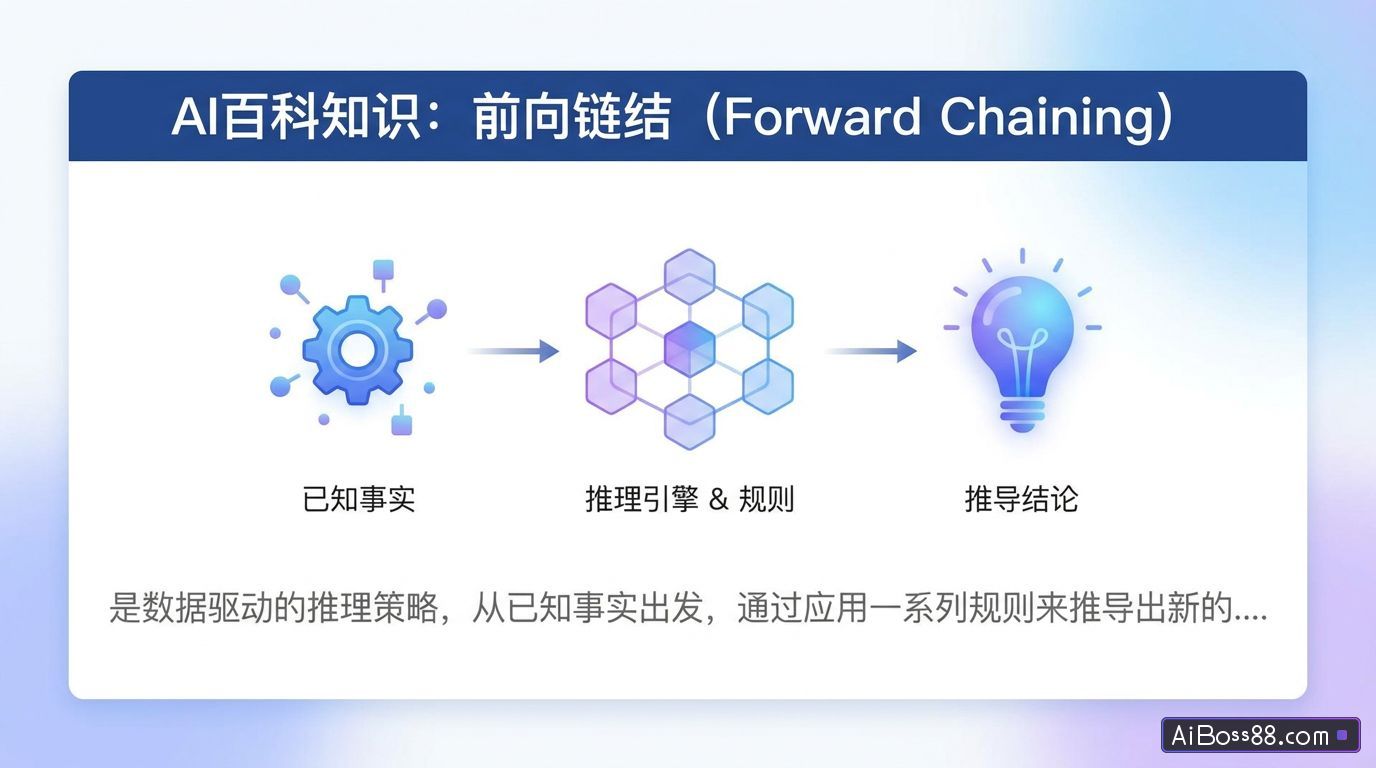
Forward chaining is a reasoning method used to progressively deduce conclusions based on known facts. It starts with known initial facts or rules, matches the conditional parts of the rules, and performs corresponding operations based on the matching results to progressively deduce new conclusions. This process continues until the desired goal is reached or further derivation is impossible. Forward chaining is primarily used in expert systems and...artificialintelligentA domain used for inference and decision-making.
What is a forward link?
Forward chaining is inartificialintelligentUsing inference engines in the domainautomaticThe reasoning method is a data-driven reasoning strategy that starts with known facts and derives new facts by applying a series of rules until a certain goal is reached or further deduction is no longer possible.
How forward links work
The inference engine begins with known facts in the knowledge base. These facts are not derived from other facts; they are the starting point of the inference process. The inference engine searches for rules whose conditional parts are satisfied by the known facts. Rules exist in the form of "if...then...", where the "if" part is the rule's condition and the "then" part is the rule's conclusion. When the rule's condition is satisfied, the rule is triggered, and its conclusion part is added to the knowledge base as a new fact. These new facts may satisfy the conditions of other rules, thus triggering more rules. This process is repeated continuously, each time checking new facts in the knowledge base to see if they satisfy the conditions of other rules. If they do, these rules are applied to derive more new facts. The inference process continues until a predetermined goal is achieved (e.g., diagnosing a disease, solving a problem, etc.), or until no more rules can be triggered, i.e., no new facts can be derived from the existing facts.
Main applications of forward links
Forward links are used in the following scenarios:
- Expert SystemIn fields such as medical diagnosis and troubleshooting, expert systems can deduce possible causes of diseases or malfunctions from symptoms through forward links.
- Business Rules SystemIn industries such as finance and insurance, business rule systems use forward links to...automaticExecute complex decision-making logic.
- Production rule systemIn manufacturing, production rule systems can use forward links to optimize production processes and quality control.
Challenges of forward links
- Management of large-scale rule basesForward links rely on a well-defined set of rules to derive new conclusions from known facts. When the rule base becomes very large, managing these rules and ensuring their correctness and consistency can become extremely difficult.
- Incompleteness of the knowledge baseThe reasoning process of forward links relies heavily on facts in the knowledge base. If the knowledge base is incomplete or contains errors, the reasoning results may be inaccurate or incomplete.
- Efficiency issuesForward links may search a large number of inapplicable rules during inference, which can lead to efficiency issues. This is especially true when the rule base is large or facts are updated frequently, as the system may need to spend a significant amount of time processing and updating the knowledge base.
- Adaptability issuesForward links may encounter adaptability issues when dealing with dynamic environments because they rely on a static knowledge base. When needed...fastIn environments that adapt to new circumstances, forward links may fail to update their knowledge base in a timely manner to reflect the new situation.up to dateInformation.
- Rule conflicts and prioritiesIn complex systems, multiple rules may be applicable to the same set of facts, which may lead to conflicts between the rules.
- Scalability issuesAs the system grows in size, the scalability of the forward links can become an issue. In large systems, the reasoning process can become very complex and time-consuming.
The Development Prospects of Forward Links
Forward chaining asartificialintelligentAnd as an important reasoning technique in expert systems, it has broad development prospects. WithartificialintelligentWith continuous technological advancements, forward links will become more adaptable to dynamic and complex environments. Through collaboration with...Machine LearningCombined with advanced algorithms, forward links can better handle uncertainty and ambiguity, thus exhibiting greater autonomy and adaptability in real-time decision-making and problem-solving. Combining forward links with backward links can fully leverage the advantages of both reasoning methods, improving the system's reasoning efficiency and accuracy. Forward links will find applications in more fields, including but not limited to medical diagnosis.intelligentTransportation and financial risk assessmentintelligentIn fields such as manufacturing and education, forward links will become more...intelligentIt is highly adaptable and can provide services in more fields.High efficiencyDecision support and problem-solving capabilities.