What is Loop Engineering? A Comprehensive Guide – AI Encyclopedia
Loop engineering is a new paradigm in AI engineering, referring to building autonomous, looping systems around large models, thus upgrading AI from single-response tools to long-term autonomous agents. Analogous to the PDCA cycle in traditional engineering, the model is the execution...
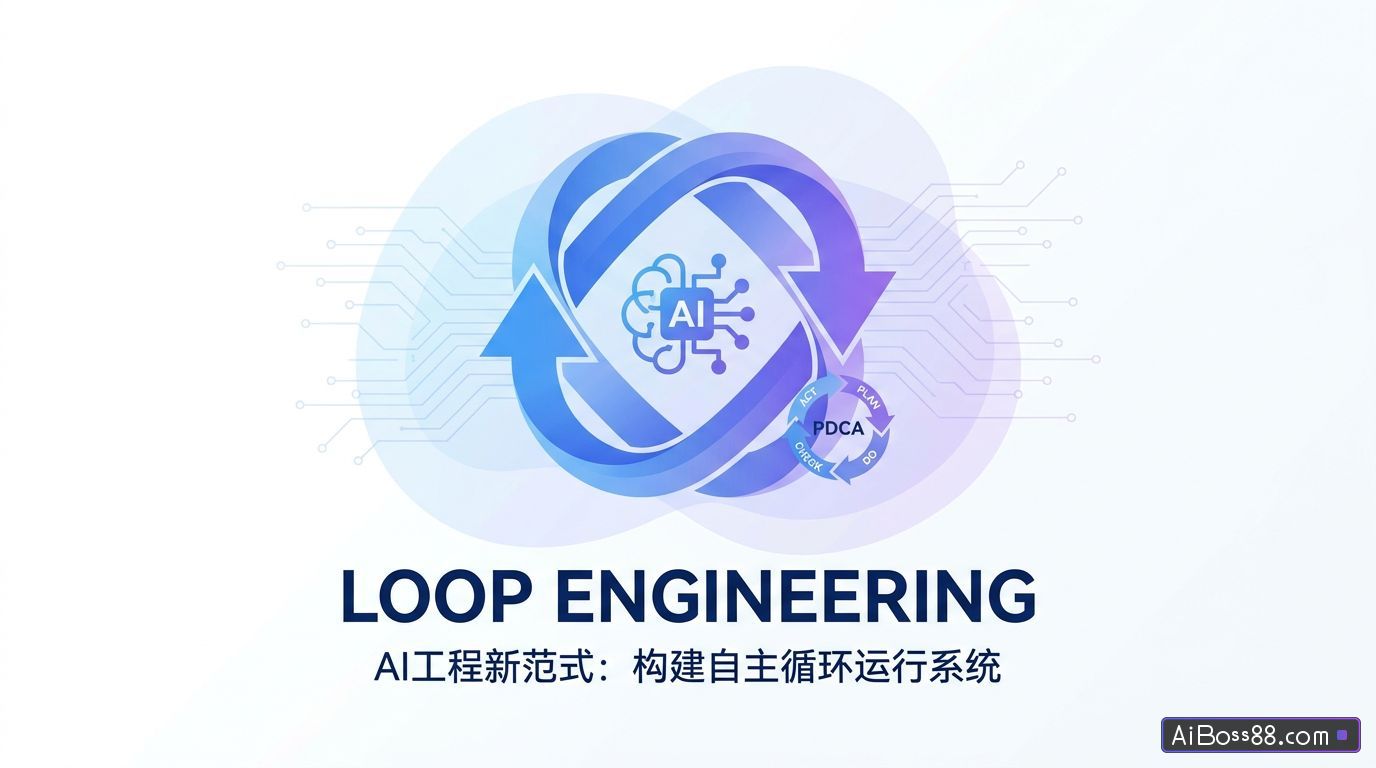
Loop Engineering is AI Loop Engineering, a new programming paradigm, is an engineering methodology introduced by Google engineer Addy Osmani. It involves designing a self-circulating system that allows the system itself to...automaticIdentify needs, assign tasks, check results, record status, and decide on the next action, then repeat the process in a loop. AI The model continues until the goal is achieved. Loop Engineering is considered a successor to... Prompt Following Engineering, Context & Harness EngineeringAI The "Third Revolution in Programming" will shift the developer's role from...Prompt wordsEngineers have been completely upgraded toAI System architect.
What is Loop Engineering?
Loop Engineering is AI A new engineering paradigm refers to...Large ModelBuild an autonomous, cyclical operating system to enable AI Upgrade from a one-time response tool to a long-term autonomous agent. Analogous to the PDCA cycle in traditional engineering, the model is the executor, and the loop is the control center, allowing... AI Within the framework of rulesautomaticAdvancing complex workflows. The core of Loop Engineering lies in the fact that, when the model's capabilities are sufficient, loop design becomes decisive. AI Key bottlenecks to autonomy and reliability.
How Loop Engineering Works
- Five-stage cycle mechanismFollow the closed loop of Discover → Plan → Verify → Iterate.automaticAfter a task is triggered, the system reads signals such as CI failures, issues, and code reviews, breaks down the objective into specific steps, executes code editing and tool calls, and verifies the results through objective signals such as testing, linting, and type checking. If a task fails...automaticRepair and restart the loop; if successful, proceed to the next task or stop.
- external state philosophyAll state is stored in an external system, not in the model's context window. Each iteration starts with a completely new context window, working based on the actual persisted content, thus completely solving the problems of model forgetting, information drift, and context compression.
- Six-element construction system:automaticThe system provides a cyclical heartbeat, triggered by a schedule or event; the working tree is configured via git for each... Agent Create independent working directories to achieve zero-conflict parallel development; skills are solidified into project knowledge through SKILL.md, avoiding re-deriving on each cold start; connectors are based on the MCP protocol to connect real toolchains such as issue systems, Slack, and CI; sub-intelligentbodySeparating code writing from code inspection creates adversarial verification; status files record progress and support resuming from breakpoints.
- Four-layer architecture support:Prompt How to ask questions at the Context layer; how to solve problems at the Context layer. AI What to see; Harness layer solvesAI In what environment does it work? The Loop layer solves this.AI What to do after completing one step?
- Adversarial verification closed loopIt adopts a "planner, generator, evaluator" triangular division of labor, and the code writer... Agent With independent verification Agent Use different models or instructions to avoid monotony. Agent Blind spots in self-examination.
/goalThe mechanism uses an independent small model to determine whether the stopping condition is met.
Main applications of Loop Engineering
- AI Auxiliary software developmentautomaticchange: Handle CI failures, unclosed issues, and code review comments through a timed loop.automaticCategorize, fix, and submit pull requests (PRs), enabling a fully managed workflow from issue discovery to code merging, typically seen in Open...AI Codex Automations is used internally for routine maintenance.
- Complex Workflow Hosting: Set verifiable stopping conditions (e.g., "all test/auth tests pass and lint is clean"), and use
/goalThe command allows the system to run offline autonomously and resume from the breakpoint in the status file the next day, which is suitable for tasks such as long-running compilation and large-scale refactoring. - Multi-module parallel development: Create isolated branches for different functions using git worktree, multiple Agent Simultaneously, they are developed independently without interfering with each other, and then merged back into the main branch upon completion, greatly improving the team's throughput.
- Performance regression monitoringEvery 2 hoursautomaticRun performance benchmark tests and find regressionsautomaticLocate the problem, generate a fix, and notify the team, shortening the feedback loop to within the system.
- Content production and scientific research analysisEstablish a complete workflow from topic selection, material collection, draft generation to quality review, and ensure consistent output style through rule constraints and evaluation mechanisms, or let AI Independently complete hypothesis generation, experimental design, data cleaning, and cross-validation.
Challenges of Loop Engineering
- Verification responsibility cannot be transferredAn unattended loop is also an unattended loop that makes mistakes. Completing the task is merely a declaration, not a proof; the verifier is the one who... Agent While it may improve credibility, critical errors may still leak into the production environment, and the final acceptance responsibility still rests entirely with human engineers.
- Understanding the Accelerated Accumulation of DebtThe faster the loop produces code that the developer didn't write, the greater the gap between the actual state of the codebase and the developer's actual understanding. A smooth loop will only cause the understanding debt to grow faster, unless the developer continues to read the loop's output.
- Recognizing the risk of surrenderWhen loops run autonomously, developers are prone to ceasing independent judgment and simply accepting whatever the system provides. Designing loops to avoid critical thinking rather than enhance judgment will become a catalyst for skill degradation.
- Token cost constraintsThe loop consumes a large number of tokens, and has multiple sub-totals. Agent Parallelism further amplifies overhead. There is a realistic gap between the unlimited token solutions offered by model vendors and the limits of the Pro plan for developers; how far the loop can go depends directly on the budget.
-
Verification responsibility cannot be transferredAn unattended loop is also an unattended loop that makes mistakes. Completing the task is merely a declaration, not a proof; the verifier is the one who... Agent While it may improve credibility, critical errors can still leak into the production environment, and the final acceptance responsibility still rests entirely with human engineers.Understanding the Accelerated Accumulation of DebtThe faster the loop produces code that the developer didn't write, the greater the gap between the actual state of the codebase and the developer's actual understanding. A smooth loop will only cause the understanding debt to grow faster, unless the developer continues to read the loop's output.Recognizing the risk of surrenderWhen loops run autonomously, developers are prone to ceasing independent judgment and simply accepting whatever the system provides. Designing loops to avoid critical thinking rather than enhance judgment will become a catalyst for skill degradation.Token cost constraintsThe loop consumes a large number of tokens, and has multiple sub-totals. Agent Parallelism further amplifies overhead. There is a realistic gap between the unlimited token solutions offered by model vendors and the limits of the Pro plan for developers; how far the loop can go depends directly on the budget.System design capability thresholdLoop Engineering Prompt Engineering is more difficult than easy. It requires developers to have system architecture thinking, to design reliable feedback mechanisms, stopping conditions, and exception handling. The requirements for rule setters are far higher than those for conversationalists.
The Development Prospects of Loop Engineering
- become AI Programming Standard ParadigmWith Codex App and Claude Code incorporates all six elements of a loop, and the industry's focus is shifting from training better models to designing better loops. Loop Engineering is poised to become... AI The default methodology for application development, similar to the role of DevOps in software engineering.
- Toolchain EcosystemfastMatureA toolchain centered around cyclical design, testing, monitoring, and state management willfastThe standardization of MCP connectors has enabled cross-tool reuse, lowered the construction threshold, and promoted the democratization of technology.
- Completely Reconstructing the Human-Machine Collaboration ModelThe human role has completely shifted from being an operator within the loop to a supervisor and goal setter within the loop. The developer's work has changed from writing...Prompt wordsChange to write loop, from AND AI The dialogue became AI Design a rule framework.
- Deep penetration of vertical industriesIn professional fields such as finance, healthcare, and law, autonomous systems that thoroughly understand complete workflows will emerge, achieving "expert-level" capabilities by solidifying industry best practices. AI The product delivery of "teams" will become the norm, transforming a single requirement into a deliverable product.
- Establishment of empirical engineering methodologyTo address the challenge of cultivating cycle designers, the industry will gradually develop teachable methodologies, transforming implicit lessons learned from mistakes into explicit knowledge, mitigating the risk of talent shortages, and fostering new professional divisions and skills certification systems.