What is a Chain of Thought (CoT)? - AI Encyclopedia
Chain of Thought (CoT) is a groundbreaking advancement in the field of artificial intelligence. By simulating the human thought process when solving problems, it endows machines with deeper logical reasoning abilities. This is particularly relevant when faced with multi-step logical reasoning...
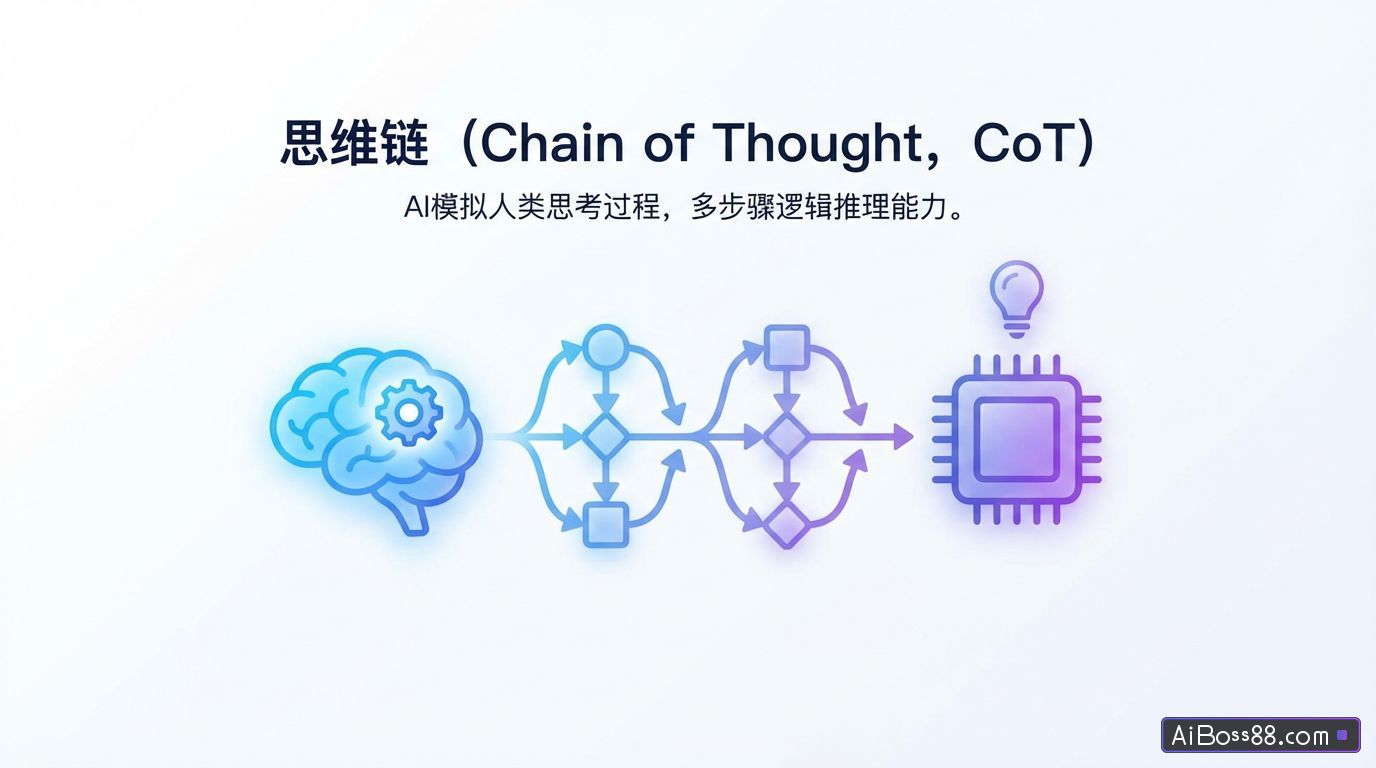
Chain of Thought (CoT) isartificialintelligentA groundbreaking advancement in the field, CoT (Coding and Reasoning) technology endows machines with deeper logical reasoning capabilities by simulating the human thought process in problem-solving. When faced with complex problems requiring multi-step logical reasoning, CoT guides large language models to analyze the problem step-by-step, generating intermediate reasoning steps and ultimately arriving at an accurate answer. This enhances the model's problem-solving ability, strengthens the transparency and interpretability of its decision-making process, and provides a foundation for...artificialintelligentThis opens up new possibilities for its future development.
What is the mind chain?
Chain of Thought (CoT) is a type of...artificialintelligentTechnology enhances the performance of large language models in complex reasoning tasks. By inserting a series of logical reasoning steps between the model's input and output, it helps the model analyze and solve problems step by step. Unlike traditional methods that directly provide hints from question to answer, CoT emphasizes demonstrating the detailed thought process before reaching a conclusion, enabling the model to better understand and handle problems requiring multi-step logical reasoning, such as arithmetic reasoning, common sense reasoning, and symbolic reasoning. This not only enhances the model's reasoning ability but also improves the interpretability of its output.
How the Mind Chain Works
Chain of Thought (CoT) works by breaking down complex problems into a series of smaller, more manageable subproblems and guiding the model to the final answer by solving these subproblems step by step. This approach encourages the model to mimic human thought processes by including intermediate reasoning steps in its input. When processing a task, the model first identifies the key parts of the problem and then builds a logical chain of reasoning, with each step extending from the previous one, until a conclusion is reached. This allows the model to analyze the problem more deeply and avoids jumping directly to potentially erroneous conclusions.
Another key advantage of CoT is improved model interpretability. By observing the intermediate inference steps generated by the model, users can better understand how the model arrives at its answers. This not only helps verify the rationality of the model's reasoning process but also provides a self-correcting mechanism. If a reasoning step proves to be incorrect, the model or its inputs can be adjusted to optimize future performance. CoT is not only a tool for improving model performance but also a method for enhancing model transparency and credibility.
Main applications of mind chain
The main application areas of Chain of Thought (CoT) include, but are not limited to, the following:
- Solving mathematical problemsMind chains can help models solve multi-step mathematical problems by showing the calculation process step by step, thus improving the accuracy of the solution.
- Common sense reasoningIn scenarios where everyday knowledge is required for reasoning, the thought chain enables the model to demonstrate its reasoning process and provide more logical answers.
- Answers to scientific questionsIn scientific fields such as physics and chemistry, the thought chain helps models analyze problems step by step and arrive at scientifically sound conclusions through logical reasoning.
- Programming and code understandingMind Chain can help models understand and generate code by demonstrating programming logic and algorithm steps, thereby enhancing the model's ability to assist in programming.
- Language comprehension and communication:existNatural Language ProcessingIn the task, MindChain improves the accuracy and reliability of language comprehension and generation by demonstrating the thought process of language models.
- Education and learning supportMind chains can be used as an educational tool to help students understand complex concepts and problem-solving strategies by demonstrating the thought process, thus promoting learning.
- Complex decision makingIn decision-making processes that require consideration of multiple factors and consequences, the mind chain can help the model analyze each factor step by step and make a more comprehensive and reasonable decision.
- MultimodalTask processingMind chains can combine visual and linguistic elements.MultimodalInformation helps models perform complex reasoning based on their understanding of image, video, or audio content.
- automaticQuestion and Answer SystemIn buildingintelligentWhen used in a question-and-answer system, MindChain can provide a detailed answer generation process, enhancing the explainability of the answers and user trust.
-
Research and ExperimentThe chain of thought inartificialintelligentIt is also an important tool in research, helping researchers explore and understand the reasoning capabilities and limitations of large language models.
Challenges facing the mind chain
While the Chain of Thought (CoT) is improving...artificialintelligentThe model shows great potential in terms of reasoning ability, but also faces some challenges:
- Resource consumptionLarge-scale language modelsLLMs) The operation itself requires a lot of computing resources, and the thought chain usually requires the model to generate additional intermediate inference steps, which further increases the demand for computing and memory.
- Model size limitationsThe effectiveness of thought chains often depends on the size of the model. Smaller models may not be able to effectively utilize thought chains to improve performance, which limits the application of thought chains in resource-constrained environments.
- Reasoning accuracyAlthough thought chains are designed to improve the accuracy of reasoning, models may still generate logically flawed or incomplete reasoning chains. Validating and correcting these erroneous reasonings is a challenge.
- manual labeling costTo train and optimize the reasoning chain, it may be necessary to manually design and label a large number of reasoning chain examples, which is both time-consuming and expensive.
- Generalization abilityWhile mind chains perform well on specific types of tasks, their ability to generalize across different domains and tasks remains a research question.
- Model interpretabilityWhile thought chains improve the interpretability of the model, understanding and interpreting the reasoning chains generated by the model may still be challenging for end users.
- Complexity ManagementAs the complexity of the problem increases, the reasoning chain generated by the thought chain may become very long and difficult to manage, which may affect the performance of the model and the user experience.
- Deviation between dataset and taskThe effectiveness of the thought chain may be affected by the training dataset and the characteristics of specific tasks, which may lead to poor model performance on certain tasks.
- Real-time performanceIn application scenarios that require real-time response, the additional reasoning steps generated by the thought chain may cause delays and affect the user experience.
- Model safety and reliabilityThe reasoning chain can make the model more susceptible to misleading inputs, so it is necessary to ensure that the reasoning chain generated by the model is not only accurate but also safe.
The Development Prospects of Mind Chain
The development prospects of mind chain are broad, and it is expected to continue to drive...artificialintelligentPerformance improvements on complex reasoning tasks. With further research, the MindChain framework is expected to achieve wider applications, such as educational assistance,intelligentQuestion and answer systemautomaticProgramming andMultimodalInteraction. Researchers are working to address challenges such as high resource consumption, model size limitations, and inference accuracy to optimize the practical application of CoT. Improving the generalization ability of CoT andautomaticChemical design is also a future research direction and will be further expanded.artificialintelligentIts boundaries are closer to human thought patterns.